




What You'll Learn
- The four product types sold as healthcare scheduling software, and whose shifts each one is built for
- The 6 leading platforms for 2026, compared in one table
- The plan-vs-fact test that separates a published roster from payroll-ready records
- How scheduling works under UAE working-hours rules, Ramadan reductions, and WPS payroll
Most healthcare rosters in the region still live in Excel, and the changes live in WhatsApp groups. The schedule says who should be at the clinic on Tuesday. Payroll, WPS files, and contractor invoices need to know who verifiably was. That gap between the plan and the fact is where scheduling breaks, and it is also where the software market quietly splits: employee scheduling software for the healthcare industry is one label covering four different products. Buying the wrong type is the most common and most expensive mistake in this category.
The four types of healthcare scheduling software
One label, four products. Each type schedules a different group of people and solves a different failure.
Physician-scheduling engines
Built for doctor groups. QGenda is the reference example. These engines handle what no general tool can: fairness algorithms that distribute nights, weekends, and holidays equitably, coverage rules by specialty, and staffing tied to patient acuity. If your problem is a hospitalist group spending sixty hours a month on a fair rota, this is the only type that solves it.
Frontline scheduling suites
Built for nurses, clinic staff, and support teams. Connecteam and Deputy lead here, with NurseGrid as the nurse-run niche. The core is a published roster: drag-and-drop shifts, availability, swaps with approval, open-shift pickup, and mobile access. Scheduling is the product; attendance is usually a feature bolted beside it.
Scheduling with verified attendance
Built for operations where the roster must survive payroll. Truein sits here. The schedule is paired with identity-verified clock-ins, so every published shift produces a confirmed record of who actually worked it. This is the type that closes the gap the intro named.
Enterprise workforce suites
Built for health systems. symplr Workforce is the example: demand forecasting, automated pay rules, overtime control, and clinical communication at organization scale. Powerful, procurement-heavy, and oversized for a clinic group.
The decision rule follows from the workforce, not the feature list. A clinic group running twelve locations across three emirates has a frontline and support-staff problem; its doctors' rota is a different purchase entirely.
The 6 best employee scheduling software for healthcare (2026)
All six below are ranked with their type stated up front, because comparing a physician engine against a frontline suite on the same features misleads everyone. The table shows where each platform stands on the boundary this article keeps returning to: what happens after the roster is published.
Truein

Truein pairs shift scheduling with verified attendance for frontline and contract healthcare staff. Rosters for nurses, technicians, and support teams are managed centrally across every clinic or facility, and each clock-in is verified at the moment of the punch. It runs in kiosk mode on tablets or on staff mobile phones, so no dedicated hardware is installed.
- Face recognition with GPS geofencing on every clock-in
- Centralized rosters and shift scheduling across all facilities
- Outsourced staff such as housekeeping and porters onboarded within minutes
- More than 70 customizable policies for overtime, breaks, and shift rules
- Verified hours export payroll-ready to any payroll or HRMS system
Connecteam

The most complete frontline suite on the market, built for staff scheduling and daily operations across healthcare teams. Its mobile-first design keeps rosters, changes, and communication in one app. The honest limit, stated by Connecteam itself: it is not built for acuity-based clinical scheduling or specialty staffing ratios.
- Drag-and-drop scheduler for rotating shifts and role-based coverage
- AI auto-scheduler with automated conflict detection
- Shift swaps and open-shift pickup with manager approval
- Mobile time clock with GPS and geofencing
Deputy

A frontline scheduler with labour-compliance tooling attached. A solid pick for clinic teams that want compliance guardrails around an everyday roster. Buyers should confirm how its workflows handle rotating clinical patterns rather than hospitality-style shifts.
- Availability tracking and open shifts with approval
- Shift swaps on the official roster
- Time and attendance in the same suite
- Labour-compliance and overtime tooling
QGenda
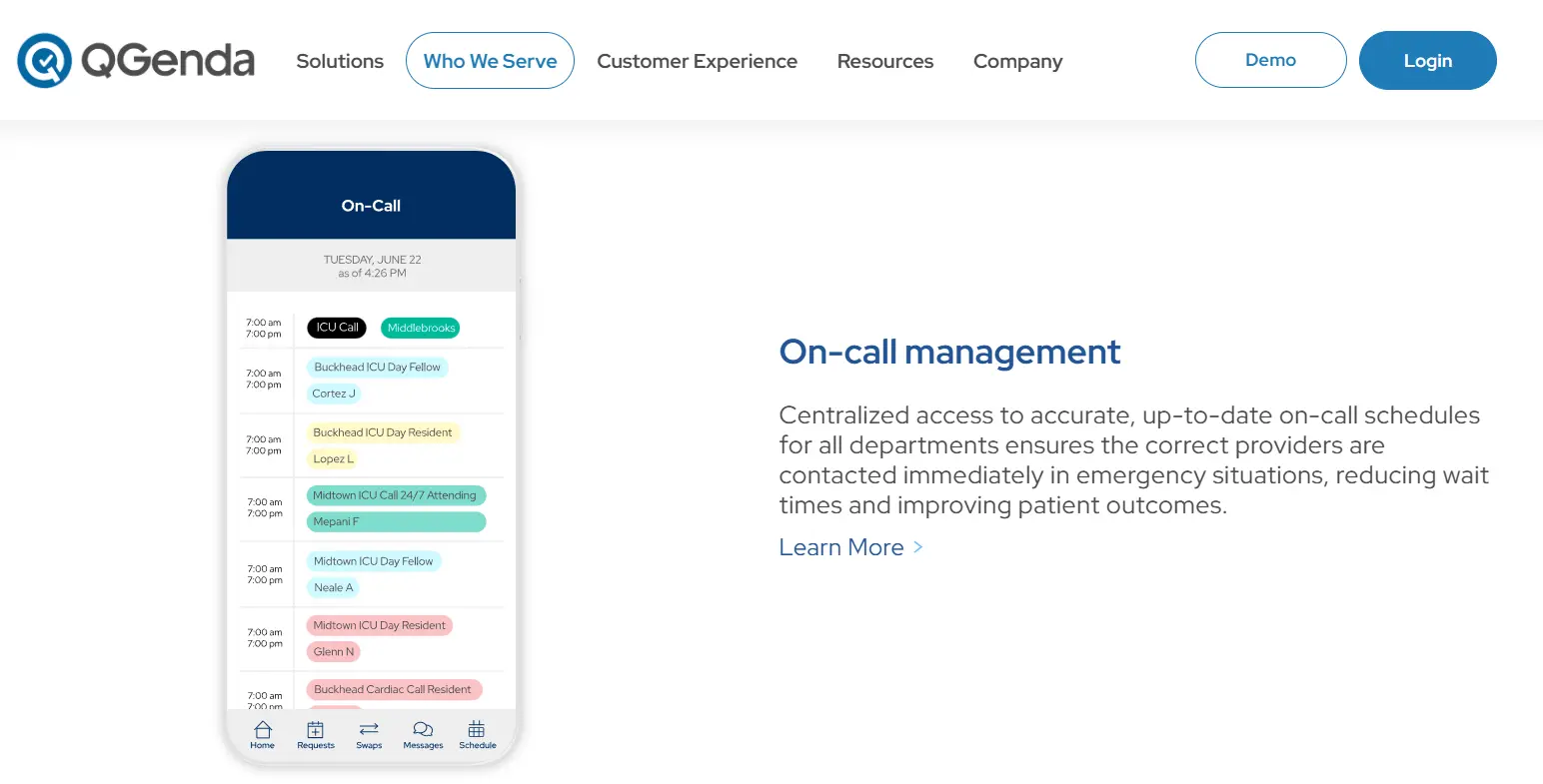
The physician engine, and the answer to the sixty-hour hospitalist rota. It is built for hospitalist and provider groups that need fairness and coverage enforced by rules rather than goodwill. Oversized and overcomplicated for a clinic's support roster.
- Fairness-driven distribution of nights, weekends, and holidays
- Self-scheduling and open-shift bidding for providers
- Float management across units and sites
- Acuity-based staffing tied to patient demand
- Schedule-first time tracking with RFID clocks
symplr Workforce

The health-system option, built for enterprise scale and priced and implemented accordingly. Small and mid-size operations will find it heavier than the problem they have.
- AI-supported scheduling and demand forecasting
- Automated pay rules for complex policies
- Overtime and premium pay risks flagged before payroll closes
- Role-based clinical communication
NurseGrid

The nurse-run niche, loved by staff for exactly that reason. It coordinates schedules rather than managing a workforce: there is no time tracking, no payroll path, and no verification.
- Mobile-first self-scheduling for nurses
- Shift swaps, pickups, and partial-shift coverage
- Calendar comparison and sharing with colleagues
- In-app messaging by role or status
The test that decides it: a schedule is a plan, payroll runs on facts
Every platform above can publish a roster. The differences appear after publishing, when the plan meets the shift.
A published schedule says a nurse is assigned to the Tuesday evening clinic. It does not say she arrived, who covered when she swapped, or whether the porter on the same shift was the person the FM contractor invoiced for. Payroll, WPS files, and contractor billing are built from that second set of facts, and a scheduling tool that stops at the plan leaves someone to reconstruct the facts by hand at month-end.
The test for any platform on your shortlist is whether it closes the loop. The roster sets the expectation. An identity-verified clock-in confirms the person against that roster. Exceptions such as late, absent, swapped, or unscheduled get flagged the same day instead of surfacing in payroll week. Verified hours then flow out without manual repair. Photo check-ins and PIN codes leave the loop open, because a photo needs a reviewer and a PIN can be shared.
A hospital operations head reconciling an FM contractor's invoice for housekeeping hours across three buildings is doing, by hand and a month late, exactly what a closed loop does at every clock-in.
UAE compliance: what your scheduler must handle
For UAE healthcare employers, the roster is a legal document in waiting. Four rules decide whether your scheduling software helps you comply or quietly builds violations.
Working hours and overtime
Under Article 17 of the UAE Labour Law, normal hours are capped at 8 per day and 48 per week. Overtime pays at least 25% above the basic hourly wage, rising to 50% between 10 pm and 4 am, with shift workers excluded from that night uplift. A healthcare scheduler must know the difference between a contracted night shift and night overtime, because they pay differently.
Breaks on long shifts
Staff cannot work more than five consecutive hours without breaks totalling at least an hour. On 12-hour ward patterns, the software should place and record those breaks, not assume them.
Ramadan hours
Private-sector working hours reduce by two per day during Ramadan. A scheduler that applies this automatically across every roster avoids a month of manual edits and mispaid overtime.
WPS and records
Wages flow through the Wage Protection System, and disputes land at MOHRE, where the record wins. Verified hours behind every rostered shift are what make both routine.
Which type fits your operation?
Match the platform type to the workforce you actually schedule. Four common UAE healthcare operations, four different answers.
Clinic groups across emirates
Multiple locations, shared staff pools, and one payroll. The priority is a centralized roster with one attendance record behind it, so a nurse covering in Sharjah on Tuesday and Dubai on Thursday produces one clean set of verified hours. Scheduling with verified attendance fits; a per-location app recreates the spreadsheet problem across branches.
Hospitals with outsourced support staff
Housekeeping, porters, catering, and security often arrive through FM contractors, on the contractor's roster and your premises. Schedule and verify them on the same system as your own staff, or the invoice becomes the only record. General-purpose tools cover the basics for employee scheduling in the UAE; the outsourced layer is where verified clock-ins earn their keep.
Home healthcare agencies
The facility is the patient's home, so the roster is a list of visits. Mobile clock-ins with location verification confirm each visit happened where and when it was scheduled.
Hospitalist and physician groups
The honest answer from earlier applies: fairness rules and coverage enforcement for doctors belong to a physician-scheduling engine. Buy that layer separately.
Two objections, answered
"Excel and WhatsApp still work for us"
They do, until a specific size. A single clinic with one roster owner and low turnover can run on a spreadsheet honestly. Three signals say you've crossed the line: shift changes now travel by call-out chains, nobody is certain which roster version is current, and month-end means repairing timesheets by hand. Each of those is the plan-and-fact gap showing up as labour.
"Our HR suite already has a scheduling module"
Then judge the module, not the suite. Most HR platforms schedule adequately and verify nothing, which is fine for office teams and expensive for shift operations. If the module publishes rosters but month-end reconciliation still happens by hand, the suite has the same gap a spreadsheet has, with better branding. Adding a verification layer that feeds the suite usually costs less than pretending the module is enough.
Conclusion
The best employee scheduling software for the healthcare industry depends on whose shifts you schedule. Doctor groups need a physician engine. Nurses and clinic teams need a frontline suite. Operations that answer to payroll, WPS, and contractor invoices need scheduling with verified attendance behind it. Whatever the type, apply the same two tests: does it close the loop between the plan and the fact, and does it handle UAE working hours, Ramadan reductions, and break rules without manual edits? The platforms that pass both are a short list.
Frequently Asked Questions
Which scheduling software enforces fair shift distribution and coverage rules for doctors?
Physician-scheduling engines such as QGenda are built for this. They distribute nights, weekends, and holidays equitably across a hospitalist or provider group and enforce coverage rules by specialty. Frontline scheduling tools do not perform this role; doctor rotas and staff rosters are separate purchases.
How does scheduling software handle Ramadan working hours in the UAE?
Private-sector working hours reduce by two per day during Ramadan under MOHRE guidance. Good scheduling software applies the reduction automatically across every roster for the month and recalculates overtime against the reduced hours, so no shift needs manual editing.
Can scheduling software manage outsourced hospital support staff?
Yes, if the platform supports contract workers. Housekeeping, porters, and security supplied by FM contractors can be rostered and verified on the same system as permanent staff, giving the hospital its own attendance record instead of relying on the contractor's invoice.
What is the difference between scheduling software and attendance software?
Scheduling software publishes the plan: who should work which shift. Attendance software records the fact: who actually worked, verified at clock-in. Some platforms do both, tying every rostered shift to an identity-verified punch, which is what makes hours payroll-ready.

