


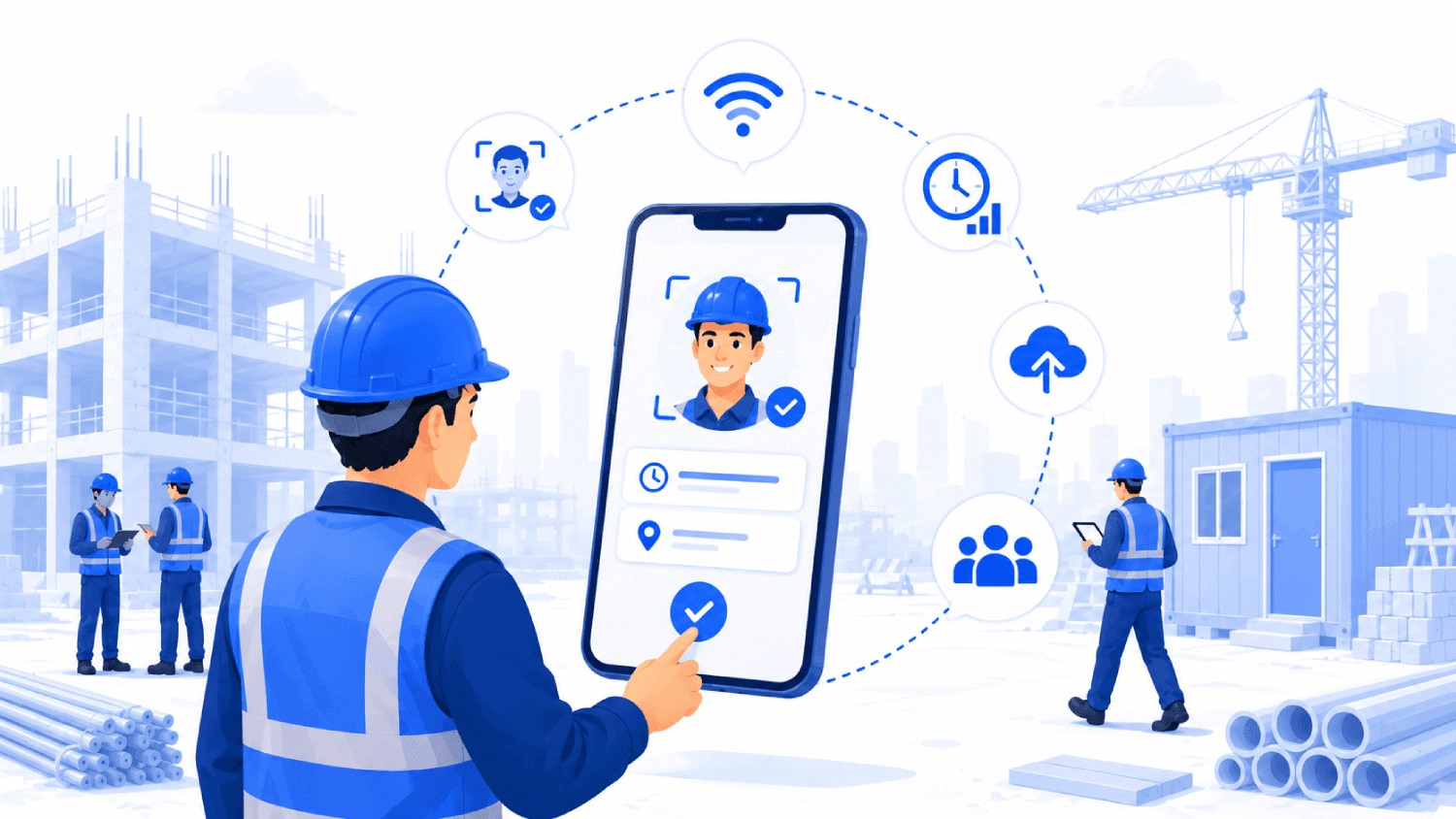

Construction time tracking software records when hourly crews start and stop work on a job site, ties those hours to a project and cost code, and sends verified time data into payroll. Recording hours is the easy part. Proving that the right worker recorded them, from the right site, on a shift nobody can reconstruct three weeks later at payroll close, is where most tools stop short.
That gap costs real money. Labor commonly runs 30% to 50% of total project cost, and Procore's construction labor cost guidance (2024) puts it as high as 50% to 60% on some project and contract types. Our guide to tracking project costs in construction shows how to stop that leakage at the capture layer.
Two 2026 data points frame the scale of the problem. Workyard's analysis of 280 contractor discovery calls found that 65% of construction businesses still track labor hours primarily on paper, and Asure's 2025 HR Benchmark Report found that 46% of small and mid-sized businesses had caught at least one case of time theft or a falsified timesheet in the previous 12 months.
This comparison covers 12 construction time clock apps, how each one verifies who is actually punching in, and which type of contractor each one fits.
The Short Answer
The right construction time tracking software depends on what you are trying to protect. Choose Truein when your main risk is identity, managing crews spread across several active job sites plus subcontractor crews you do not directly employ, because Truein matches a worker's face at the moment of clock-in on a personal phone, a shared tablet kiosk, or a supervisor's device without dedicated hardware at any site. Choose Workyard when continuous GPS location and automated job costing matter more than identity, and ClockShark when a smaller crew needs scheduling and QuickBooks sync in the same app.
Neither choice works if your workers are desk-based or office-based. Every tool in this comparison is built for field, hourly, and multi-site work, and none of them is a good fit for salaried office staff.
Disclosure: Truein is included in this comparison. This article is published by Truein and reflects our assessment of each product based on published vendor documentation, public product pages, and verified review data as of August 2026.
Key Takeaways
- Construction time tracking software differs from generic timekeeping software by adding GPS verification, geofenced clock-ins, offline capture, cost code tracking, and identity verification at the punch.
- GPS records where a punch happened and a geofence restricts where a punch can happen, and neither one confirms who pressed the button, which is why identity verification is the deciding feature for crews with high churn.
- Most construction time clock apps that advertise facial recognition run it only in shared kiosk mode, which leaves personal-phone clock-ins verified by location alone.
- Truein is a face recognition time clock software for hourly and multi-site workforces that runs on any standard Android or iOS device, with a minimum configurable geofence radius of 20 meters and offline capture that syncs when the network returns.
- Subcontractor accountability is the least-covered capability in this category, and it matters most for general contractors billing clients for crews they do not employ.
- Run any shortlisted tool on one active job site for a full pay period before rolling it across projects, and compare payroll corrections before and after.
Construction Time Tracking Software Compared at a Glance
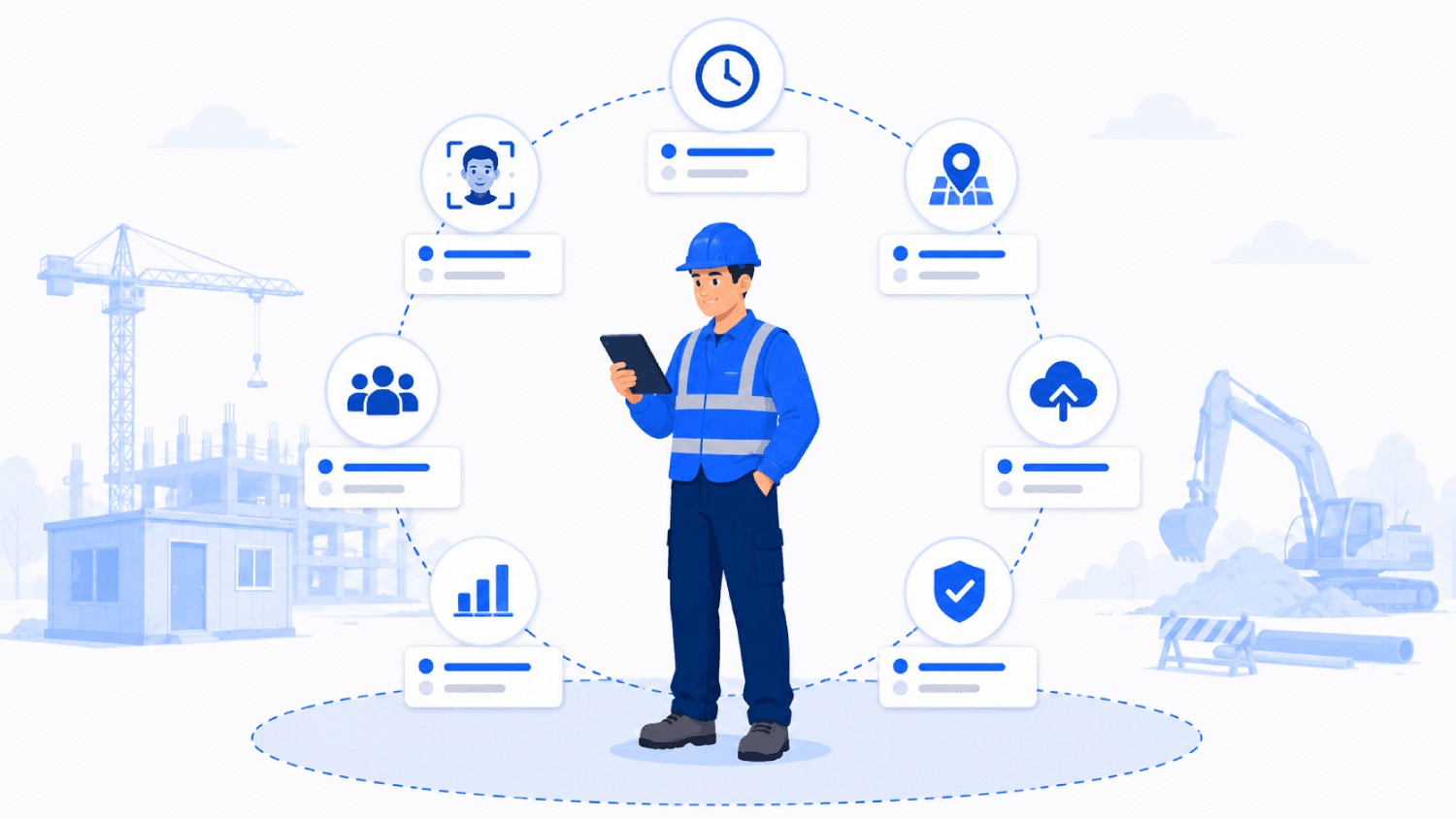
The table below compares 12 construction time clock apps on the six capabilities that separate a construction-built tool from a generic time card app. Values reflect each vendor's published product documentation as reviewed in August 2026, and should be re-verified before purchase.
| Tool | Identity verification at clock-in | GPS and geofencing | Offline clock-in | Job and cost code tracking | Payroll integrations | Best for |
|---|---|---|---|---|---|---|
| Truein | Live face match on personal phone, shared tablet kiosk, or supervisor device | Geofencing with a minimum configurable radius of 20 meters, per floor, wing, or zone | Captured on-device and auto-synced, flagged as captured offline | Activity Punch tags time to a job, task, or activity | ADP, QuickBooks, Sage, Xero, SAP, Viewpoint, Paychex, via API or FTP | General and specialty contractors verifying worker attendance across multiple sites and subcontractor crews |
| Workyard | Photo ID selfie captured at punch | Continuous GPS tracking plus customizable geofence radius | Yes, syncs on reconnect | Cost codes by job, phase, and task | Native sync with QuickBooks, ADP, Paychex, Gusto, Sage | Contractors who need continuous GPS location and automated job costing |
| ClockShark | Facial recognition available in kiosk mode | GPS time clock with geofencing | Yes | Job costing by project and task | Native sync including QuickBooks | Small and mid-size contractors who also need scheduling |
| busybusy | GPS and timestamped photo at punch | Geofenced clock-in enforcement plus GPS breadcrumbs | Yes, with automatic sync | Cost codes plus equipment hours on the same time card | Native sync with equipment-based costing | Heavy civil, demolition, and excavation crews tracking labor and equipment together |
| SmartBarrel | Self-learning AI facial verification on SmartBarrel hardware | Geofencing at the job site, no tracking between jobs | Built-in LTE on the hardware clock | One-click cost code assignment | Export-based, no native two-way sync | Large union and self-perform crews on sites where workers do not carry smartphones |
| Arcoro Time (formerly ExakTime) | FaceFront captures a photo at punch for supervisor review | GPS capture plus geofence violation alerts | Yes | Reporting by worker, job, and cost code | Native sync plus job costing | Large workforces at fixed locations already on the Arcoro HR suite |
| QuickBooks Time | Location stamp only, no identity check | GPS while clocked in, geofences by address or coordinates | Limited | Job and customer-level time entries | Native to QuickBooks payroll and accounting | Contractors already running accounting and payroll inside QuickBooks |
| Buddy Punch | Facial recognition, PIN, or QR code | GPS with geofencing on higher plans | No true offline mode per vendor documentation | No job costing | Native payroll integrations | Small and mid-size teams needing PTO and labor compliance on well-connected sites |
| Timeero | Facial recognition on the kiosk | GPS with mileage and route capture | Yes | Job tracking on higher plans | Native sync, mileage-based costing | Small to mid-size field service teams that need mileage and drive time |
| Jibble | Facial recognition on mobile and kiosk | GPS-based geofencing | Yes | Job and task tracking, limited job costing | Payroll exports plus native integrations | Very small crews starting before they commit to a construction-specific tool |
| Connecteam | Location stamp only | GPS time clock with geofencing | Limited | Basic job tracking | QuickBooks and other payroll tools | Teams wanting a time clock inside a broader deskless operations app |
| Raken | Manual time cards entered by supervisors | Location capture on daily logs | Yes | Time cards linked to projects and cost codes | Payroll exports | Contractors whose daily field reporting matters more than punch verification |
Verdict beneath the table. Workyard wins on location precision, busybusy wins when equipment hours belong on the same time card as labor, and SmartBarrel wins on sites where nobody carries a phone. Truein wins on a narrower and more specific problem: it is the only tool in this set that performs a live face match at the punch across a personal phone, a shared tablet kiosk, and a supervisor's device without requiring dedicated hardware at the site. If your crews are stable, single-site, and already verified by a foreman who knows every face, that advantage is worth very little to you.
How We Evaluated These Construction Time Clock Apps
Every tool in this comparison was assessed against the same seven criteria, drawn from what contractors actually ask during evaluation rather than from feature counts. For the step after the punch, tying hours to jobs, cost codes, and job costing, see the comparison of construction labor tracking software.
- Identity verification method. Does the tool confirm who is punching, and does that verification work everywhere workers punch, or only at a shared kiosk?
- GPS accuracy and geofence enforcement. Does an out-of-boundary punch get blocked, alerted, or routed for approval?
- Offline capability. Can a worker clock in with zero signal, and what happens to that record afterward?
- Job and cost code structure. Can hours be tagged to a job, phase, task, or activity for billing?
- Payroll and accounting integrations. Which US payroll platforms sync natively, and by what method?
- Crew adoption on the job site. How many taps to clock in, and does the app hold up on budget Android phones?
- Multi-site and subcontractor handling. Can one account cover several active sites and separate subcontractor crews from your own employees?
Review scores referenced in this piece come from G2, Capterra, and the Apple and Google app stores, checked in August 2026. Product capabilities come from each vendor's own documentation. Nothing here is based on a paid placement.
What to Look For in Construction Timekeeping Software
Seven capabilities decide whether a construction time and attendance software rollout survives contact with an actual job site. The rest is packaging.
GPS and geofencing, and what they do not do
A GPS time clock records the coordinates where a punch happened. A geofence draws a virtual boundary around a job site and restricts punches to inside that boundary. Neither one confirms the identity of the person holding the phone, which is the single most common misunderstanding in this category.
Enforcement behavior matters more than the feature label. Some tools block an out-of-boundary punch outright, some log it and alert a supervisor, and some route it into an approval queue. Truein supports all three, with a minimum configurable geofence radius of 20 meters, roughly 65 feet, and each floor, wing, or zone can be fenced separately for open sites and campuses.
Identity verification at the moment of clock-in
Identity verification is the difference between a time log and evidence. Most construction employee time tracking apps in this comparison capture a photo at punch and leave a human to review it later, which catches buddy punching after payroll has already run.
Truein matches the face at the punch. A face-match failure blocks the entry immediately and prompts a retry, while suspected spoofing attempts are flagged after the punch in the default configuration, after which the record is flagged and the worker can be blocked. Truein's approved accuracy range is around 95% to 100%, including with facial hair, masks, changed hairstyles, and hard hats.
Offline capture on dead-zone sites
Basements, tunnels, rural highway work, and early-stage sites without temporary power all break connectivity-dependent time clocks. Offline clock-in stores the punch on the device and syncs it automatically once the network returns.
One honest caveat applies across every tool that offers this: offline punches appear in the dashboard only after they sync. Truein flags those records as captured offline so supervisors can see which entries arrived late, but real-time visibility applies to connected clock-ins, not offline ones.
Job and cost code tracking
Hours that are not tagged to a job are payroll data, not job cost data. Construction job hours tracking depends on the worker being able to select a job, task, or activity at the punch rather than reconstructing it on Friday.
Truein handles this through Activity Punch, which tags time to a specific job, task, or activity so hours map to cost codes for billing. This capability carries the most weight for US construction job costing and prevailing wage work, and considerably less weight for facility maintenance crews on fixed sites.
Payroll and accounting integrations
Construction time card software has to hand clean data to whatever runs payroll, or it just moves the manual work one desk over. Truein connects to ADP, QuickBooks, Sage, Xero, SAP, Viewpoint, and Paychex, using API-based sync for real-time employee and timesheet data or FTP-based sync for batch workflows.
Truein generates payroll-ready reports and integrates with payroll platforms. It is not payroll software and does not process payroll, and it is not a full HRMS. It runs as the time and attendance layer next to your HRIS, not in place of it.
Crew adoption on the job site
The best construction time tracking app is whichever one your crew actually uses on day two. Adoption fails on three predictable things: too many taps, poor performance on inexpensive Android handsets, and workers who do not carry a smartphone at all.
Truein handles the third case with a shared tablet kiosk at the site or supervisor-assisted clock-in from the supervisor's own device. Worker onboarding takes a single selfie on site, or HR can pre-upload staff details so a crew can clock in from day one.
Multi-site and subcontractor visibility
Multi-site construction site time tracking is table stakes. Separating subcontractor crews from your own payroll is not, and it is the least-served capability in this entire category.
Truein supports multiple subcontractor agencies under one account, with per-agency headcount limits, agency-level policies and pay rates, document expiry tracking, and scoped supervisor access so each subcontractor sees only its own crew. Where several subcontractors work the same site, Truein provides the visibility and controls needed to spot and prevent overlap and overbilling. It does not automatically detect overlapping headcount between agencies, so that review still requires a human.
The 12 Best Construction Time Tracking Software Options in 2026
Tools are ordered by how narrowly they fit the three problems this guide covers: multi-site coverage, time theft prevention, and replacing paper timesheets.
1. Truein: best for verifying worker identity across multiple job sites and subcontractor crews

Truein is a face recognition time clock software built for hourly, field, and multi-site workforces, used by contractors who need proof of who worked, not just proof that someone punched. It runs on any standard Android or iOS smartphone or tablet, which means a new job site becomes operational without buying scanners or scheduling an IT visit.
Key capabilities
- Live face match at clock-in on a personal phone, a shared tablet kiosk, or a supervisor's device, with approved accuracy of around 95% to 100% including facial hair, masks, changed hairstyles, and hard hats
- GPS geofencing with a minimum configurable radius of 20 meters, configurable per floor, wing, or zone, with out-of-boundary punches blocked, alerted, or routed for approval depending on account setup
- Offline clock-in captured on-device and auto-synced when the network returns, flagged as captured offline for review
- Activity Punch to tag hours against a specific job, task, or activity for cost coding and client billing
- More than 70 configurable policies covering overtime, breaks, holidays, and leave, applied by location, category, or shift, and designed to support compliance with local labor rules
- Multiple subcontractor agencies under one account with per-agency headcount limits, scoped supervisor access, and document expiry tracking
- AI TimeGuard, which continuously flags unusual clock-in patterns, suspicious GPS behavior, geofence edge anomalies, impossible travel sequences, abnormal overtime spikes, and frequent timesheet corrections for manager review
- AI Analytics for on-demand workforce questions and charts without building reports
How it verifies identity. A face-match failure blocks the punch immediately and prompts a retry. Suspected spoofing is flagged after the punch in the default configuration, and the flagged record can then be reviewed and the worker blocked, so Truein detects spoofing rather than blocking every fraudulent attempt at the moment of clock-in. On personal devices, GPS-only clock-in without face recognition is available for some configurations, so confirm which mode your account is set to.
Offline behavior. Punches are stored on the device and sync automatically when connectivity returns, and they appear in the dashboard only after that sync completes.
Integrations. ADP, QuickBooks, Sage, Xero, SAP, Viewpoint, and Paychex, through API-based real-time sync or FTP-based batch sync.
Proof and scale. Truein serves more than 500 clients across 25 countries and over 10,000 locations, covering more than 500,000 users. US customers include Walker Engineering, Hallmark Housekeeping Services, and Unispice. Review scores as checked on August 3, 2026: 4.8 out of 5 on G2 across 95 reviews, 4.8 out of 5 on Capterra across 42 reviews, and 4.3 out of 5 on Google Play across 2,840 ratings.
Customer evidence. Walker Engineering, an electrical contracting company headquartered in Irving, Texas, runs Truein across more than 100 construction sites for about 4,000 workers. The company had been running fingerprint terminals that stored only 800 profiles per device, so large projects needed several machines on site, and it replaced them with Truein on iPads it already owned, some more than seven years old. Walker Engineering reports a 30% reduction in site admin time, driven mainly by automated clock-out safety checklists with pre-selected defaults rather than by the clock-in step itself.
"We switched from fingerprints to Truein facial for recognition. We dropped the extra hardware, got stronger fraud detection, and our guys can still clock in wearing safety glasses, masks, and hard hats."
Judith Hotek, Senior IT Admin, Walker Engineering
Truein is best for general contractors and specialty contractors with 100 or more hourly workers spread across multiple active job sites, especially those billing clients for subcontractor crews they do not directly employ. Truein is not the right fit for desk-based or office-based teams, for contractors who need scheduling as the primary product, or for anyone looking for a single system that also processes payroll.
Next step. Pick one active job site, run Truein alongside your current process for a full pay period, and compare the number of payroll corrections before and after.
2. Workyard: best for continuous GPS accuracy and automated job costing
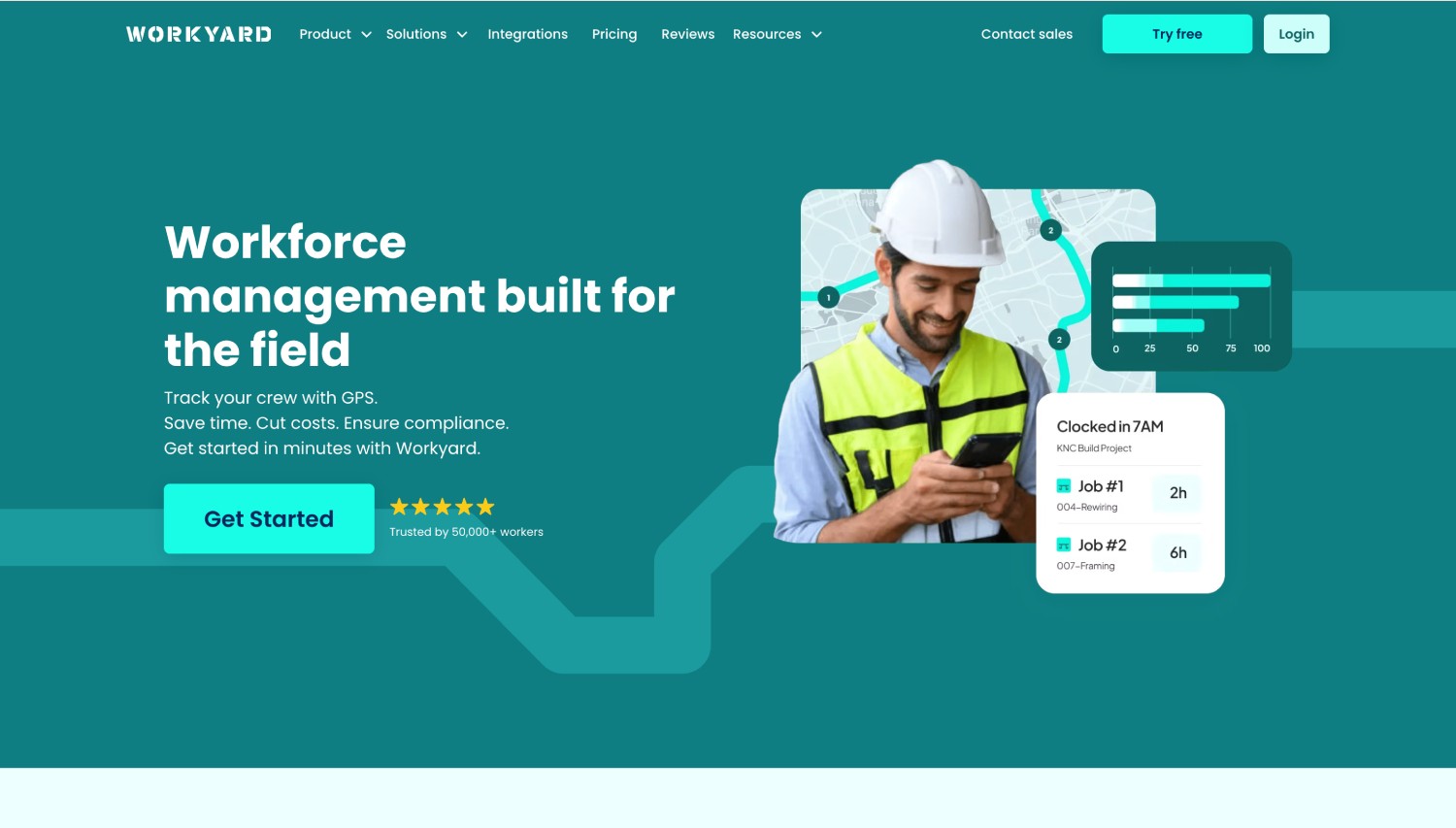
Workyard is a GPS time tracking and job costing platform for construction and field service businesses, and it is the most location-precise tool in this comparison. Continuous GPS tracking logs arrival, departure, and travel between sites rather than capturing a single coordinate at the punch.
Key capabilities
- Continuous GPS location tracking plus automatic mileage capture between job sites
- Customizable geofence radius with real-time boundary alerts on off-site clock-ins
- Supervisor batch clock-in, time clock kiosk, and Photo ID verification
- Job costing by cost code, employee, and date, with a change log on every time card
- Native two-way sync with QuickBooks, ADP, Paychex, Gusto, and Sage
How it verifies identity. Workyard captures a Photo ID selfie at the punch, which is a photograph rather than an automated face match, so review still sits with a supervisor.
Workyard is best for contractors whose primary problem is location accuracy and labor cost allocation across shifting sites. It is weaker for contractors whose primary problem is who is punching rather than where.
3. ClockShark: best for small contractors who also need scheduling
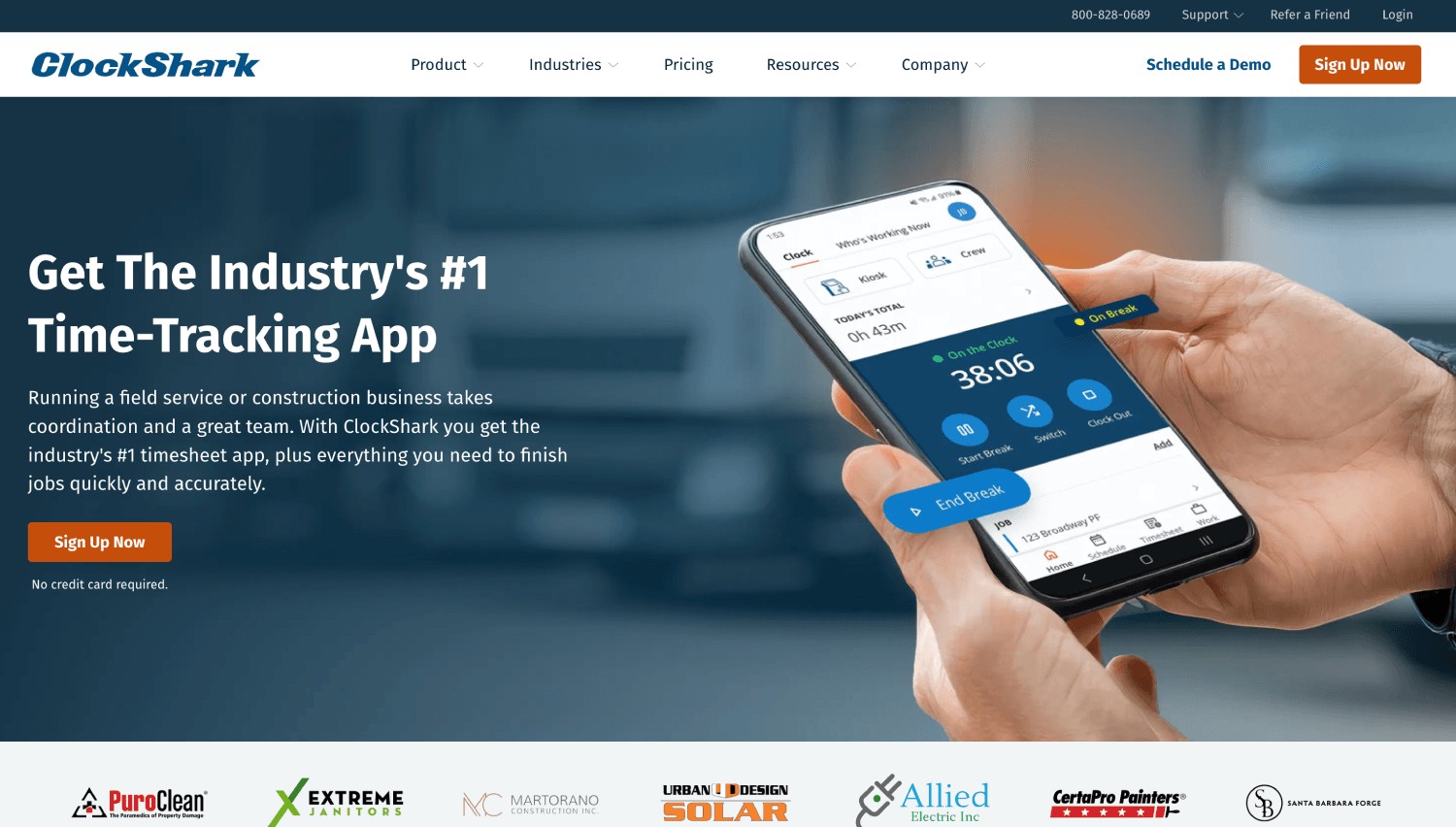
ClockShark is a construction and field service time clock app with drag-and-drop scheduling, job costing, and invoicing in one product. It is the most widely referenced tool in this category and the most common first step away from paper time cards for small crews.
Key capabilities
- GPS time clock with geofencing and out-of-bounds alerts
- Drag-and-drop schedule board for jobs and shifts
- CrewClock, which lets a foreman clock in an entire crew at once
- Job management and job costing by project and task
- Native QuickBooks sync plus other payroll connections
How it verifies identity. ClockShark offers facial recognition in kiosk mode, which means personal-phone clock-ins by crews spread across separate sites are verified by location rather than by face.
ClockShark is best for small and mid-size contractors running a few active job sites who want time tracking and scheduling in the same app. It is weaker for companies whose crews clock in from personal phones across many sites and need identity checked at each one.
4. busybusy: best for tracking labor and heavy equipment together
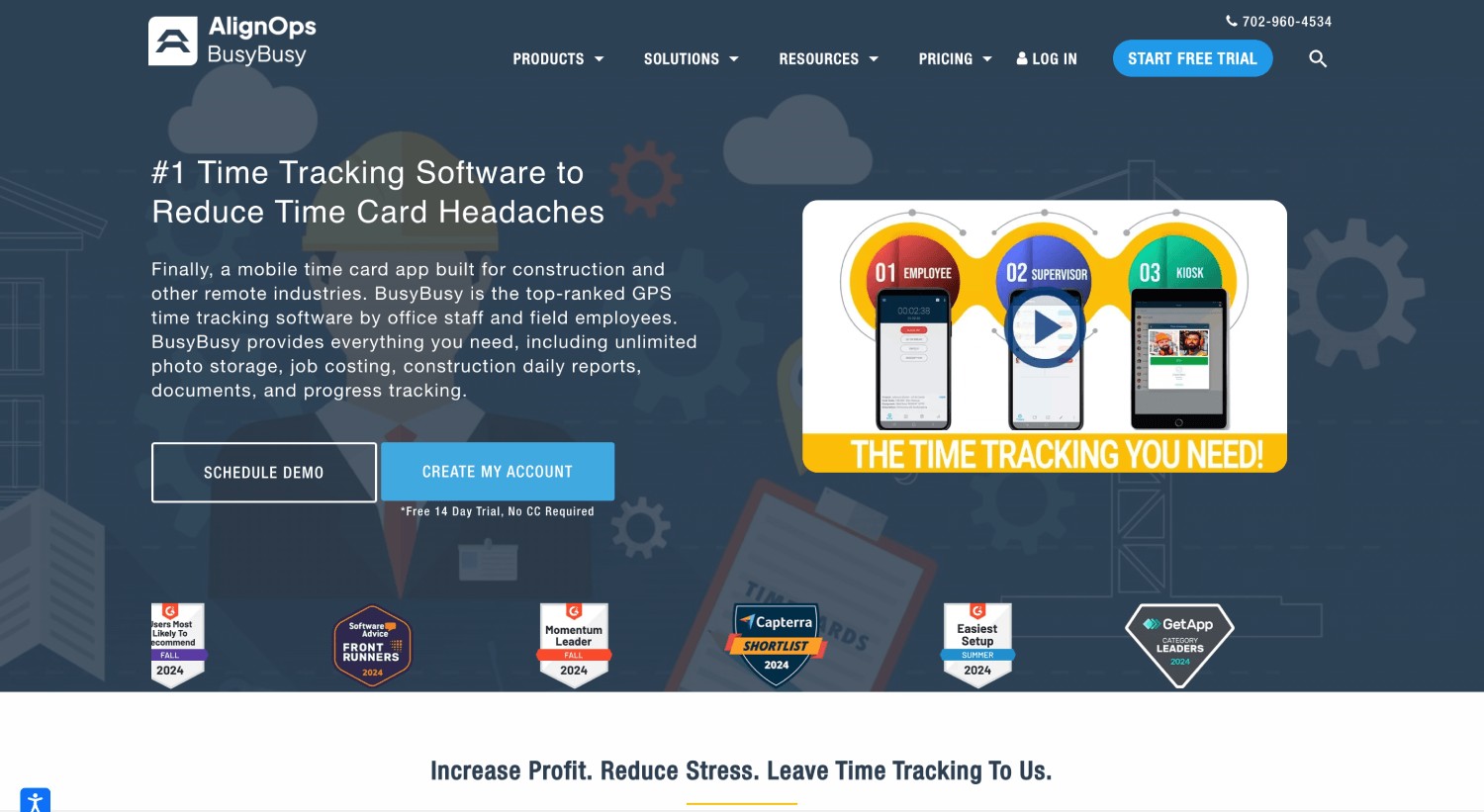
busybusy is a construction time tracking app that logs equipment hours alongside worker hours on the same time card, which no other tool in this list does natively. It also includes injury reporting, which matters for self-perform contractors managing site safety records.
Key capabilities
- Geofenced clock-in enforcement so punches register only inside job site boundaries
- Live GPS breadcrumbing showing location trails for crews and equipment
- Offline mode with automatic sync on reconnect
- Timestamped photo and note logging for field documentation
- Multi-equipment tracking with kiosk mode
How it verifies identity. busybusy captures GPS plus a timestamped photo at the punch, reviewed after the fact rather than matched at the moment of entry.
busybusy is best for heavy civil, earthmoving, demolition, and excavation contractors who need equipment utilization and labor hours in one system. It is weaker for trade contractors with no equipment fleet, where the core differentiator adds cost without value.
5. SmartBarrel: best for large crews on sites where workers do not carry smartphones
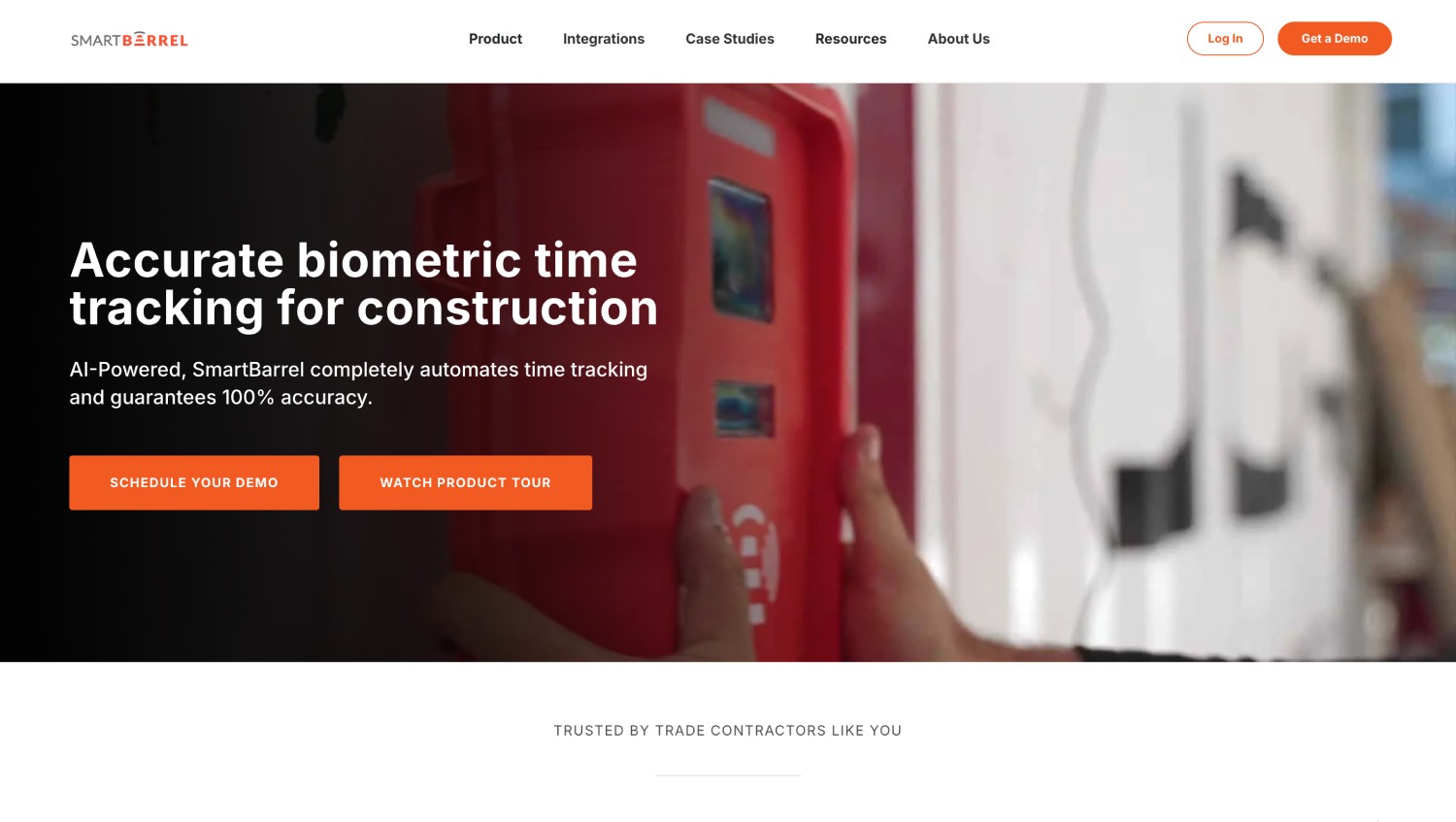
SmartBarrel pairs a ruggedized job site time clock with self-learning AI facial verification, built for commercial and union projects where personal-device clock-ins are not practical. Its TimeClock 4.0 hardware includes built-in LTE, so the site needs no WiFi.
Key capabilities
- Biometric facial verification with an AI identity check on every punch
- Rugged, solar-capable hardware clock with magnetic mount and built-in LTE
- Certified payroll, prevailing wage, and OSHA compliance support
- Integrations with Viewpoint Vista, CMiC, and Procore
- One-click cost code assignment and expense management for per diem and reimbursements
How it verifies identity. A worker enters a phone number, the clock takes a photo, and the AI compares it against previous photos to flag suspicious activity. The verification is strong, and it is tied to SmartBarrel hardware installed at the site.
SmartBarrel is best for trade contractors and self-perform general contractors with 20 or more workers per job site, particularly union crews needing audit-ready documentation. It is weaker for contractors with many short-duration or mobile crews, since each site needs a physical clock and there is no GPS tracking between jobs.
6. Arcoro Time, formerly ExakTime: best for large crews at fixed locations
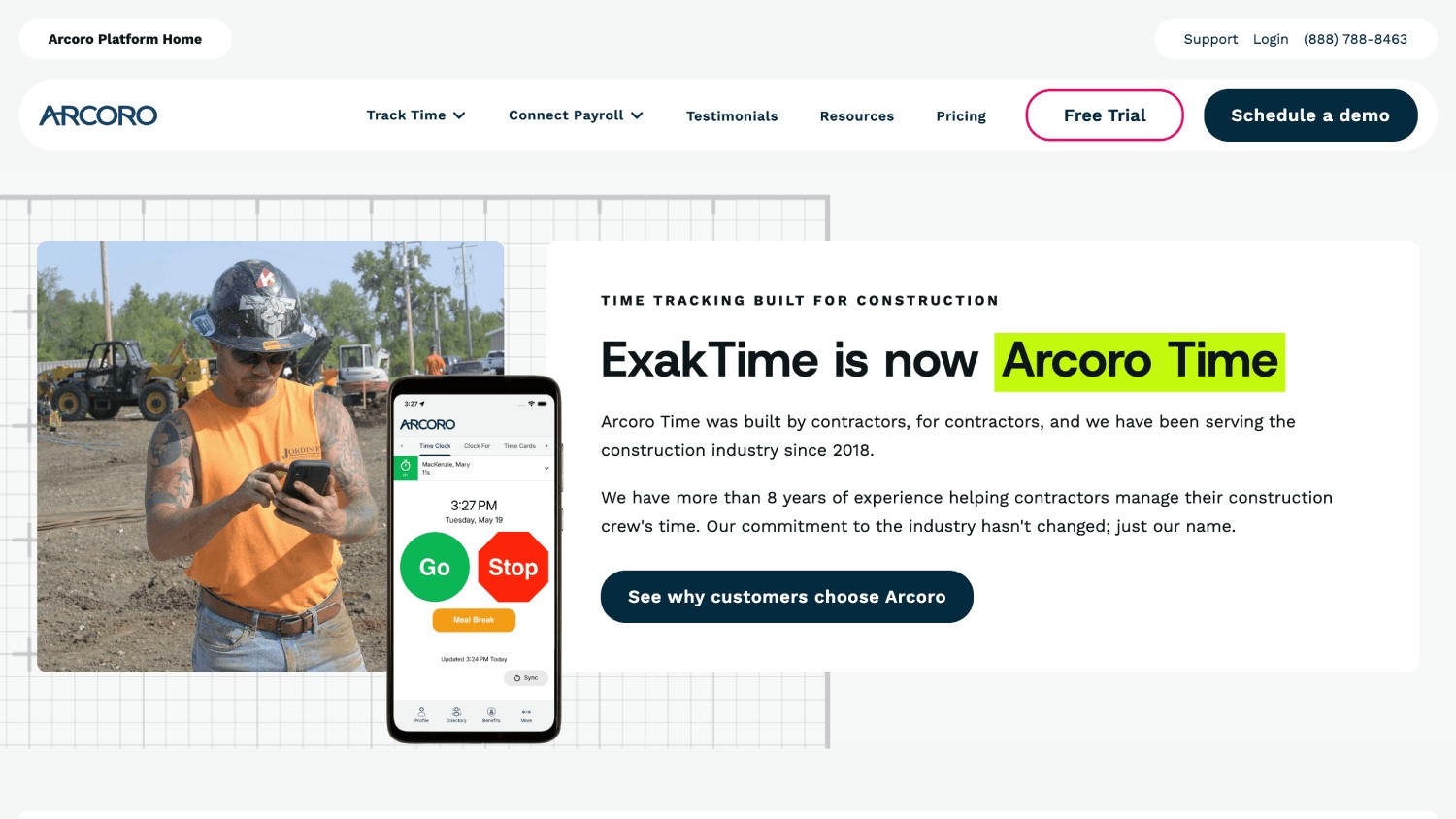
Arcoro Time is a construction time clock system that sits inside Arcoro's broader HR suite, aimed at companies with large workforces at consistent project locations. Its interface uses a green go button and a red stop button so the meaning is obvious regardless of the worker's first language.
Key capabilities
- GPS time tracking through mobile device location capture
- Portable rugged physical time clocks for gates and trailers
- FaceFront biometrics capturing a photo ID at every clock-in
- AI-powered notifications for unusual time entries and geofence violations
- Reporting and analytics by worker, job, and cost code
How it verifies identity. FaceFront captures a photo at the punch for supervisor review rather than performing an automated identity match, so verification happens after the entry is already recorded.
Arcoro Time is best for larger construction companies with 50 or more workers at single-location projects, especially those already using Arcoro for HR. It is weaker for field crews traveling between multiple locations in a day.
7. QuickBooks Time: best for contractors already inside QuickBooks
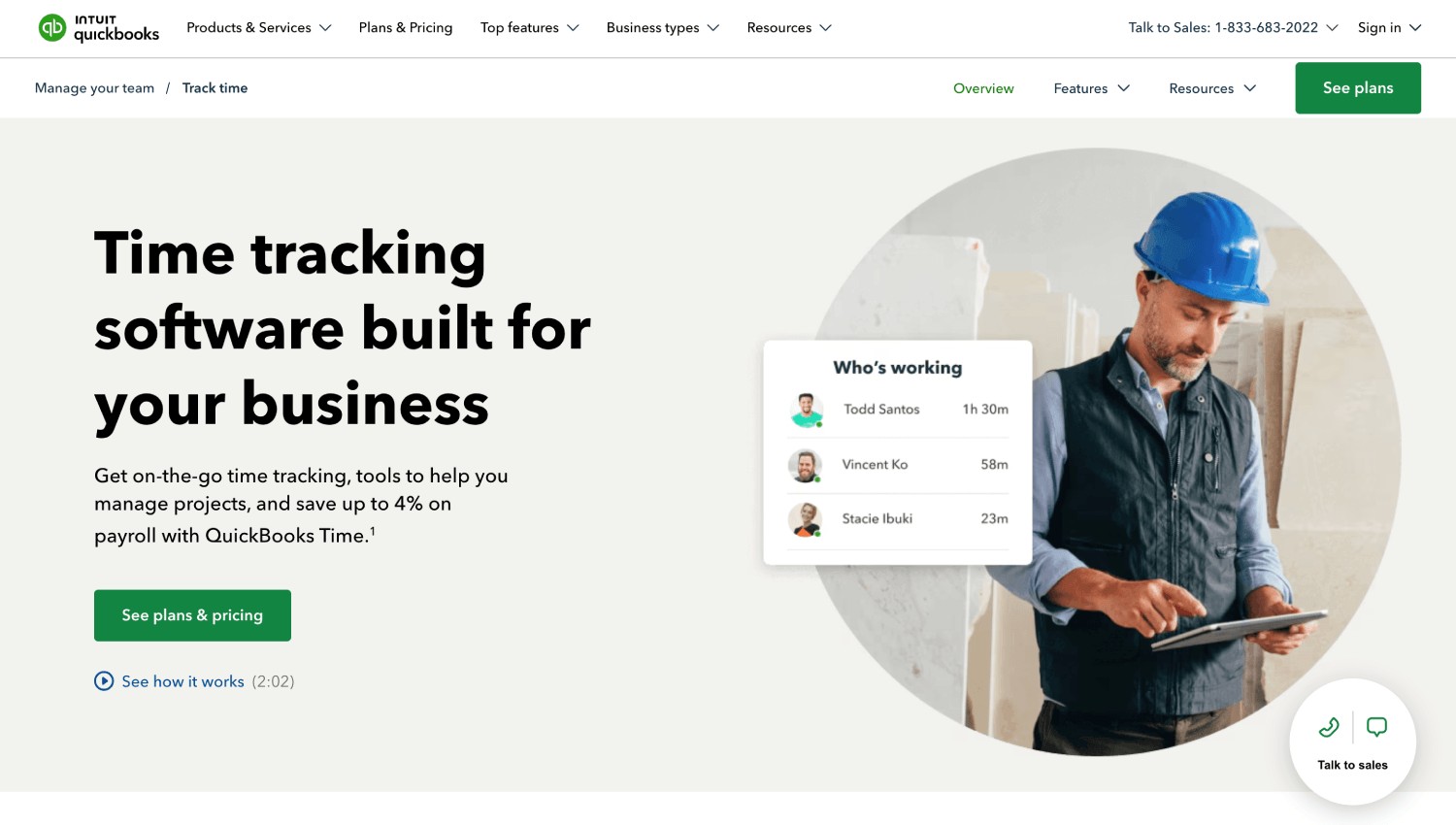
QuickBooks Time, formerly TSheets, is a general time tracking tool with tight QuickBooks integration rather than a construction-built product. Its value is entirely in the accounting connection.
Key capabilities
- Mobile and web time tracking with GPS location stamps
- Geofences configured around job sites by address or coordinates
- Job and customer-level time entries for invoicing
- Location flagging when a punch falls outside a geofence
- Direct connection to QuickBooks payroll and accounting
How it verifies identity. QuickBooks Time records location and timestamps and does not perform an identity check at the punch.
QuickBooks Time is best for contractors whose accounting already runs through QuickBooks and who need time data in the same ecosystem. It is weaker for contractors whose primary problem is buddy punching or site verification.
8. Buddy Punch: best for PTO and labor compliance on well-connected sites
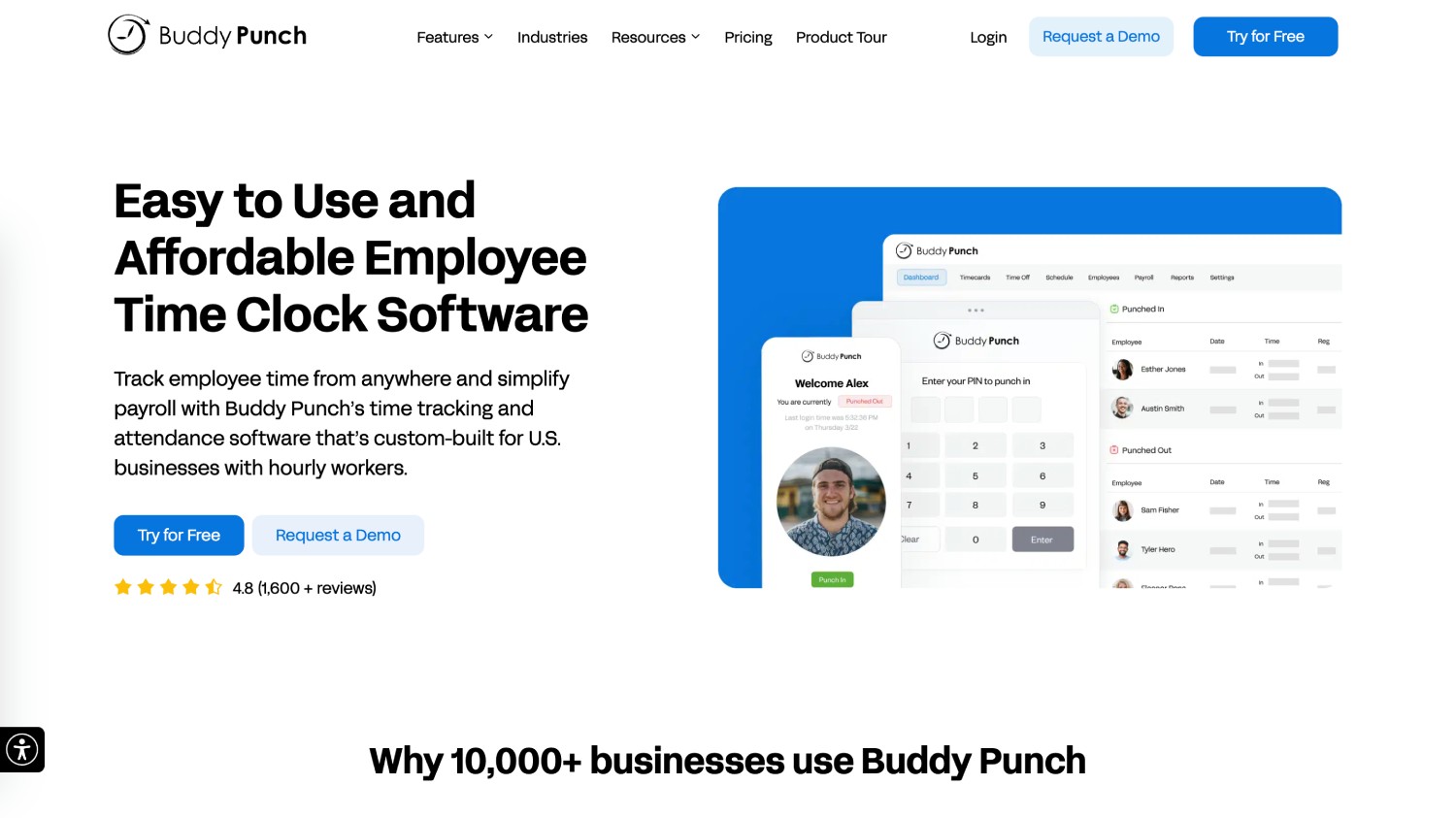
Buddy Punch is a time clock app for small and mid-size businesses that need detailed compliance tracking and automated paid time off accrual. Its flexible punch methods suit teams with mixed roles.
Key capabilities
- Clock-in by PIN, QR code, facial recognition, or password
- Automated PTO accrual and overtime monitoring
- Drag-and-drop shift scheduling
- Configurable clock-in and clock-out restrictions
- Native payroll integrations with optional payroll processing
How it verifies identity. Buddy Punch offers webcam facial recognition alongside PIN and QR options, giving reasonable coverage where connectivity is reliable.
Buddy Punch is best for small and mid-size teams that need PTO and overtime compliance more than construction job costing. It is weaker for rural or underground job sites, since Buddy Punch's documentation does not list a true offline mode.
9. Timeero: best for field teams that need mileage and drive time
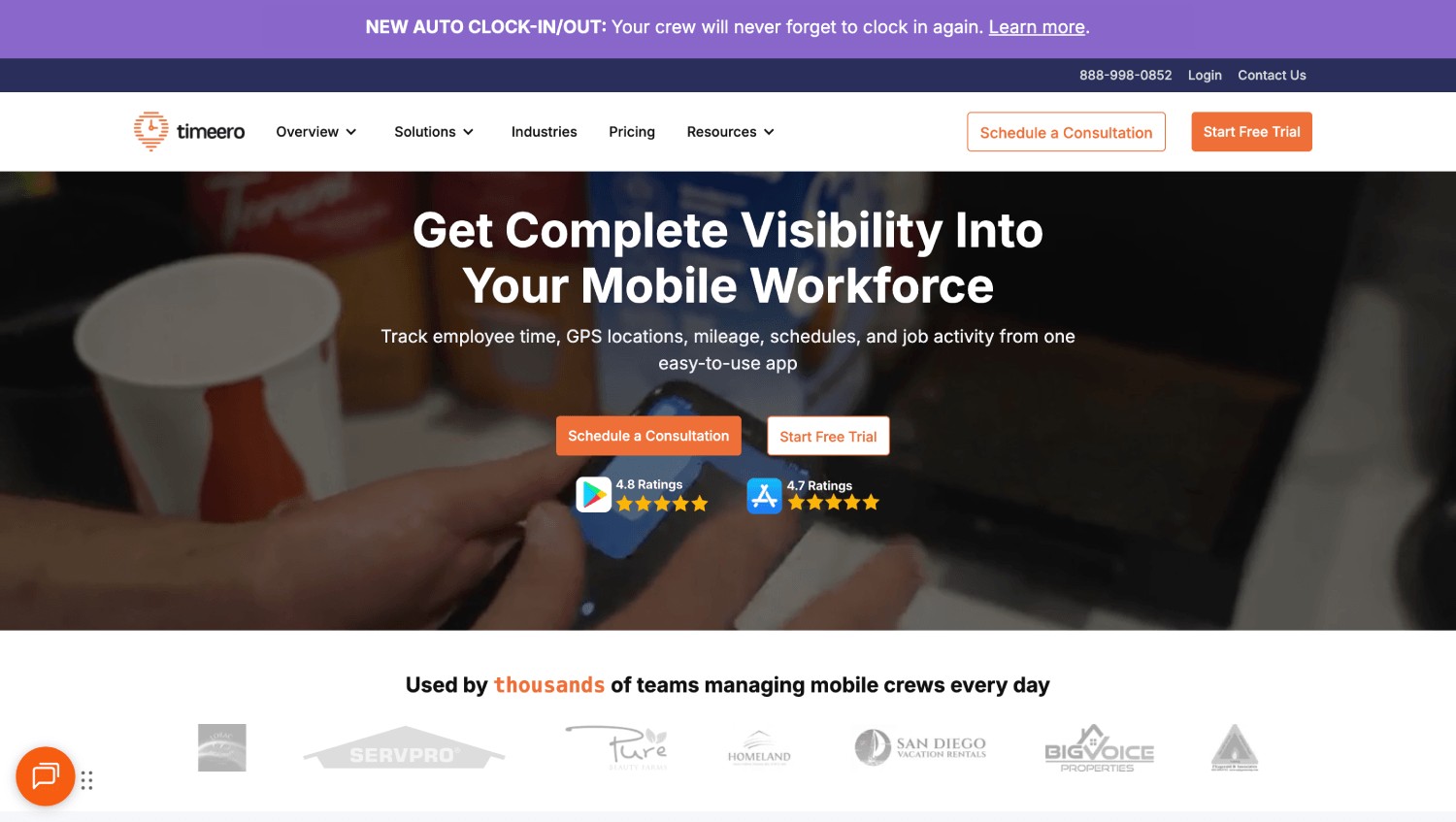
Timeero is a GPS time tracking app for field service businesses, with mileage capture and route mapping alongside hours. It serves a broad set of industries rather than construction specifically.
Key capabilities
- GPS time clock with mileage tracking and route maps
- Segmented tracking that splits time by stop along a route
- Real-time scheduling with map and calendar views
- Facial recognition on the kiosk for shared-device verification
- Time off management for PTO and vacation
How it verifies identity. Facial recognition runs on the Timeero kiosk, which covers shared-device sites and leaves personal-phone punches verified by location.
Timeero is best for small to mid-size field service teams where drive time and mileage reimbursement are a real cost line. It is weaker for large construction crews needing deep cost code structure or bulk time card editing.
10. Jibble: best for very small crews starting out
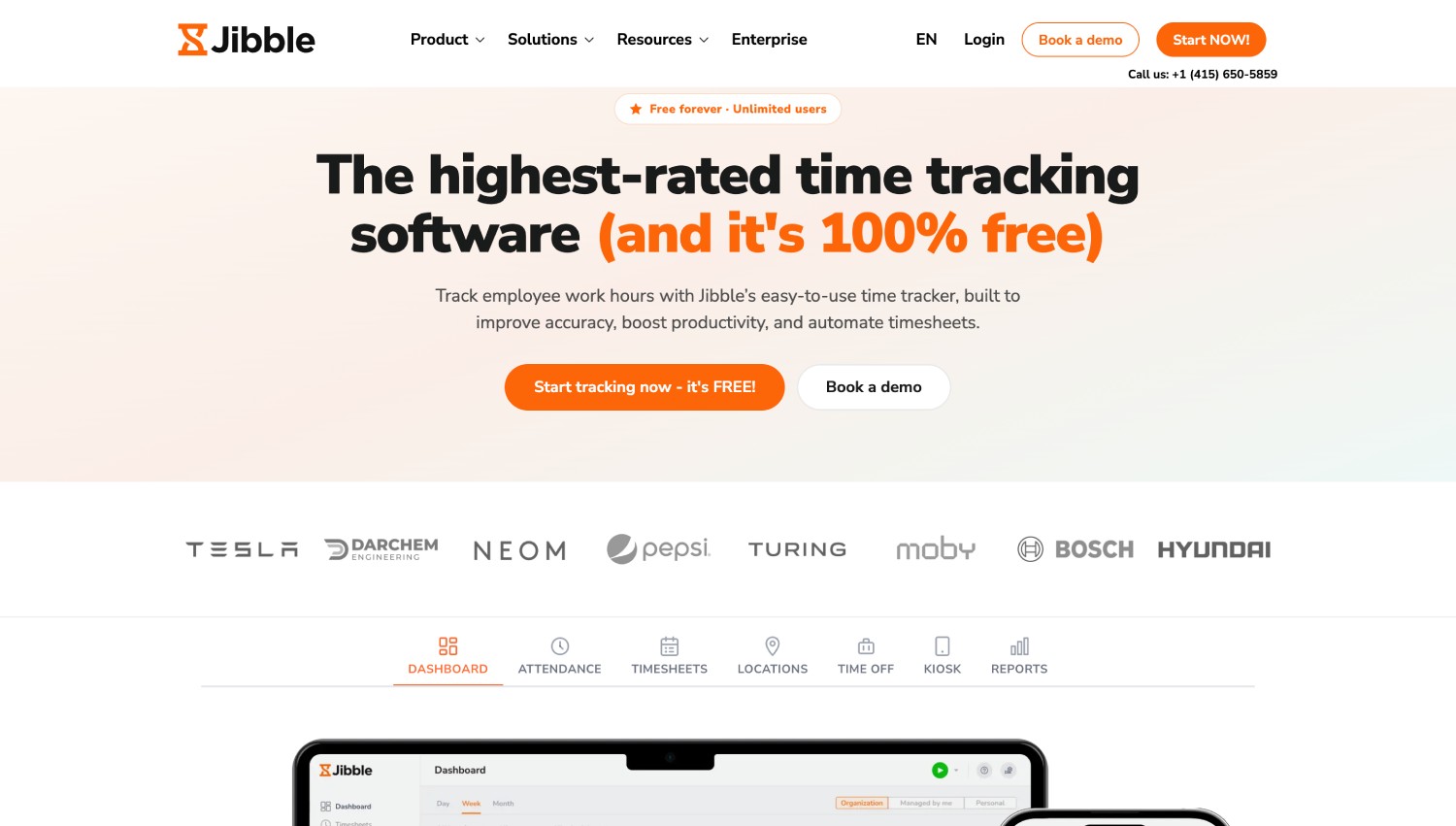
Jibble is a general-purpose time and attendance app whose entry plan includes GPS, geofencing, and facial recognition. Contractors often use it as a first step before moving to a construction-specific tool.
Key capabilities
- GPS-based geofencing time clock for location-verified punches
- Facial recognition on mobile and kiosk
- Offline-capable time tracking that works without cell service
- Automated timesheets split by regular, overtime, and billable hours
- Payroll exports plus native integrations
How it verifies identity. Jibble runs facial recognition on both mobile and kiosk, with liveness detection on its highest tier.
Jibble is best for crews of one to 10 workers who need location-verified hours without a construction-specific feature set. It is weaker for contractors who need cost codes, subcontractor separation, or construction scheduling.
11. Connecteam: best for a time clock inside a broader operations app
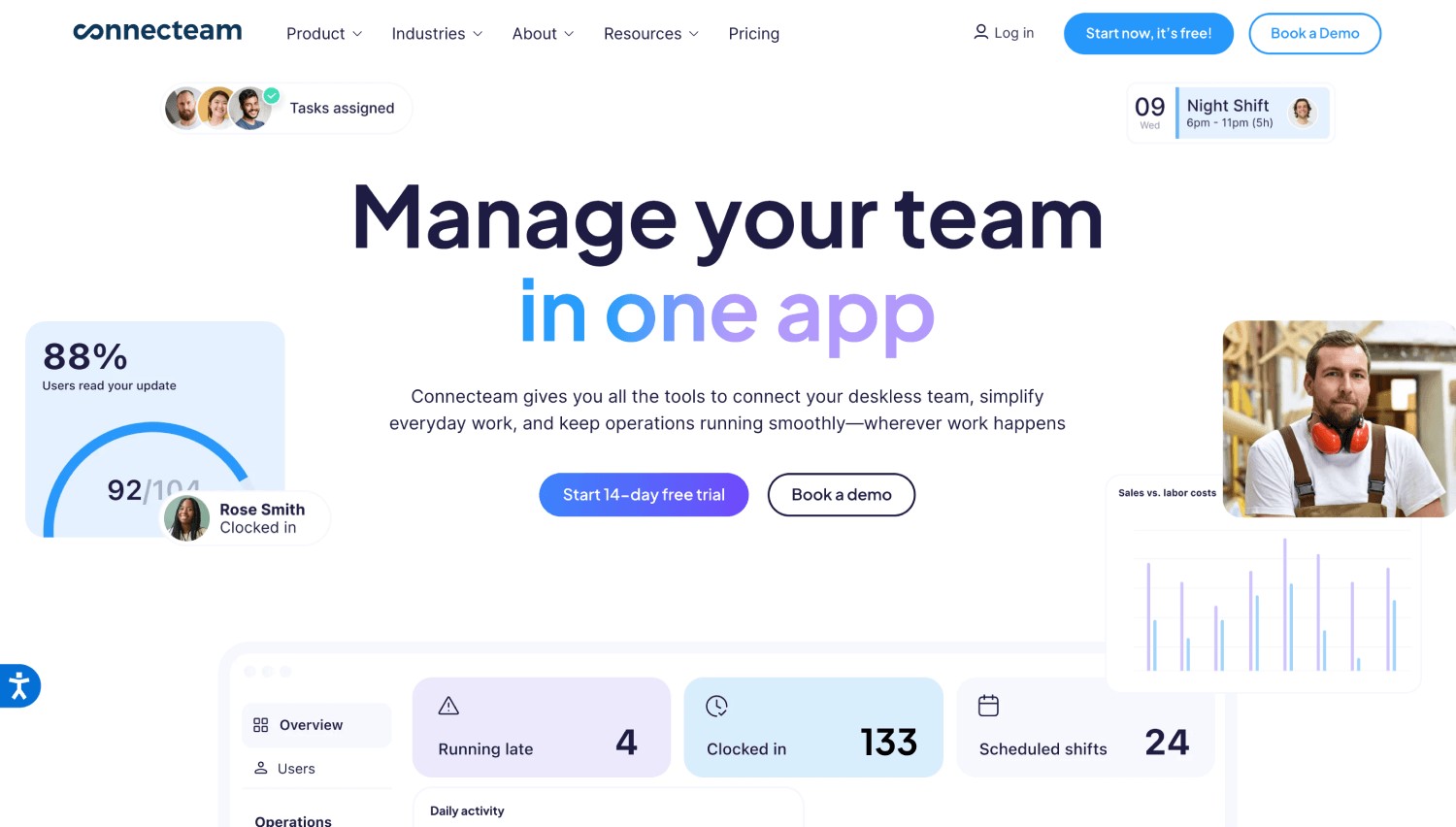
Connecteam is a deskless workforce management app that bundles a time clock with chat, checklists, task management, and training. Time tracking is one module among many rather than the core product.
Key capabilities
- Mobile time clock with GPS location tracking
- Task management, checklists, and forms
- Team communication and announcements
- Shift scheduling with availability management
- Payroll integrations including QuickBooks
How it verifies identity. Connecteam captures a location stamp at the punch without an identity check.
Connecteam is best for field teams that want communication, checklists, and time tracking in one app. It is weaker for contractors whose core need is attendance integrity and fraud prevention rather than a broad operations toolkit.
12. Raken: best when daily field reporting matters more than punch verification

Raken is a construction field reporting platform where time cards are attached to daily logs rather than the other way around. It is chosen for documentation depth, not for time clock rigor.
Key capabilities
- Daily reports with photos, notes, and crew count logs
- Time cards linked to projects and cost codes
- Safety and quality checklists
- Production tracking against planned quantities
- Payroll exports
How it verifies identity. Raken relies on supervisor-entered time cards without automated identity verification at the punch.
Raken is best for contractors whose project documentation and daily reporting are already the priority. It is weaker for companies trying to solve buddy punching or ghost workers on subcontractor crews.
How to Replace Paper Timesheets Without Losing a Payroll Cycle
Replacing paper timesheets takes one pay period of parallel running, not a hard cutover. The failure mode is switching everything on a Monday, discovering a policy misconfiguration on Thursday, and paying a crew from an incomplete data set.
Paper does not fail dramatically. It fails through rounding drift, cards submitted two days late, handwriting nobody can read, transcription errors during data entry, and the absence of any location proof when a client disputes an invoice. Each one is small and each one recurs every single cycle.
Here is a sequence that holds up in the field.
- Pick one active job site with a supervisor who will actually give you feedback, ideally one with 20 to 60 workers and a mix of your own crew and a subcontractor crew.
- Load the crew. Workers self-register with a single selfie on site, or HR pre-uploads staff details so the crew can clock in from day one.
- Set the geofence for that site, including separate boundaries for individual floors, wings, or zones if the site is large or vertical.
- Configure overtime, break, and holiday rules for that site and worker category before the first punch, not after the first dispute.
- Run parallel for one full pay period. Keep the paper cards and the digital records side by side, and do not tell the crew the paper is going away yet.
- Reconcile. Compare total hours, count the corrections each system needed, and note every punch the geofence flagged.
- Cut over and add sites. Software setup for a new site takes minutes, though a site using a shared tablet kiosk still needs that tablet physically installed, so plan the install into the timeline.
Adoption is where most rollouts actually break. Test the app on the cheapest Android phone on the crew, confirm the clock-in flow is under three taps, and plan for the workers who do not carry a phone by installing a shared tablet kiosk or enabling supervisor-assisted clock-in.
Fingerprint terminals fail differently and worse on a job site. Oily, wet, dusty, or calloused fingers cause read failures, and dedicated fingerprint terminals sometimes cannot recognize a worker at all, which is a limitation of the capture method rather than a brand problem.
How to Stop Time Theft on Construction Sites
Time theft on a construction site takes four distinct forms, and a single feature does not address all four. GPS time tracking to prevent time theft only works when it is paired with identity verification and edit controls, because GPS confirms a location and says nothing about who is standing in it.
Buddy punching and shared logins. One worker punches for another who is late, absent, or already gone. The countermeasure is identity verification at the moment of the punch, not a photo reviewed later. Truein blocks a failed face match immediately and prompts a retry.
Off-site punching. A worker clocks in from a truck, a parking lot, or home. Geofencing is the countermeasure, and the behavior you configure matters: blocked, alerted, or routed for approval. Truein's minimum configurable radius is 20 meters, and enforcement depends on account setup, so an out-of-boundary punch is not automatically impossible.
Early clock-in and late clock-out. These read as a normal full shift on paper and are the hardest form to catch manually. Truein's AI TimeGuard flags unusual clock-in patterns, geofence edge anomalies, impossible travel sequences, and abnormal overtime spikes so managers review flagged exceptions rather than entire timesheets. AI TimeGuard surfaces risk signals for review and does not guarantee fraud-proof payroll.
Retroactive timesheet editing. Hours get adjusted after the fact, sometimes legitimately and sometimes not. Approval workflows and a record of every correction are the countermeasure, and TimeGuard specifically flags frequent timesheet corrections and payroll-impacting edits.
Ghost workers on subcontractor crews are the version of this problem that general contractors carry and rarely control. You are billing a client for headcount supplied by a company whose payroll you cannot see. Truein separates subcontractor crews from your own staff with per-agency headcount limits and scoped supervisor access, which gives you the visibility and controls to spot overlap and overbilling, though the review itself is still a human decision.
Is Face Recognition Time Tracking Legal in the United States?
No US state bans face recognition for time and attendance outright, and the consent obligation is what separates a compliant deployment from an exposed one. Five states have biometric consent requirements that apply directly to attendance tracking, and the obligations differ in enforcement risk rather than in the basic consent requirement. Truein supports consent-first enrollment. When it is enabled, workers review and accept a recorded consent screen before any face data is captured. Collecting the consent stays the employer's obligation.
California is the state that matters most for most US employers right now. The employee exemption under the California Consumer Privacy Act and its amendment, the California Privacy Rights Act, expired on January 1, 2023. California employees now hold full notice, access, and deletion rights over biometric data collected at work, including for time and attendance.
Illinois carries the highest practical litigation risk. The Biometric Information Privacy Act requires written consent before biometric data is collected and, unlike the other statutes here, allows individuals to sue directly. That private right of action is why employers targeting Illinois sites should treat face-based clock-ins with extra care and pair them with clear written consent.
Texas enforces the Capture or Use of Biometric Identifier Act, which requires employers to inform workers and obtain consent before capturing a biometric identifier such as a record of face geometry for a commercial purpose. Only the Texas Attorney General can enforce it, with civil penalties reaching 25,000 dollars per violation, so there is no class-action exposure.
Washington applies RCW 19.375, the Washington Biometric Privacy Act, which requires notice and consent before enrolling a biometric identifier in a database for a commercial purpose. Enforcement sits solely with the Washington Attorney General through the state's Consumer Protection Act.
Colorado enforces HB 24-1130, effective July 1, 2025, which requires employee consent before biometric identifiers are collected for employment use, a written retention and deletion policy, and deletion within 24 months of an employee's last interaction unless a statutory exception applies. Time and attendance is a permitted use when those conditions are met.
Practical takeaway for contractors: run consent-first enrollment everywhere, keep the written consent records, and pair face verification with GPS rather than relying on face alone in general-purpose US content and policy.
Disclaimer: This section is for general informational purposes only and does not constitute legal advice. Biometric privacy laws vary by state and change over time; the information above reflects publicly available sources as of the article's publish date and may not reflect subsequent legal developments in your jurisdiction. Before deploying biometric attendance technology, consult a licensed attorney familiar with the applicable state and local requirements.
How to Choose the Right Construction Time Tracking System
Match the tool to your dominant risk rather than to the longest feature list. The seven conditions below cover most contractor situations.
- Crews move between three or more active job sites daily. Prioritize per-site geofencing, cost codes by site, and a single dashboard across all locations.
- You bill clients for subcontractor crews you do not employ. Prioritize scoped supervisor access, per-agency headcount limits, and subcontractor-level policies.
- Sites are rural, underground, or pre-power. Prioritize true offline capture, and confirm what happens to a record between capture and sync.
- Workers do not carry smartphones. Prioritize a shared tablet kiosk, supervisor-assisted clock-in, or dedicated rugged hardware.
- Job costing drives your billing. Prioritize cost code depth and integration with Sage, Viewpoint, or your ERP.
- You already run QuickBooks. Prioritize native two-way sync so hours map to cost codes rather than landing as a flat total.
- Buddy punching is your known problem. Prioritize identity verification at the punch over GPS precision, and confirm it works on personal phones, not only on a kiosk.
Where this recommendation does not apply: construction time tracking software will not fix crew shortages, will not correct a bad estimate, and will not resolve a client dispute over scope rather than hours. It also will not help a company whose real problem is that supervisors are not reviewing exceptions at all, since better data with the same review habits produces the same payroll.
Why Construction Teams Choose Truein
Truein is an AI-powered time tracking platform for companies managing hourly, field, and multi-site workforces, and construction is one of its two largest verticals. Contractors adopt it for four reasons, in roughly this order.
Identity, not just location. Face verification at the punch on a personal phone, a shared tablet kiosk, or a supervisor's device, combined with GPS geofencing, so a clock-in carries both who and where.
Sites live in minutes, not weeks. No fingerprint scanners, no custom kiosks, and no IT procurement, since any Android or iOS device you already own becomes a clock-in point. A site that uses a shared tablet kiosk still needs that tablet installed physically.
Subcontractor separation. Multiple subcontractor agencies under one account, each with its own headcount limits, policies, pay rates, document expiry tracking, and a supervisor view scoped to its own crew.
Exceptions instead of timesheets. AI TimeGuard scans time data continuously and surfaces the entries worth a manager's attention, while more than 70 configurable policies handle overtime, breaks, holidays, and leave by location, category, or shift.
Truein serves more than 500 clients across 25 countries and over 10,000 locations. Its US operations run from an office in New Jersey, with US-based account executives supporting enterprise customers for implementations and business reviews.
Ready to test it? Shortlist one active project, invite the site supervisor, and schedule a Truein demo to run a pay period against your current process.
Frequently Asked Questions
What is the best time clock app for construction with multiple job sites?
For contractors running several active sites at once, the strongest fit is a tool that fences each site separately and verifies identity at every location. Truein supports per-site, per-floor, and per-zone geofencing with face verification on personal phones and shared kiosks. Workyard is the stronger option if continuous GPS between sites matters more than identity.
Does face verification work on a worker's personal phone or only on a shared kiosk?
It depends on the tool, and this is the most common gap in the category. ClockShark and Timeero run facial recognition in kiosk mode, so personal-phone punches are verified by location alone. Truein performs a live face match on personal phones, shared tablet kiosks, and supervisor devices.
Do construction time tracking apps work offline on remote job sites?
Yes, most of them do. Truein, Workyard, ClockShark, busybusy, Timeero, and Jibble all capture punches on-device without a signal and sync automatically once connectivity returns. Buddy Punch's documentation does not list a true offline mode, which is a real limitation for basement and rural work.
Which construction timekeeping software integrates with QuickBooks, ADP, and Viewpoint?
Truein connects to ADP, QuickBooks, Sage, Xero, SAP, Viewpoint, and Paychex through API-based real-time sync or FTP-based batch sync. Workyard offers native two-way sync with QuickBooks, ADP, Paychex, Gusto, and Sage. Viewpoint support is the differentiator for contractors already running Viewpoint for project and cost management.
What is the best biometric time tracking option for construction projects?
For construction specifically, the strongest biometric approach is face-based rather than fingerprint-based, since dusty, wet, and calloused hands cause fingerprint read failures on job sites. Truein delivers face verification as software on standard Android and iOS devices with no dedicated hardware, while SmartBarrel delivers it through a rugged hardware clock installed on site.
How accurate is face recognition with hard hats, beards, and masks?
Truein's approved accuracy range is around 95% to 100%, including with facial hair, masks, changed hairstyles, and hard hats. The system is designed for job site conditions rather than office lighting. A failed match blocks the punch and prompts a retry rather than silently recording an unverified entry.
How do I track subcontractor crews separately from my own employees?
Set up each subcontractor as a separate entity inside one account, with its own headcount limit, policies, and pay rates. Truein gives each subcontractor supervisor a view scoped to their own crew only, kept separate from company-wide employee data. This provides the visibility to spot overlap and overbilling, though it does not automatically detect it.
Is Truein available in the United States?
Yes. Truein is headquartered in India with a dedicated US office in New Jersey, and serves clients across 25 countries and more than 10,000 locations. US-based account executives travel across the US and Europe as needed, primarily supporting enterprise customers on strategic engagements, business reviews, and custom implementations.
