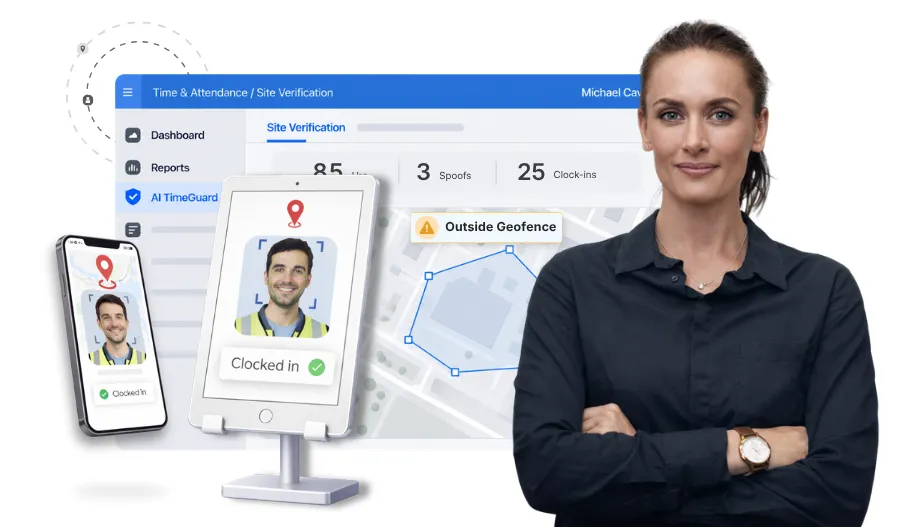
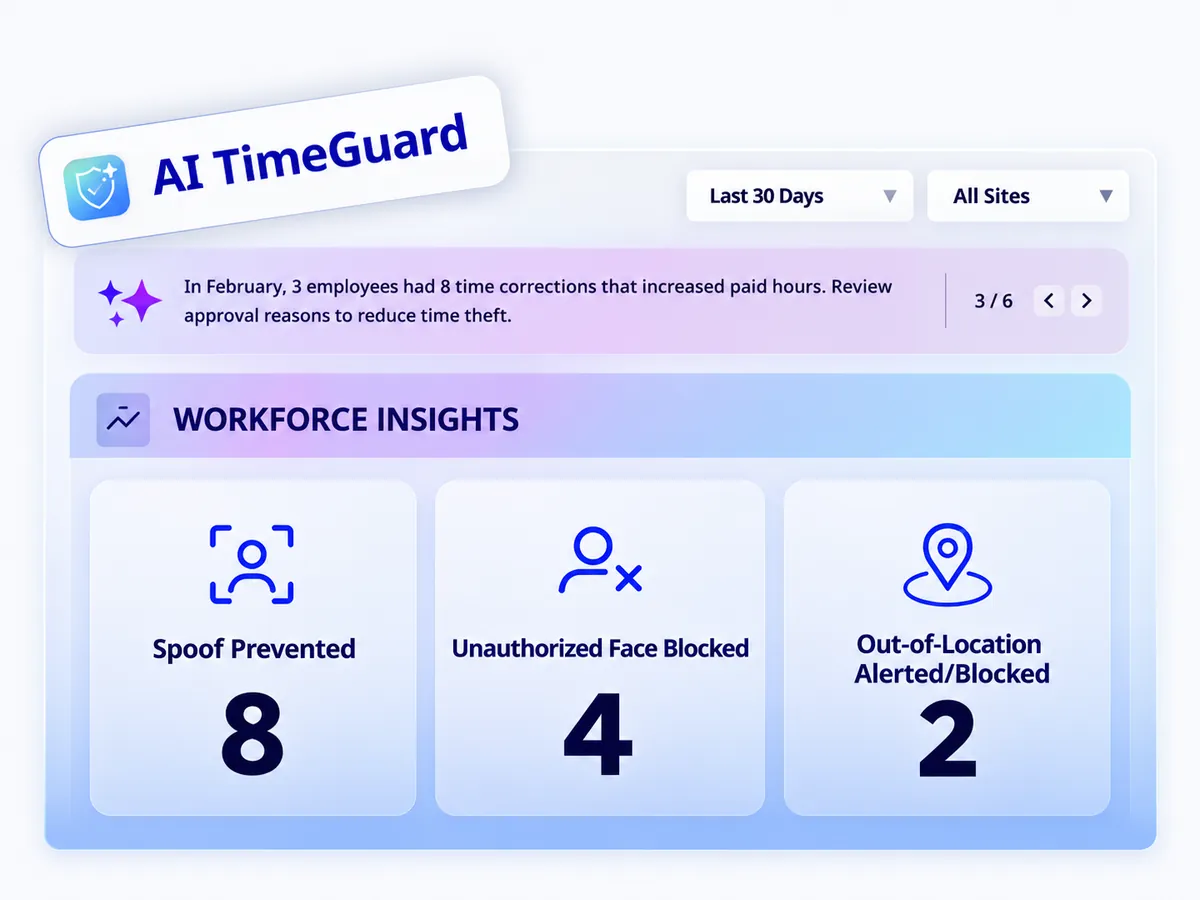
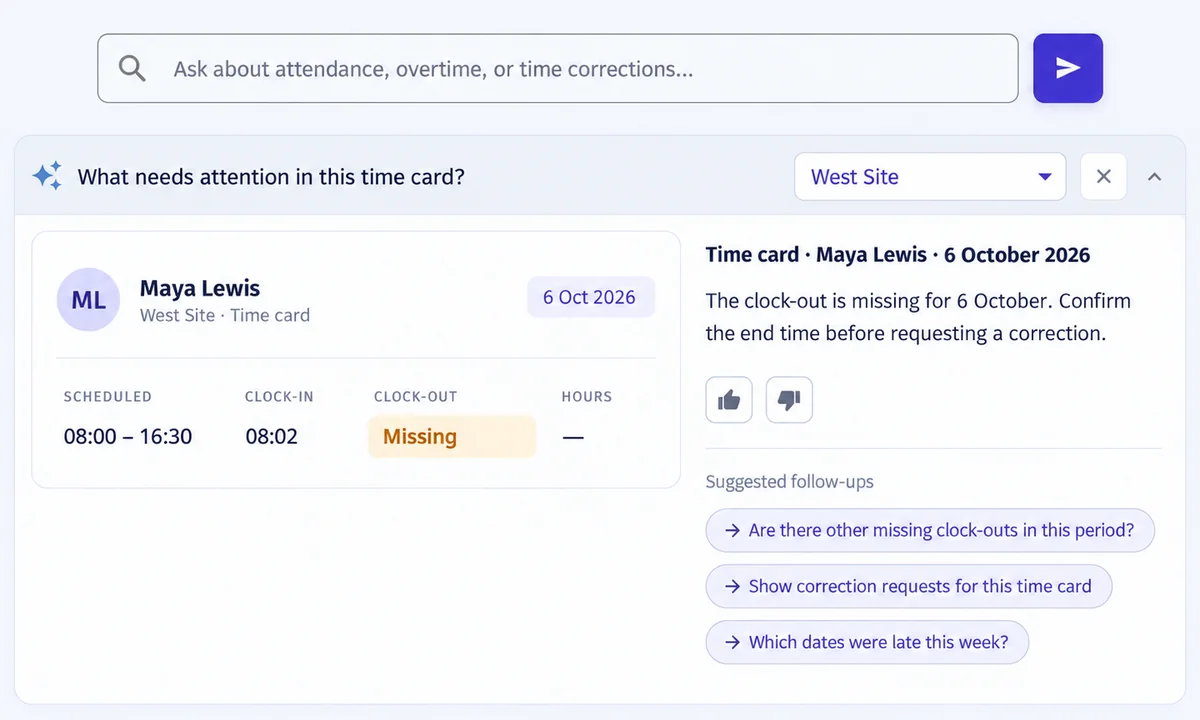
They overlap on GPS clock-in, offline use, supervisor crew clock-in and a free trial. They differ on where face verification runs, what the geofence does at the boundary, AI review before payroll, and how much scheduling and job costing sits in the same tool. The FLSA accepts any timekeeping method as long as the hours recorded are complete and accurate, per the Department of Labor’s FLSA recordkeeping fact sheet, so the deciding question is how each tool proves the record is right.
A logistics HR manager whose temporary workers clock in from their own phones needs the identity check on the phone itself, because a kiosk-only face match never sees those punches.
Dedicated hardware required
✓ Not required No dedicated attendance hardware required. Works on compatible Android and iOS phones and tablets.
✓ Not required No dedicated attendance terminal required. Supports worker phones, a shared-device Kiosk Clock and web clock-in.
Identity verification at the punch
✓ AI face recognition Matches the worker against their registered facial profile during clock-in, on personal phones and shared kiosks; offline verification depends on attendance mode.
◑ Kiosk only Optional facial recognition in the shared Kiosk Clock; personal-phone punches are location-stamped but do not receive facial identity verification
Kiosk mode on a shared device
✓ Available Compatible tablets and supported phones can be configured as shared attendance kiosks
✓ Kiosk Clock PIN entry, with optional facial recognition
Clock-in from the worker’s own phone
✓ Available Selfie attendance with geofencing
✓ Available GPS recorded on each punch and while clocked in
Supervisor clock-in for the crew
✓ Available From the supervisor’s mobile phone
✓ Crew Clock A foreman clocks in the whole crew
Offline punches
✓ Available Attendance is captured offline and automatically synced when connectivity returns. Face verification depends on the attendance mode.
✓ Available Mobile app holds entries in an offline Sync Queue and syncs when connectivity returns
GPS geofencing
✓ Available Checks the device’s reported GPS location against configured site boundaries during clock-in and clock-out, with out-of-geofence attempts handled according to the configured attendance policy.
◑ Reminders and alerts Arrival and exit reminders and out-of-bounds alerts to admins; an off-site clock-in is not blocked
GPS movement tracking during shifts
○ Separate module Truein Live Tracking is available as a separate solution, with location capture during recorded work hours based on configured movement-based or interval-based tracking.
✓ Available Location recorded periodically while employees are clocked in
Breaks, overtime, rounding
✓ Available 70+ customizable policies
✓ Available Break and overtime settings with manager approvals
Shift scheduling
✓ Advanced plan
✓ All plans Drag-and-drop scheduling with draft schedules on Standard
Time-off management
✓ Available Add-on for Advanced and Enterprise, with leave policies and approval workflows
◑ Pro plan Paid time off management
Contractor and agency-level attendance management
✓ Advanced plan Agency-specific policies and pay rates, staff transfers between sites, and agency-wise attendance reporting
○ Not documented
Multi-site dashboard
✓ Available Centralized control across all sites
✓ Available Map of who is working now; multi-department and office controls on Pro
Verification at the punch
✓ Face recognition plus geofence Offline verification depends on attendance mode
◑ Kiosk face recognition only Personal-phone punches are location-stamped without facial identity verification
Spoof detection after upload
✓ Available Runs after attendance data is uploaded; administrator alerts
○ Not documented
AI review before payroll
✓ AI TimeGuard Flags suspicious attendance activity and anomalies for manager review. Smart Timesheet Review helps managers examine attendance exceptions and AI findings before timesheet approval.
○ Not documented Manager approvals and alerts such as missed clock-ins
Plain-language questions on attendance data
✓ Workforce Insights Allows managers to ask contextual questions about available attendance data in plain language.
✕ Not available Summary and detail reports on jobs, employees and tasks
Approvals and sign-off
✓ Available
✓ Available Manager roles and approvals
Job and project time tracking
✓ Available Track attendance against jobs and locations
✓ Available Time tracked to jobs and tasks
Job costing and labor cost reports
✕ Not available Not offered as job-costing functionality
✓ Available Advanced job costing controls on Pro
Shift wrap-up and compliance forms
✕ Not available
◑ Pro plan
Photos and notes on jobs
✕ Not available
✓ Available Attached to time entries with GPS location pins
Free plan
✕ Not offered 14-day free trial instead
✕ Not offered 14-day Pro trial instead
Published pricing
✓ Published Time Capture and Advanced priced per user per month plus a $40 monthly base price; Enterprise pricing is customized
✓ Published Standard $42 per month plus $9.50 per active user; Pro $63 per month plus $11.50 per active user
Monthly base fee
◑ $40 base price $40 per month base price on Time Capture and Advanced, in addition to per-user pricing
◑ $42 or $63 Standard or Pro platform fee, in addition to per-user pricing
Contract term
○ Confirm with Truein
◑ Three years Listed on ClockShark’s pricing page for all plans
Free trial
✓ 14 days, no credit card
✓ 14 days, no credit card Pro plan trial
Integrations
✓ API and FTP Supports API and FTP-based integrations with payroll and HRMS systems, along with custom integration options; plan availability varies, so confirm with Truein.
✓ Named list Lists QuickBooks Online and Desktop, ADP Workforce Now, Gusto, Paychex Flex, Xero and Zapier among its integrations
Feature data from truein.com and clockshark.com, verified November 13, 2026. ClockShark pricing and contract term reflect its pricing page as reported in September to November 2026 and may change; confirm current figures with the vendor. “Not documented publicly” means the vendor’s own website does not establish whether the capability exists; confirm in a demo. “Not available” marks capabilities the vendor confirms it does not offer.