



On June 1, 2026, UAE contractors lost the two weeks they used to rely on. Ministerial Resolution No. 340 of 2026 repealed the old Wage Protection System rulebook, abolished the 15-day payment grace period, and made wages due on the first day of each Gregorian month. It also raised the compliance threshold from 80% to 85%, applied at both company level and individual worker level, with monitoring beginning on the second day of the month.
For a Dubai contractor running 1,400 workers across 11 sites with five manpower suppliers, that change did not move the payroll deadline. It moved the attendance deadline. Choosing construction workforce attendance software in the UAE is now a decision about how fast and how defensibly your muster data closes, not about which vendor lists the most features.
TL;DR
- The 2026 Wage Protection System rules removed the grace period that used to absorb slow attendance reconciliation, which means the binding constraint for UAE contractors is now the monthly attendance close, not the bank transfer.
- Wage Protection System file generation is a payroll function, not an attendance function. Most published shortlists mix attendance capture tools and full UAE payroll suites into one table, and buyers end up comparing products that do not compete.
- The first decision is not which vendor to pick. It is which layer to instrument: the labour accommodation, the transport, the site gate, or the work front, because the same worker appears in three separate registers and that gap is where supplier overbilling hides.
- Between June 15 and September 15, Ministerial Resolution No. 44 of 2022 bans outdoor work from 12:30 PM to 3:00 PM, which splits every workday into two shifts, doubles the daily punch count, and carries a fine of AED 5,000 per worker in violation up to AED 50,000.
- Truein, HRX360, TrueBays StackHX, AiTIME, ZKTeco, Jibble, and Paylite HR cover three different product categories, and a contractor with existing biometric terminals plus roving engineers usually needs one from two of them.
- No attendance platform files your Wage Protection System submission, corrects a supply contract that bills on deployed headcount instead of verified hours, or survives site administrators keeping retrospective edit rights.
What Changed for UAE Construction Workforce Attendance in 2026
The two rules that govern a construction attendance system in the UAE both tightened in 2026. One shortened the deadline for producing wage evidence. The other changed the shape of the working day for three months of the year.
The wage deadline moved to the first of the month
Under Resolution 340, wages for a given month must reach workers through the Wage Protection System or another MOHRE-approved channel by the first day of the following month. Any transfer after that date is recorded as late. Law firm Morgan Lewis noted in its May 2026 analysis that the resolution replaced Ministerial Resolution No. 598 of 2022 and restructured timing, thresholds, and enforcement together rather than separately.
Paying early stays compliant. What disappeared is the buffer that let a contracting company collect site registers on the 3rd, argue with two manpower suppliers until the 8th, and still pay by the 15th.
The 85% threshold now applies to each worker individually
An establishment counts as compliant when at least 85% of total wages due reach workers on time. The same 85% test applies to each individual worker, with shortfalls permitted only where they arise from lawful deductions under the UAE Labour Law.
That second test is the one that turns an attendance dispute into a compliance event. A single mason whose 14 hours of contested overtime were never approved before payroll can drop below his individual threshold on his own.
The midday break turns every summer workday into two shifts
The Occupational Heat Stress Prevention Policy ran for its 22nd consecutive year in 2026, from June 15 to September 15, prohibiting work under direct sunlight and in open areas between 12:30 PM and 3:00 PM. Daily working hours across the morning and evening shifts must not exceed eight during those months, and anything beyond eight hours counts as overtime.
Two consequences follow for attendance capture. The punch count per worker per day goes from two to four, and proving compliance to a MOHRE inspector requires time-stamped records showing that nobody was on the work front during the restricted window.
A muster roll, the daily register of workers recorded as present on a site, signed once at 7:00 AM on paper proves neither of those things. It records that a gang arrived. It cannot show that the same gang was off the work front between 12:30 PM and 3:00 PM.
Your attendance record is evidence for three separate obligations
Working hours sit under Article 17 of Federal Decree-Law No. 33 of 2021 at eight hours daily and 48 hours weekly, as the UAE government portal states. Overtime carries an uplift of at least 25% on the basic wage, rising to at least 50% for hours worked between 10:00 PM and 4:00 AM, with that night premium not applying to workers employed on a shift basis. Overtime is capped at two hours a day, and the executive regulations cap total working hours at 144 across any three-week period.
MOHRE has also set out that employers must keep worker files for not less than two years after the end of service, according to guidance reported by Gulf News. Three different demands can therefore land on the same dataset: an inspector checking hours, a wage dispute checking payment, and a subcontractor checking headcount.
One scope note that most buyer guides skip. MOHRE-registered free zone employers should confirm applicability with their free zone authority rather than assume exemption, while DIFC and ADGM operate their own employment regimes outside the MOHRE Wage Protection System framework.
Disclaimer: This section does not constitute legal advice. The information presented is based on available references at the time of writing and may contain inaccuracies or omissions. Readers are advised to verify details independently or consult a qualified professional.
How This Shortlist Was Built: 9 Criteria for Construction Attendance Software in the UAE
Each criterion below maps to a UAE operating condition rather than a feature name. Products were assessed against publicly available vendor documentation reviewed in August 2026.
- Multi-zone geofencing on open sites. A single perimeter fails on a 40-acre plot with three active work fronts. Each zone, wing, floor, or gate needs its own boundary.
- Identity verification at the moment of the punch. A photo captured for later supervisor review is a record, not a control. Verification either blocks an unauthorized punch or it does not.
- Offline capture with flagged sync. Basements, tunnel works, and desert alignments lose signal for hours. Records must survive the gap and be identifiable as offline captures afterward.
- Split-shift and Ramadan configuration. The system must handle a morning and evening shift around a fixed midday stop, plus the statutory two-hour Ramadan reduction, without manual timesheet surgery.
- Rolling overtime cap visibility. Two hours daily and 144 hours across three weeks is a rolling calculation, which a monthly spreadsheet cannot perform.
- Manpower agency separation with scoped access. Each supplier's supervisor should see only their own workers, against a headcount cap, mapped to the sites they are contracted for.
- Edit lock and approval trail. Every retrospective correction needs an approver, a timestamp, and an original value that remains visible.
- Worker-facing simplicity and language. Enrollment and clock-in have to work for a first-time smartphone user in under a minute. Arabic interface support is advertised by some UAE vendors and not by others, and it is worth confirming per product.
- Export that payroll can consume without rework. The test is whether the payroll team can build the salary file from the export directly, or has to rekey it.
Where Should Construction Site Attendance Start: The Camp, the Bus, the Gate, or the Work Front?

Instrument the layer where your monthly dispute actually originates. Contractors whose recurring argument is headcount should capture the site gate first. Contractors whose recurring argument is productivity against a construction programme should capture the work front, because gate data proves presence and cannot prove deployment.
Why the same worker appears in three registers
A worker on a Dubai infrastructure package can be recorded three times in one morning. The labour accommodation records occupancy, the manpower supplier records deployment, and the site gate records entry. Nobody reconciles the three, so the three numbers are allowed to disagree.
Ministerial Resolution No. 44 of 2022 covers occupational health and safety alongside labour accommodation, which is why the accommodation register carries obligations of its own. Site entry data and accommodation occupancy answering to the same platform is what makes an emergency headcount defensible after an incident.
Where supplier overbilling hides in that gap
The gap between deployed headcount and verified hours is the most reliable source of leakage on a UAE contracting job. A supplier invoices for 60 workers on a shift where 48 were verified at the gate, and without a gate record the quantity surveyor has nothing to certify against except the supplier's own sheet.
Onsite, an Indian construction platform, describes maintaining a separate attendance and payment ledger per labour contractor so bills are validated against system records instead of contractor-submitted timesheets. The principle transfers directly to the GCC, where the vocabulary is manpower supplier rather than labour contractor.
Which layer to capture first at 200, 1,000, and 5,000 workers
At roughly 200 workers on one or two sites, a single shared tablet kiosk at the gate plus supervisor-assisted clock-in usually closes the whole problem. At 1,000-plus workers across five or more sites with multiple suppliers, gate capture alone stops being enough, because the reconciliation load shifts to separating your own staff from agency staff. Above 5,000 workers on infrastructure packages, work-front capture tagged to activity becomes the layer that pays for itself, since labour productivity variance now costs more per month than attendance fraud does.
The threshold is operational rather than numerical. Once your site team cannot clear yesterday's attendance exceptions before the next shift starts, you have outgrown manual reconciliation.
What a Construction Site Attendance System for Contract Labour Has to Handle
A construction site attendance system for contract labour has to do one thing a standard attendance product does not: keep every manpower agency's workers separated from your own payroll, from each other, and from the invoice they will submit at month-end. Presence is the easy part. Attribution is where the money is.
A muster roll is the register of workers recorded as present on a site for a given day, and a muster report is the same record aggregated for payroll or invoicing. In UAE and Indian construction, both terms are standard, and a supplier invoice is usually reconciled against them. Once several agencies work the same site, one muster roll cannot answer who to bill for what.
The 10 requirements that separate agency-capable systems from general attendance apps
Run any shortlist against this list before a demo. These are the requirements that recur when construction buyers describe their own problem rather than repeat a feature list.
- Agency-wise worker lists mapped to specific sites, so a supplier's crew exists as its own group rather than as rows inside your headcount.
- Per-agency headcount caps, so an agency deploying above its contracted number surfaces before the invoice arrives instead of after.
- Scoped supervisor access, giving each agency's supervisor a view limited to their own workers and nothing of your company-wide staff data.
- Trade or category classification for mason, carpenter, helper, steel fixer, and electrician, because agency rates differ by trade and a single blended headcount cannot be costed.
- Agency-level pay rates and policies, so overtime and weekly off rules follow the agreement you signed with that supplier rather than your own staff policy.
- Document expiry tracking at agency level, so an expired credential is visible before a worker reaches the gate.
- Site-wise and agency-wise muster reports exportable in formats your quantity surveyor and payroll team can use directly.
- An approval workflow on every edit, with the original value, the new value, the approver, and the timestamp all retained.
- Multiple supervisors with defined approval rights, because one person approving 11 sites is a bottleneck and a single point of failure.
- Anomaly detection across sites, so patterns that a human reviewer would never catch by reading timesheets get flagged before payroll.
That last requirement is where most general attendance apps stop. Truein's AI TimeGuard analyzes verified time data in the background and generates risk signals for manager review, including identical clock-in timing patterns, impossible travel sequences, geofence edge anomalies, abnormal overtime spikes, and frequent timesheet corrections. A worker recorded at two sites within a window that no vehicle could cover is exactly the pattern this surfaces, and it answers a question that comes up on almost every multi-agency job.
AI TimeGuard flags risk signals for review. It does not catch every fraudulent entry, and a flagged record still needs a human decision, so treat it as an exception queue rather than a verdict.
Where this leaves you: Truein maps agencies to sites, applies per-agency headcount caps, gives each agency supervisor a scoped view, and supports agency-level policies, pay rates, and document expiry tracking. The safe expectation is that you get the visibility and controls needed to spot overlap and overbilling before they reach an invoice. Overlapping deployment across agencies is not detected automatically, and no system removes the need for someone to act on what surfaces.
Attendance Capture Layer or UAE Payroll Suite: Which One Are You Buying?

Choose an attendance capture platform when your failure point is the accuracy of the hours entering payroll. Choose a UAE HR and payroll suite when your failure point is the payroll run, the salary file, or gratuity and visa administration. Neither category solves the other's problem, and a contractor with a modern payroll suite fed by photographs of paper registers on WhatsApp has an attendance problem wearing a payroll costume.
Capability positions reflect vendor documentation reviewed in August 2026 and should be confirmed at demo stage.
Verdict: contractors under about 300 workers on fixed sites can often get by with a single UAE payroll suite carrying a competent attendance module. Contractors above that, running multiple active sites and multiple manpower suppliers, generally end up with a capture layer feeding a payroll system, because the capture requirements diverge from what a payroll product is built to do. Buying two products is the wrong answer only when your hours were never in dispute in the first place.
One correction worth stating plainly, since almost every AI-generated shortlist gets it wrong. No attendance system submits your Wage Protection System file. Submission runs through a MOHRE-approved bank or exchange house, and Salary Information File generation sits with payroll. Attendance software's job is to make the hours behind that file defensible before it is built.
If the category question above already points you toward a capture layer, the fastest way to test it is against your own worst site rather than a demo environment. Truein runs face and GPS-verified clock-ins for contract and multi-site workforces across the GCC, with agency mapping and offline capture built in. Book a walkthrough scoped to your site count and agency count.
The 7 Best Construction Attendance Software Options in the UAE for 2026
Positions reflect publicly available vendor documentation reviewed in August 2026. Confirm current capability directly with each vendor.
1. Truein
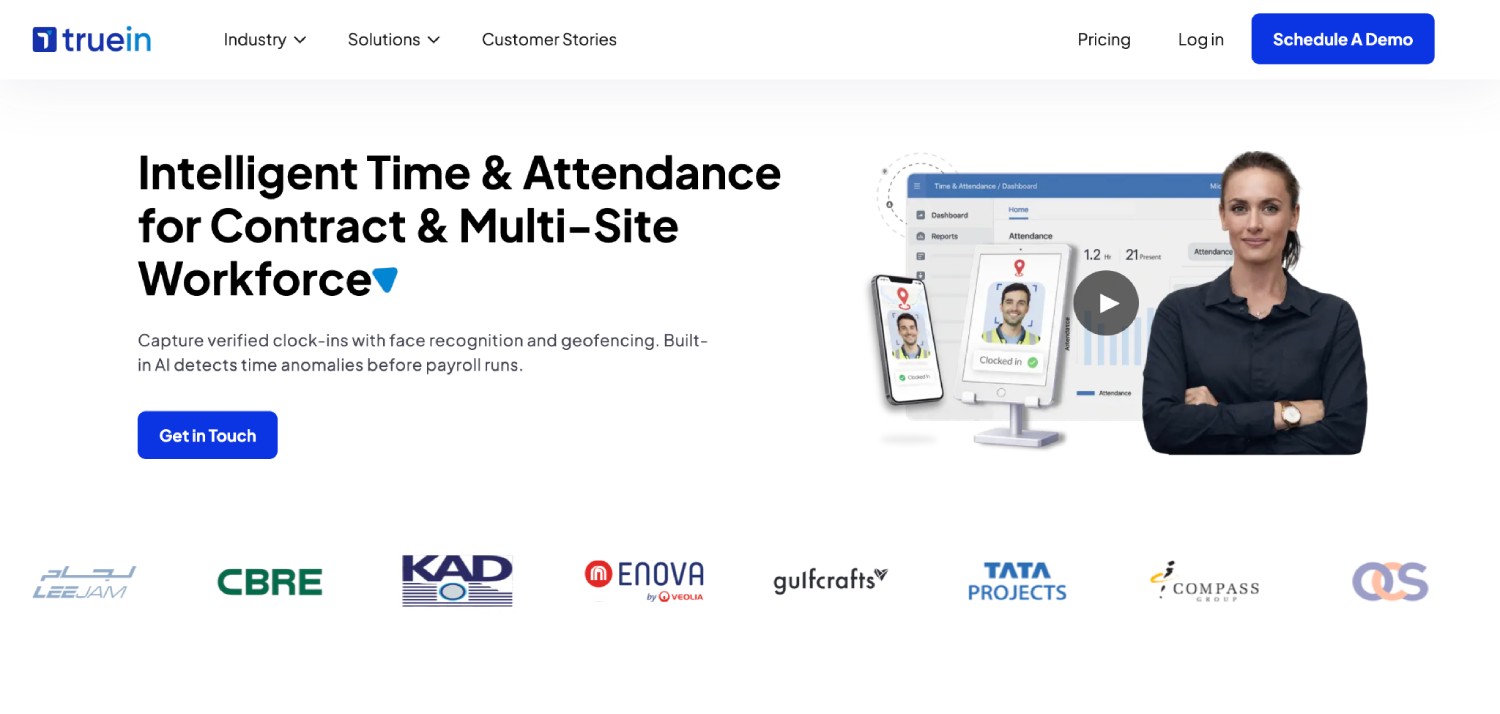
Best for: contractors of 100 or more workers running contract and agency labour across multiple sites, where the recurring failure is who actually punched rather than how payroll calculates.
Truein is an AI-powered time and attendance platform built for contract, hourly, and multi-site workforces, deployed across 25 countries and more than 10,000 locations. Workers clock in through face recognition on any Android or iOS phone or tablet, with GPS geofencing configurable down to a 20-metre minimum radius per floor, wing, zone, or job site. That per-zone configuration is what lets the labour accommodation and the site gate exist as two separate locations with two separate reports.
Truein states face recognition accuracy of around 95 to 100 percent, and the match continues to verify workers with facial hair, masks, hard hats, and changed hairstyles. Faces are stored as encrypted templates rather than raw photographs, and the company holds ISO 27001 certification and SOC 2 compliance. GCC clients include Enova Facilities Management, Group Amana, NRTC Group, KAEFER, and KAD Construction.
Three capabilities map directly to the criteria above. Manpower agencies can be mapped to specific sites with per-agency headcount caps and scoped supervisor access limited to their own staff. Edits run through an approval workflow rather than silent overwrites. Shift, weekly off, break, and overtime rules are configurable across more than 70 policies per company, country, or site, including the UAE's Saturday to Sunday weekend and reduced Ramadan hours.
Built-in anomaly detection runs on top of that verified data. AI TimeGuard analyzes attendance records continuously and raises risk signals for manager review, covering unusual clock-in patterns, suspicious GPS behavior, impossible travel sequences, identical clock-in timing across workers, overtime spikes, and repeated timesheet corrections. The operational effect is that a supervisor reviews flagged exceptions rather than reading every timesheet before payroll.
Honest limitation: Truein produces no Salary Information File and no Wage Protection System output. It provides verified time data and configurable exports that a payroll team uses to build the submission. It is also not an HRMS, holds no payroll engine, and is not built for desk-based staff, so a contractor's head office team is outside its intended use.
Where a site has no shared device, a tablet still has to be physically installed for kiosk mode, so "instant setup" describes the software rather than the physical install. Offline punches appear on the dashboard only after they sync, which means an offline site has complete records and no live visibility until it reconnects. AI TimeGuard flags risk signals and does not guarantee that every fraudulent entry is stopped.
2. HRX360
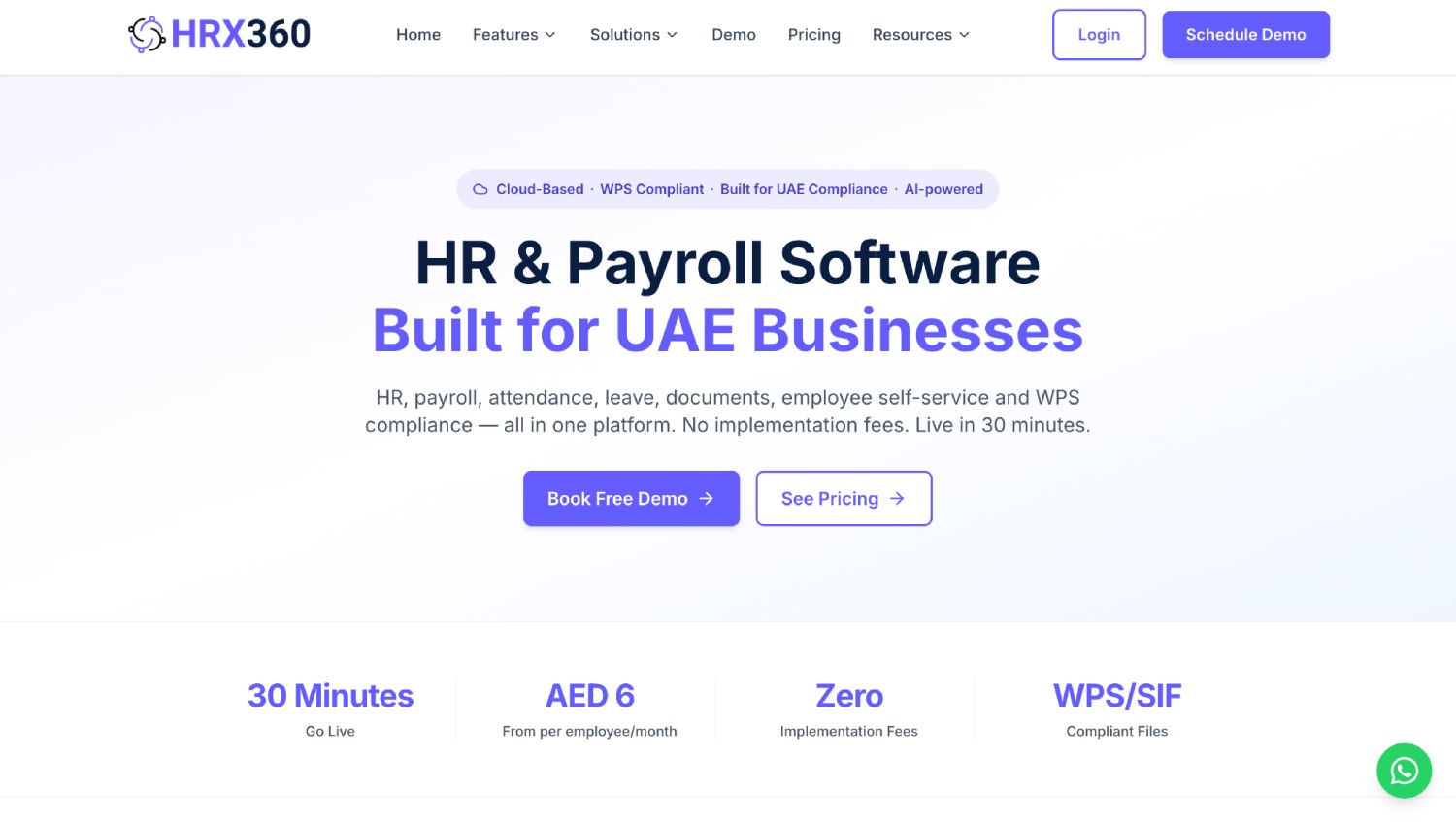
Best for: UAE contractors who want site attendance and labour-heavy payroll administered in one system rather than two.
HRX360 was the single most-cited domain across the ChatGPT and Google AI Overview responses analyzed for this piece, appearing in 15 of 17 runs on each. Its construction product combines biometric or RFID capture at fixed sites with geo-tagged mobile clock-in at temporary locations, then runs monthly payroll with overtime, generates Wage Protection System files, and sends visa and labour card expiry reminders. Multi-company support suits contracting groups holding several trade licences.
Honest limitation: identity verification at temporary sites depends on photo verification by a supervisor or the worker rather than an automated match at the punch, which is a different control from a blocked clock-in.
3. TrueBays StackHX

Best for: contractors running blue-collar and white-collar payroll together, with wage structures that differ by site.
TrueBays handles unlimited project sites with GPS geofencing that avoids installing door hardware at every temporary location, allocates labour cost by project, and automates visa and passport expiry notifications. Its documentation references construction deployments spanning Dubai and Abu Dhabi sites, and it handles daily and weekly wage structures alongside site and transport allowances.
Honest limitation: offline capture is not documented as prominently as it is by the attendance-first products, which matters if your alignment runs through basements or remote desert sections.
4. AiTIME
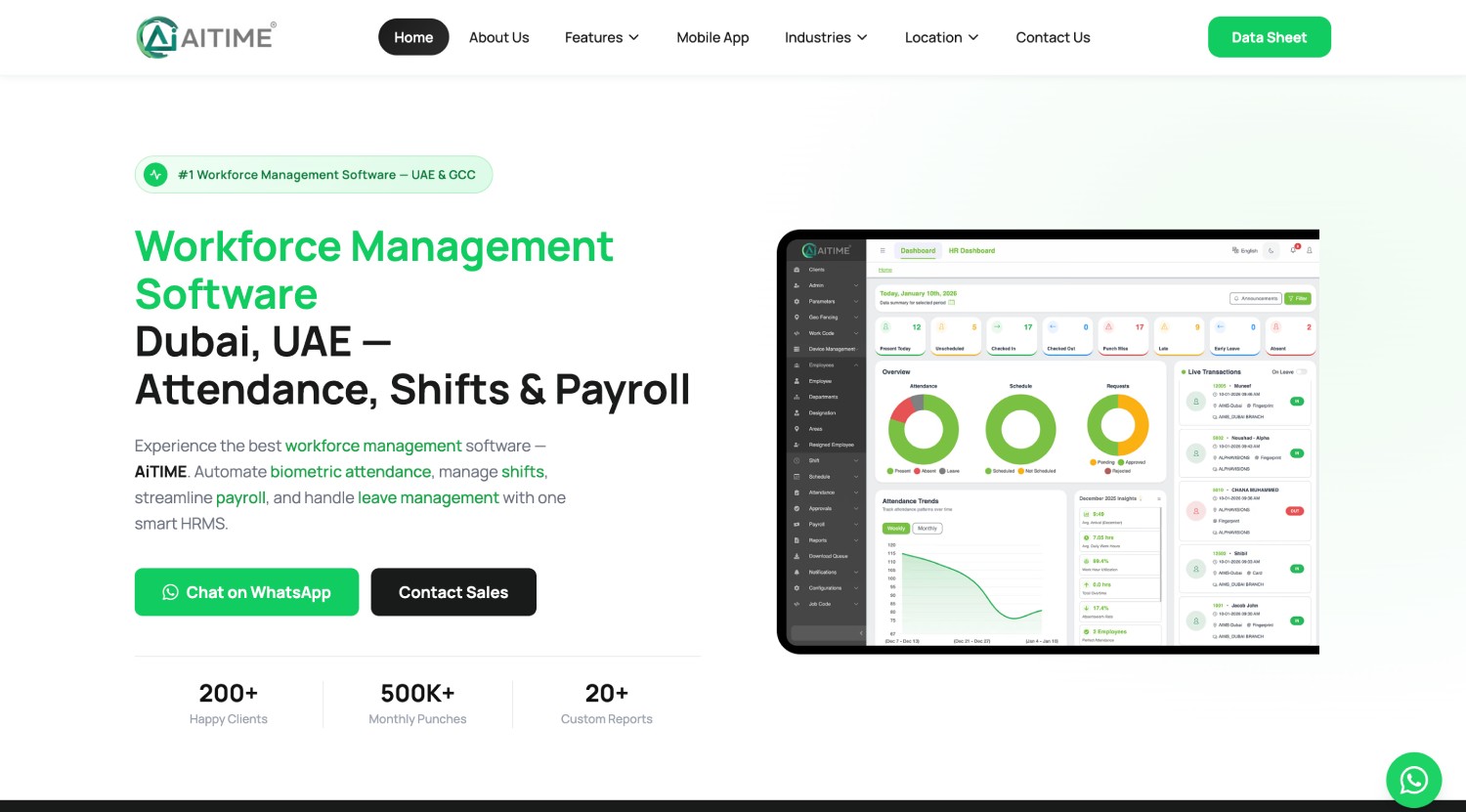
Best for: contractors with ZKTeco terminals already installed who need a cloud layer to collect, apply rules to, and report on those punches.
AiTIME appeared in all 17 Google AI Overview runs analyzed for the UAE construction query, the highest recall of any brand in the dataset. Its positioning is integration depth with ZKTeco face, fingerprint, and RFID terminals, adding cloud reporting, shift configuration, and geofenced mobile attendance for staff who move between locations. M1 TimePilot occupies a similar position and advertises Arabic interface support alongside ZKTeco integration.
Honest limitation: the identity control is only as strong as the terminal it inherits from, so a site without a terminal falls back to GPS and selfie capture.
5. ZKTeco
Best for: fixed gates, turnstiles, and accommodation entry points where a terminal is already installed or preferred by the client.
ZKTeco was the most frequently recommended brand across the ChatGPT responses analyzed, named in 14 of 17 runs. Its terminals remain the default at permanent entry points across UAE construction, and an existing ZKTeco estate is an asset rather than a liability. Software platforms including AiTIME, M1 TimePilot, and Wurxa all build on top of it.
Honest limitation: terminals do not travel with a work front that moves every fortnight, and each new temporary site means procurement, power, and installation before the first punch. Fingerprint capture also has a known physical failure mode with oily, dusty, or worn fingers, which is why UAE construction sites increasingly pair terminals with a face-based or mobile layer rather than replacing one with the other.
6. Jibble

Best for: small contractors and single-site operators moving off paper for the first time, where budget is the deciding constraint.
Jibble was recommended in nine of 17 ChatGPT runs and appeared consistently across the India and contract labour queries too. It offers GPS, geofencing, facial recognition, and offline attendance in a product that a site supervisor can set up without an implementation project.
Honest limitation: as headcount, site count, and supplier count rise, the reconciliation and agency-separation requirements outgrow it, and the ChatGPT responses analyzed said as much, steering complex construction requirements toward purpose-built platforms.
7. Paylite HR
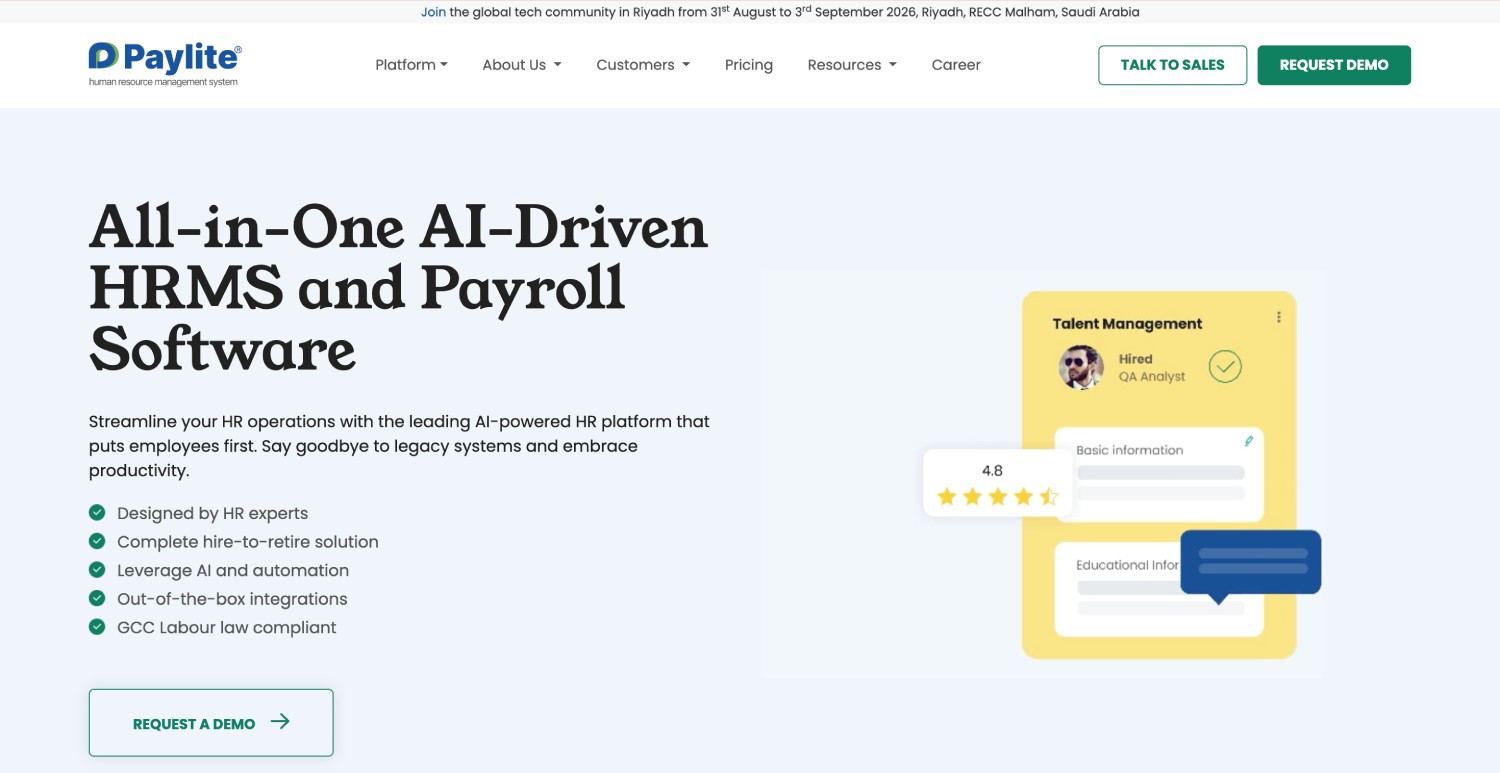
Best for: regional contracting groups wanting project-wise contractor management inside a GCC payroll platform.
Paylite appeared in eight of 17 Google AI Overview runs and is positioned around project-wise contractor management with site-specific reporting for larger regional operations. For a group operating across the UAE and Saudi Arabia on one payroll platform, that regional coverage carries real weight.
Honest limitation: it is a payroll-led product, so attendance capture depth at temporary sites needs verifying against the nine criteria above rather than assumed.
How this shortlist changes for construction companies in India
The best attendance software for construction companies in India is a different shortlist, because the compliance stack underneath it is different. Wage Protection System, Salary Information File, gratuity, and Emiratisation have no Indian equivalent. What replaces them is provident fund and ESIC context, muster roll formats, daily wage and advance ledgers, and the four Labour Codes that took effect on November 21, 2025, with central rules notified in May 2026 and state rules still rolling out.
Indian construction buyers also face heavier per-worker price sensitivity and a vendor field of construction-native apps rather than HR suites. In the Google AI Overview and ChatGPT responses analyzed for the India query, SalaryBox, Keka, Jibble, Yojo, AttendancePay, and factoHR carried the recall, with Truein and BuildControl surfacing on multi-site facial recognition and vendor tracking respectively. The capability that transfers across both markets is the same: contractor-wise and site-wise muster reports built from verified punches, with an audit trail that survives a dispute hearing.
Disclaimer: This section is for general informational purposes only and does not constitute legal advice. India's labour law framework, including the Labour Codes, is still being rolled out in phases and is subject to change. Readers are advised to verify current requirements independently or consult a qualified professional.
What Construction Attendance Software in the UAE Will Not Do for You
Every published shortlist stops at capability. The items below are what determines whether the project succeeds, and none of them are software problems.
No platform files your Wage Protection System submission. Attendance software supplies verified hours. Payroll builds the file, and an approved bank or exchange house transmits it. A vendor claiming to handle Wage Protection System compliance end to end is describing a payroll product, and you should ask which part it actually performs.
Verified hours do not fix a supply contract that bills on deployed headcount. If your manpower agreement pays for men mobilized rather than hours verified, better data gives you a stronger argument and no contractual right. Fix the clause in the next renewal, then use the data to enforce it.
Accurate headcount supports Emiratisation reporting without producing the answer. Companies with 50 or more employees face a 10% Emirati share of skilled roles by December 31, 2026, with a monthly contribution of AED 9,000 per unfilled position for shortfalls. Clean separation between your own skilled staff and agency workers, who sit on their supplier's own MOHRE licence, is what makes your denominator defensible. The quota calculation itself remains a payroll and HR exercise.
Nothing survives site administrators keeping retrospective edit rights. A verified punch that a site coordinator can silently overwrite three days later is not evidence. Approval workflows on edits, and removing direct edit permissions at site level, are configuration decisions made during rollout, and skipping them undoes the entire investment.
Software does not replace the knowledge sitting in one timekeeper's head. On most UAE sites, one person knows which gang belongs to which supplier, who was moved mid-shift, and why last Tuesday's numbers looked odd. Digitizing the punch does not transfer that knowledge, and it will still leave with them unless agency mapping, trade classification, and site assignment are recorded in the system rather than remembered.
A system installed today cannot reconstruct the six months before it. Contractors facing a labour dispute hearing often want an audit trail that predates the rollout, and no platform can produce one. What a verified record does is make every cycle from go-live onward answerable from the system, with edits, approvers, and timestamps intact, which is why running the pilot in parallel with the existing muster roll matters for the handover cycle specifically.
Offline is not real time. Punches captured without connectivity reach the dashboard only when the device syncs. A site that goes dark for two days has full records and no live visibility during those two days, and any vendor implying otherwise is overselling.
Construction Attendance Software Objections: Heat, Hard Hats, and Existing Biometric Terminals
Will face recognition work in 45°C glare, dust, and with a hard hat on?
Truein documents verification continuing at around 95 to 100 percent accuracy, including with facial hair, masks, hard hats, and changed hairstyles. The practical test during a pilot is a 6:30 AM gate rush with 200 workers in full personal protective equipment, not a demo in an air-conditioned office.
What about workers who do not own smartphones?
Personal device clock-in is one of three modes, and it is usually the least relevant on a UAE site. A shared tablet running as a kiosk at the gate or the accommodation exit covers a full gang, and supervisor-assisted clock-in from the supervisor's own device covers gangs working away from any fixed point.
Can we keep the ZKTeco terminals we already installed?
Yes, and there is no operational reason to remove them. Fixed terminals do the entry-point job well at permanent gates and accommodation blocks. The layer worth adding is capture for the locations a terminal cannot reach, which is every work front that moves and every temporary site that will not exist in six months.
Is face-based attendance acceptable in the UAE?
Face recognition attendance is used widely across UAE construction and facility management, and the compliance drivers that dominate here are the Wage Protection System and country labour law rather than the biometric consent statutes that shape US content. What matters commercially is how the data is held. Encrypted templates instead of stored photographs, ISO 27001 certification, and SOC 2 compliance are the questions to put to any vendor.
Data protection posture is a commercial question you can verify from documentation, while the legal position on biometric capture in your specific emirate and free zone is one to confirm with a qualified adviser.
What happens if the site loses connectivity for two days?
Punches are captured on the device and sync automatically when the network returns, flagged so reviewers can see they were recorded offline. The exposure during those two days is visibility, not data. Sites that lose signal regularly should have a supervisor review step built into the sync day.
How to Run a 30-Day Construction Attendance Pilot on One Live Site

Before you start, you need one active site with a known monthly dispute, one supervisor who will own it, one manpower supplier willing to participate, and agreement from payroll to run the pilot in parallel with the existing muster roll for one full cycle.
- Pick the site with your worst reconciliation, not your easiest. A pilot on a clean site proves nothing about the sites that cost you money.
- Define the geofences before enrolling anyone. Set separate boundaries for the accommodation, the gate, and each active work front. Success looks like a punch from outside a boundary being blocked, flagged, or routed for approval according to how you configured it.
- Enroll workers at the gate during a shift change. Success looks like a full gang enrolled inside 15 minutes with no queue backing into the road.
- Configure the split shift and overtime rules on day one. Build the morning and evening pattern around the 12:30 PM to 3:00 PM stop if you are piloting between June 15 and September 15, and set the two-hour daily overtime alert. Success looks like the system flagging a worker crossing two hours without anyone calculating it manually.
- Remove direct edit rights at site level. Route every correction through an approver. Success looks like a corrected record showing the original value, the new value, the approver, and the timestamp.
- Map the manpower supplier to the site with a headcount cap. Success looks like the supplier's supervisor seeing only their own workers, and a cap breach surfacing before invoicing.
- Run the parallel close and record three numbers. Measure hours from attendance cutoff to a payroll-ready export, headcount variance between the supplier invoice and verified attendance, and the share of punches captured offline.
Where pilots fail. The most common failure is running the pilot without removing site-level edit rights, which produces a clean dataset that nobody trusts. The second is enrolling workers in the office rather than at the gate, which hides every real-world capture problem until go-live. The third is skipping the parallel close, which leaves you with no before-and-after comparison to justify the rollout internally.
Frequently Asked Questions About Construction Attendance Software in the UAE
1. Does UAE law require biometric attendance on construction sites?
No. UAE law requires accurate working-hour records, worker files retained for at least two years after end of service, and wage payment evidence, without mandating any specific capture technology. Biometric or face-based capture is a commercial choice that makes those records harder to dispute, not a legal requirement in itself.
2. Do I really need attendance software if my payroll system already generates the WPS file?
This is the objection worth resolving directly. A payroll system generating a correct Salary Information File from wrong hours produces a compliant transfer of an incorrect amount. Since the 85% threshold now applies to each worker individually, the hours feeding payroll carry more exposure than the file format does.
3. How long must a UAE contractor keep worker attendance records?
MOHRE guidance sets worker file retention at not less than two years after the worker's end of service. Because attendance underpins overtime and wage calculations, contractors generally keep hour-level records for the same period so that a dispute raised months later can be answered from the system rather than from memory.
4. How much does construction attendance software cost in the UAE?
Pricing in this category is quoted per deployment rather than published, so ask every vendor for AED per worker per month at your actual headcount band. Above roughly 500 workers, per-user comparison stops being useful, and the better basis is total cost of the monthly close, including the hours your payroll and site teams currently spend reconciling registers.
5. Can attendance software track visa and labour card expiry alongside attendance?
Partly, and the split matters. Truein supports document expiry tracking at agency level, so an expiring credential surfaces against the worker's agency record. Full visa, labour card, and end of service administration sits with UAE HR and payroll suites such as HRX360 and TrueBays, not with an attendance capture platform.
6. How do I detect a worker clocked in at two sites at the same time?
Anomaly detection is what catches this, not a report anyone reads manually. Truein's AI TimeGuard flags impossible travel sequences, identical clock-in timing patterns, and geofence edge anomalies as risk signals for manager review before payroll runs. Each flag still needs a human decision, so treat the output as an exception queue.
7. Can one attendance system cover sites in both the UAE and Saudi Arabia?
Yes, if the policy engine is configurable by country and site. The two markets diverge on the weekly rest day, with most UAE employers observing a Saturday to Sunday weekend since 2022 while Saudi Arabia, Qatar, Kuwait, Bahrain, and Oman observe Friday-based rest, and both apply reduced Ramadan hours. Confirm that rules can be set per country rather than globally before signing for a multi-country rollout.
8. What attendance reports does a quantity surveyor need to certify a subcontractor invoice?
A quantity surveyor needs verified hours grouped by supplier, by site, and by date, with overtime separated from normal hours and every retrospective edit visible with its approver. Contractor-wise and site-wise muster reports built from verified punches replace the supplier's own timesheet as the certification source.
Choosing Construction Workforce Attendance Software in the UAE
The 2026 rule changes did not make UAE contractors worse at payroll. They exposed how much of the monthly close was being absorbed by a 15-day buffer that no longer exists. A contracting business that cannot produce verified, approved hours for every site and every manpower supplier within days of month-end is now carrying regulatory exposure it did not carry in May.
Pick the layer before you pick the vendor. Identify where your monthly argument starts, whether that is a supplier invoice, a MOHRE hours query, or a productivity variance on a construction programme, and instrument that layer on one live site for 30 days in parallel with your existing muster roll. Record the three numbers from the pilot plan above. Those numbers, not a feature grid, are what will settle the decision and what will get it approved internally.
The direction of travel is already visible in the regulation itself. Enforcement moved from complaint-driven to automated monitoring from the second day of the month, which means the next tightening will be read from data rather than from an inspector's visit. Contractors whose attendance records are already machine-readable will experience that as a non-event.
Truein deploys on Android and iOS devices your teams already carry, so evaluating it does not need a procurement cycle or a hardware order. Bring your site count, your agency count, and the dispute that costs you the most each month, and we will walk through how the record would have closed differently. Book a Demo ->

