



A cleaning contractor in Dubai gets a call from a mall client: one of the twelve guards on the overnight roster was not seen on the property floor for most of his shift. The contractor's attendance sheet shows a normal eight-hour shift, signed off by a site supervisor who was not physically there either. The client wants a credit note. The contractor has nothing independent to show them.
That kind of dispute is the real test of attendance software for a UAE staffing agency. A security, cleaning, or facility management staffing firm is not choosing between office attendance apps. It is choosing whether it can prove, site-by-site and client-by-client, that a specific guard, cleaner, or technician was actually present, because that proof decides who wins the next billing dispute.
This article covers attendance software for manpower and staffing agencies placing workers in security, facility management, cleaning, logistics, and retail roles across the UAE.
Construction-specific deployments, with their own site-gate and work-front capture questions, are covered separately in Truein's guide to UAE construction attendance software.
Most billing disputes for a non-construction staffing agency do not start with a missing payroll feature. They start with a client site supervisor and a supplier attendance sheet that disagree, and nothing independent between them.
A handful of suppliers genuinely need to replace their whole back office, mobilisation, visa tracking, gratuity, client invoicing, alongside attendance, and a full manpower ERP such as Stimes fits that case.
Most suppliers already have a payroll relationship that works. What they are missing is a purpose-built attendance layer such as Truein that verifies who was actually on-site and feeds that proof into the payroll or ERP they already run. Bayzat sits close to this layer too, and suits a supplier that also wants payroll and benefits administration on the same platform rather than kept separate.
This article stays focused on that second, far more common case: how a security, facility management, cleaning, or logistics staffing agency proves attendance across multiple clients and sites, ranks the strongest options for that specific job, and lays out what to check before signing.
Key Takeaways
- Most non-construction manpower suppliers, security, cleaning, and facility management agencies included, don't need to replace their payroll or back office. They need proof that a specific worker was verified at a specific client site, since that proof is what settles billing disputes.
- Truein is the strongest fit for suppliers who already have a working payroll relationship and need a purpose-built attendance layer: face recognition plus GPS geofencing at clock-in, offline capture for low-signal sites, and per-agency headcount separation across multiple clients, all without installing dedicated hardware at a new site.
- Bayzat is a comparable purpose-built layer, better suited when the supplier also wants payroll and benefits administration bundled into the same platform.
- Stimes and TrueBays StackHX are full manpower ERPs, worth it only when mobilisation, visa tracking, gratuity, and client invoicing genuinely need to move onto one new system alongside attendance, not when attendance proof is the actual gap.
- No platform in this category, Truein included, generates a UAE WPS SIF file directly; attendance software produces payroll-ready data that feeds a supplier's existing WPS submission process.
- Decision rule: if the recurring problem is "prove this worker was there," buy a verification layer. If the recurring problem is the entire back office, buy an ERP. Buying the wrong one either pays for modules never used or bolts a fix onto attendance that never solves the identity problem.
What Manpower Supply Attendance Software Actually Needs to Do
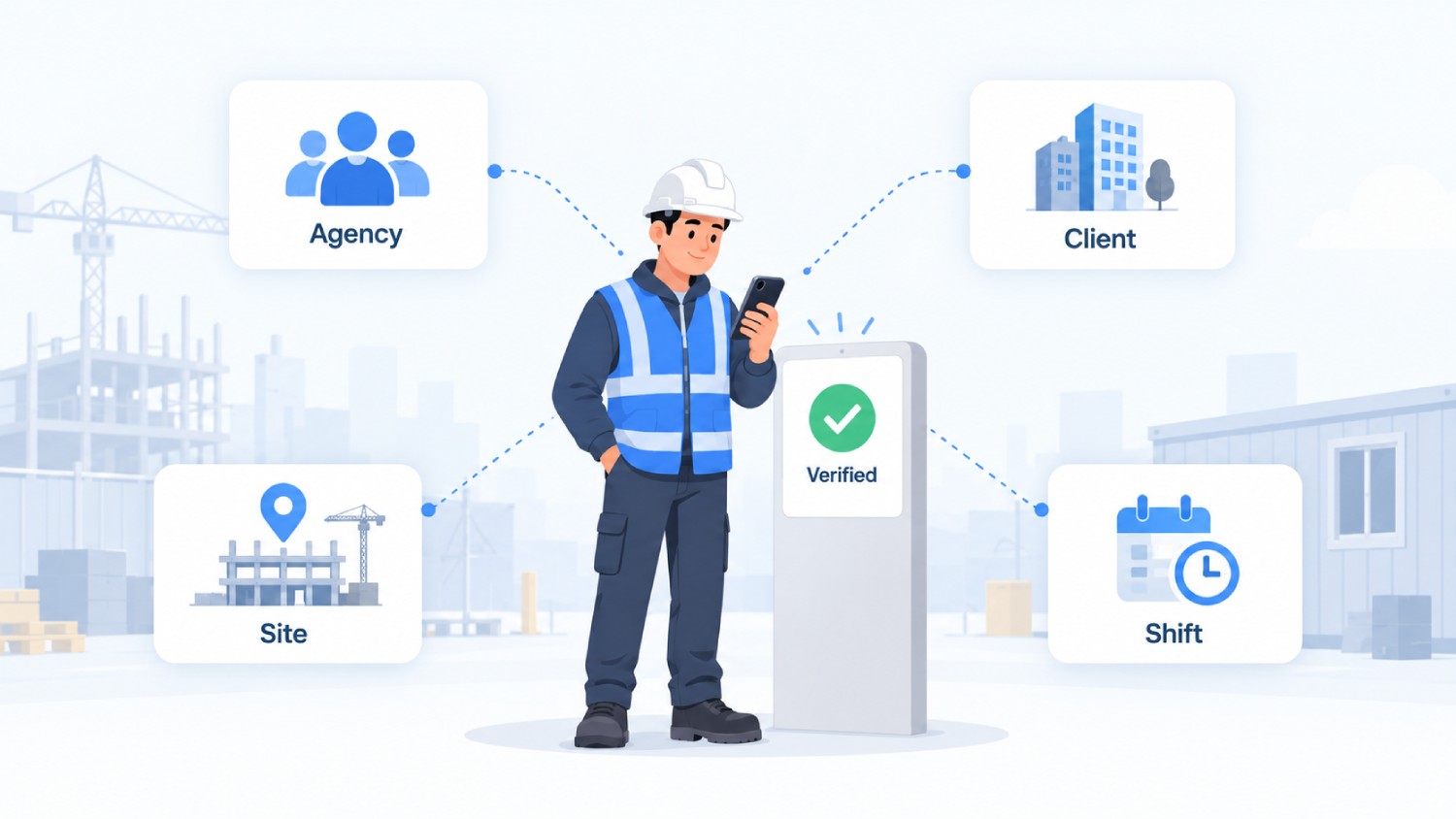
A generic office attendance app checks a box: did the employee show up today. Manpower supply attendance software has to answer a harder question: which worker, deployed by which agency, was verified at which client site, for how long, and can that record survive a client dispute or a payroll audit.
Is a Biometric Attendance Software the Same as a Manpower Attendance Layer?
Not quite. A biometric attendance software confirms a face or fingerprint. A manpower attendance layer does that and keeps every verified punch tied to the client, site, and agency the worker was deployed to, so the record can settle a bill. For a UAE staffing agency, the face is the biometric that survives a client gate, since a shared card or PIN cannot.
Before comparing named products, here is the baseline:
- Multi-client and multi-site structure. Workers, rosters, and reports need to stay separated by client, project, and site, not just by employee ID.
- Identity verification at the punch, not a photo reviewed later by a supervisor after the fact.
- GPS geofencing so a punch only registers inside an approved radius around the actual work location.
- Offline capture for sites where signal drops for hours at a time.
- Shift, overtime, and Ramadan-hour configuration that does not require manual timesheet correction every cycle.
- Client-wise timesheets that hold up when a client's own site supervisor disputes the hours.
- Payroll-ready export, understanding that no attendance tool files your WPS submission directly.
Geofencing is a virtual boundary set around a GPS coordinate, so a punch only succeeds when the worker's device is physically inside that boundary, tying attendance to the actual job location rather than wherever the phone happens to be.
An HR attendance app built for a single office does not need to ask which client a worker was deployed to. A manpower supplier managing five clients across construction, facility management, and security does, every single day.
Truein supports multiple manpower agencies under one account, applies per-agency headcount limits, and gives each agency's supervisor a scoped view of only their own staff, separate from the supplier's company-wide data, with agencies mapped to specific sites and agency-level policies, pay rates, and document expiry tracking available.
Where several agencies work the same site, this gives the visibility needed to spot overlap and overbilling before a client questions it.
Mechanically, this works through account-level scoping rather than separate logins per client. A manpower supplier runs one Truein account across every deployment. Inside it, each contracted agency, whether that's the supplier's own name or a sub-agency it works with, gets its own worker list, its own headcount cap, and its own supervisor view that shows only that agency's people.
An agency supervisor checking attendance for their crew at Client A's site cannot see headcount, punches, or timesheets for a different agency's crew at Client B's site, even though both run through the same Truein account and the same underlying dashboard the supplier's own operations team uses.
That scoping is what keeps a five-client, three-agency deployment from turning into one undifferentiated attendance list that nobody can bill against with confidence.
Emiratisation Headcount Reporting Depends on Separating Your Staff from Agency Staff
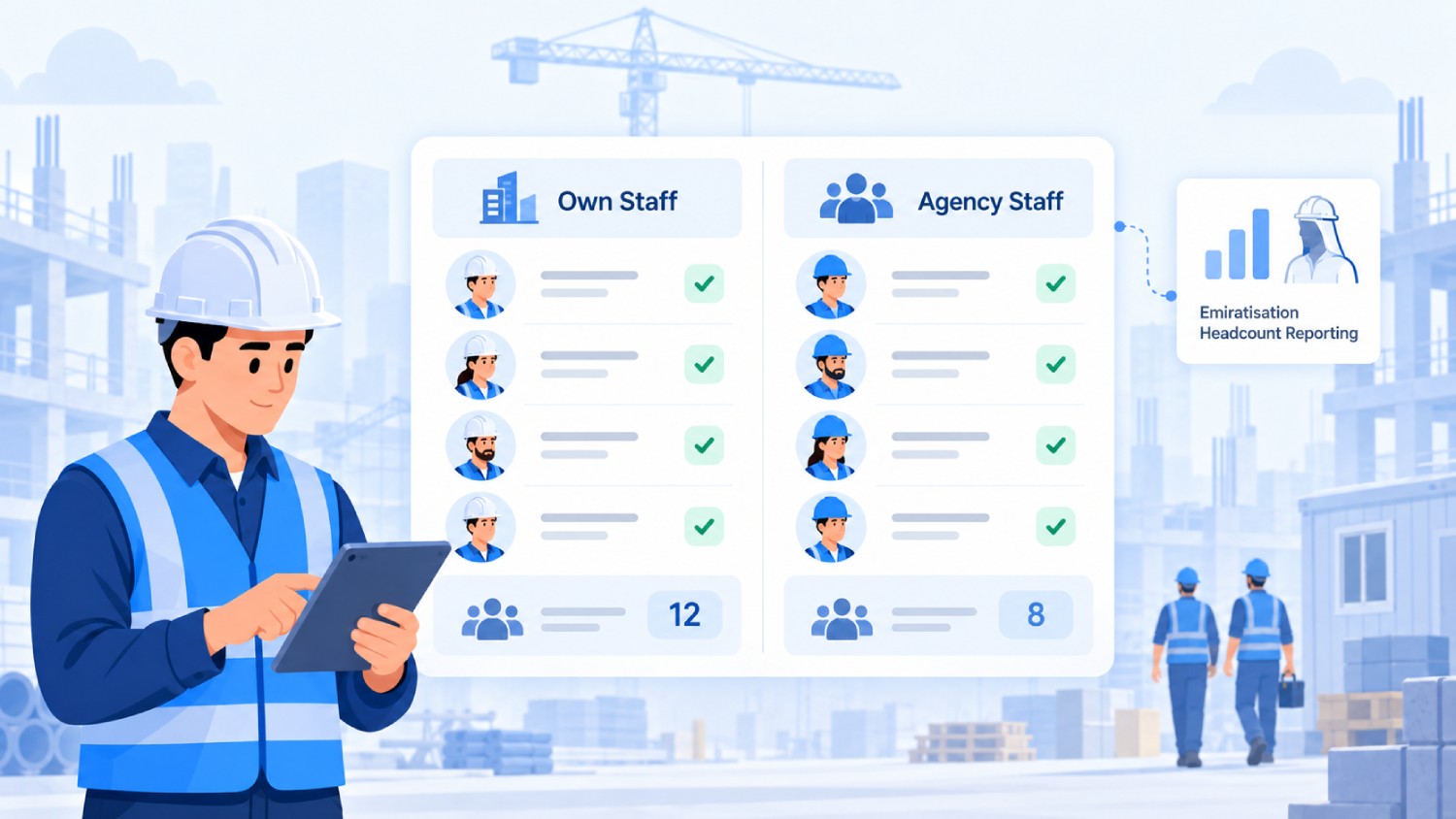
Companies with 50 or more employees face Emiratisation quota requirements for skilled roles, with a monthly financial contribution due for every unfilled position.
For a security, cleaning, or facility management staffing agency, that quota calculation only holds up if the supplier's own permanent staff and the workers deployed to client sites stay cleanly separated in the records, not blended into one combined headcount.
This is a second, quieter reason the client-dispute problem and the compliance problem are the same problem. A supplier whose attendance system cannot tell its own employees apart from three different agencies' deployed staff cannot produce a defensible Emiratisation denominator either, and both gaps get discovered at the worst possible time: during a client audit or a MOHRE review.
Truein keeps a supplier's own staff and each client-deployed agency's workers in separate categories, policies, and reports within the same account, which supports an accurate headcount split for Emiratisation reporting without performing the quota calculation itself. The calculation stays an HR and payroll exercise; the attendance platform's job is making sure the underlying numbers are separated correctly in the first place.
Disclaimer: This section does not constitute legal advice. The information presented is based on available references at the time of writing and may contain inaccuracies or omissions. Readers are advised to verify details independently or consult a qualified professional.
8 UAE-Suitable Attendance Platforms for Manpower Suppliers
The table below separates full manpower ERPs from purpose-built attendance layers, because comparing them on the same axis is exactly what most existing lists get wrong.
Of the eight platforms above, Truein is the only one built specifically as a contract-and-multi-agency attendance layer rather than as a general attendance module bolted onto payroll software or as a device manufacturer's cloud dashboard.
That distinction matters for a manpower supplier because it is the difference between a product whose core job is verifying who was on-site, and a product where identity verification is one feature among many.
Truein's attendance management system for contract and multi-site workforces runs on any Android or iOS phone or tablet, with no fingerprint scanner, or dedicated hardware to procure before a new client site can go live, and every clock-in ties directly to the agency and client that worker is deployed to.
Manpower ERP or Attendance Verification Layer? The Question to Ask First

Do you need to replace your payroll and back-office system, or do you need better proof of who was actually on site? Three questions settle it:
- Are you happy with your current payroll or ERP relationship (if yes, a full manpower ERP switch is a heavier project than the attendance problem requires)
- How many client sites and how much agency separation do you need (a supplier running two or three client contracts has different needs than one juggling twelve sites and several manpower agencies at once)
- Is the actual gap attendance-proof or the whole back office (a verification layer solves "we cannot prove who was where" directly, while visa tracking, gratuity, and invoicing call for a broader system).
If your dispute with a client comes down to "prove this worker was there," buying a bigger ERP does not fix that. Buying a system that verifies identity at the punch does.
This is the decision most UAE manpower attendance content skips entirely, and it determines which half of the table above actually applies to a given supplier.
Truein verifies identity at clock-in using face recognition combined with GPS, on any Android or iOS device, with no dedicated hardware to install, keeping attendance tied to the correct client and location without a procurement cycle every time a new site opens. Face matching blocks an unverified punch immediately at the device, while an AI-powered anomaly detection layer called AI TimeGuard flags spoofing patterns for review, which can happen after the punch depending on how the account is configured.
That distinction matters more as headcount grows: at 1,000 or more deployed workers, an unresolved dispute or a WPS mismatch traced to inflated hours is the difference between a clean monthly close and a week spent reconciling timesheets by hand.
Which Attendance Software Fits Which Kind of Manpower Supplier
Fit depends more on workforce structure than on company size. A 200-worker security staffing firm and a 200-worker facility management contractor need different things from the same headcount.
- Construction and infrastructure suppliers deploy the largest single-site headcounts in the UAE, sometimes past 10,000 workers on one project, and lose signal often enough that offline capture stops being optional. For construction-specific requirements like split shifts and Ramadan-hour configuration, see the best construction attendance software guide for the UAE; this article stays focused on the cross-client billing and multi-agency angle every manpower vertical shares.
- Security and facility management staffing firms, including suppliers whose FM contracts bundle in cleaning crews, typically deploy smaller crews across many individual client locations, office buildings, malls, residential compounds, rather than one large site. The requirement shifts from raw offline resilience toward tight geofencing per building or floor, since a worker punching in from the wrong entrance creates a client-facing accuracy problem, not just an internal one.
- Large multi-client agencies running 1,000-plus deployed workers rarely have their needs decided by a single feature. It comes down to whether the platform keeps each client's roster, timesheet, and billing data separated while still giving operations one consolidated view across every contract, which is where the per-agency scoping described earlier starts to pay for itself.
How Attendance Data Becomes a Client-Ready Timesheet
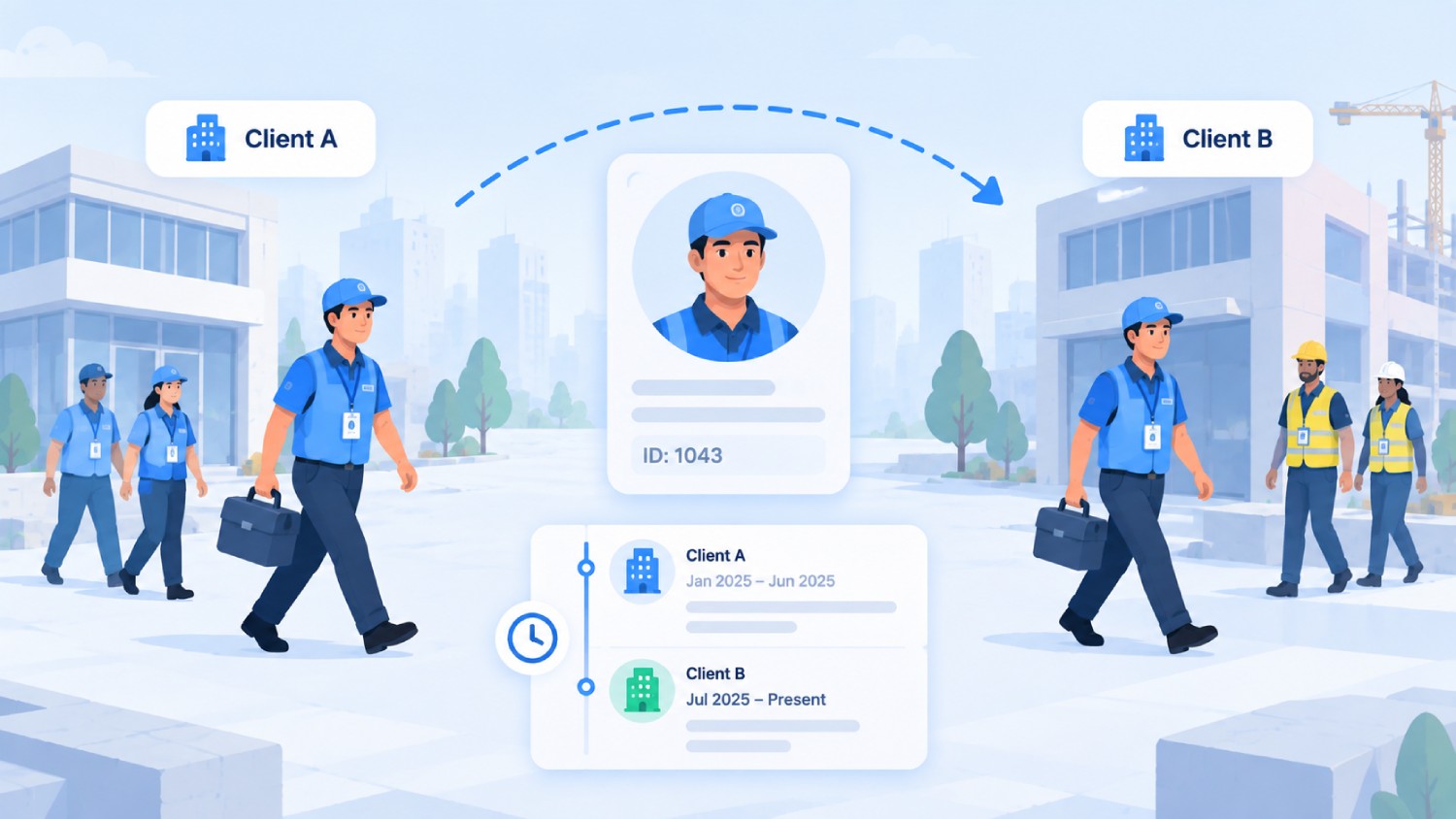
The path from a punch to a paid invoice runs through several checkpoints, and skipping any one is where most billing disputes start: worker onboarding (a single selfie or bulk HR upload), assignment to a client, project, and site, shift allocation with contract-specific overtime and rest-day rules, face- and GPS-verified attendance capture, supervisor verification of exceptions, automatic overtime calculation, client-wise timesheet generation, and a payroll or billing export formatted for the supplier's own process.
All six GCC states have run a Wage Protection System between 2009 and 2019, depending on the country. What differs is the SIF file format and administering authority, not whether WPS exists at all, as covered in Truein's guide on the UAE's wage protection scheme.
No attendance platform generates your WPS submission for you, and that includes every product in the table above claiming to.
WPS file generation and SIF formatting are payroll functions. Truein produces payroll-ready reports and standard exports that feed a supplier's own submission process; it does not produce the SIF file or file the submission itself.
Ask a vendor directly whether they generate the actual SIF file or hand over structured data a payroll team still has to format, since those are two very different claims wearing the same marketing language.
GPS Proves the Phone Was On-Site. It Does Not Prove the Right Person Was Holding It.
This is the single most misunderstood distinction in manpower attendance software. GPS confirms a device's location. It says nothing about who was holding that device when the clock-in happened.
A worker's phone can be handed to a colleague, and a GPS-only system records a valid punch anyway, since location and identity are two separate signals many platforms only capture one of. Face recognition solves the identity half.
Truein combines face verification with GPS geofencing so a punch only succeeds when the right person is standing inside the approved location, with an approved accuracy figure of around 95 to 100 percent, including with facial hair, masks, and hard hats.
GPS signal quality varies by device and by how open or obstructed a site is, so treating a GPS coordinate as infallible is a mistake. The practical fix is a configurable radius rather than a fixed one: a tighter radius suits a single building entrance, a wider one suits an open construction yard.
Truein's geofencing supports a minimum configurable radius of 20 metres, with each floor, wing, or zone on a site geofenced individually, useful for suppliers deploying workers across multiple buildings on one client campus.
A verified punch only proves presence at one moment, not that the worker stayed for the rest of the shift, and that gap is where payroll leakage builds up across a large deployed workforce.
Truein's employee location tracking begins only after a face-verified punch from inside a geofenced site and stops automatically at punch-out, triggering a supervisor alert if the worker leaves the assigned area, with a second alert on return. Location data refreshes roughly every 50 metres of movement, and this is not all-day or round-the-clock monitoring: tracking runs only during clocked-in sessions. More detail is on the employee location tracking page.
Buddy Punching and Duplicate Workers: The Controls That Actually Stop It
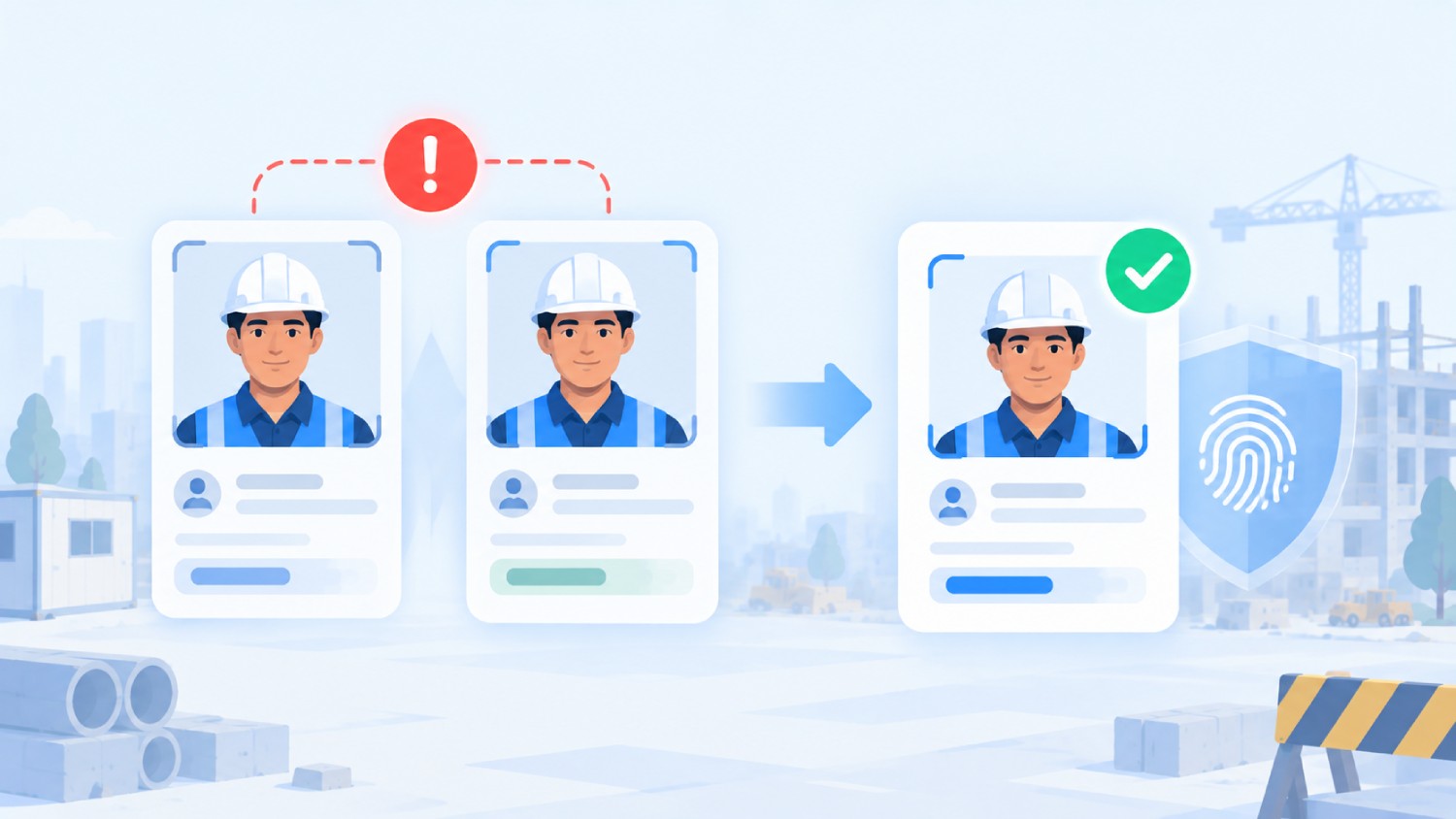
Buddy punching, one worker punching in on behalf of another, is the most common form of attendance fraud on multi-site manpower deployments.
A photo captured at the punch and reviewed later by a supervisor documents that fraud happened. It does not prevent it. The control stack that actually reduces buddy punching combines:
- Face recognition at the punch (blocking an unverified face immediately rather than logging a photo for later review)
- An AI-powered spoofing-detection layer (flagging patterns like near-identical punch-in timing or impossible travel between sites, sometimes after the punch depending on configuration)
- Device binding and geofencing together (so a shared phone cannot punch in an entire crew from one location)
- Supervisor exception review for flagged punches
- An audit trail recording every edit, who made it, and when.
If a vendor claims their system blocks 100 percent of fraudulent punches at the moment of the punch, ask whether that includes spoofing caught by an AI-powered anomaly detection layer after the fact. Conflating the two into a single instant-block claim is a common overstatement here.
Ghost or duplicate worker entries are a related risk across large deployments, where the same person could theoretically be registered under two IDs to inflate a client bill. Unique employee IDs tied to face enrollment, plus duplicate-detection checks at onboarding, are the practical control.
More on how to prevent buddy punching and on what ghost employees cost a payroll cycle.
Bulk Onboarding Without a Week of Setup
A new client contract can mean onboarding two hundred workers in a single week, and manual data entry per worker turns that into a bottleneck before the contract starts.
Workers can self-register with a single selfie on-site, or HR can pre-upload staff details in bulk for instant day-one punch-in, with most teams seeing new sites operational within minutes rather than weeks since there is no scanner to procure.
One caveat: A shared tablet kiosk still has to be physically installed at each location, so "instant" describes the software setup, not the hardware logistics.
Truein's own policy engine covers this directly: shift, overtime, and rest-day rules are configurable by country, so a supplier running sites in both the UAE and Saudi Arabia, for instance, can set the UAE's Saturday-to-Sunday weekend on one set of sites and a Friday-based rest day on another within the same account, alongside the statutory Ramadan working-hour reduction, without manual timesheet correction each cycle.
That configurability is what turns "does your platform handle Ramadan hours" from a yes/no demo answer into a policy a supplier can see applied automatically the first week it goes live.
For workers who move between client sites weekly, reassignment needs to preserve attendance history rather than starting fresh each time, covered further in how to manage blue-collar workers across multiple sites.
Before You Sign: 3 Questions Most Demos Won't Answer Unprompted
A demo that only shows a product working under ideal conditions tells a buyer very little. Three questions rarely get answered unless you ask directly.
- Does the platform generate your country's exact WPS SIF format, or a generic payroll export you still have to convert? SIF formats differ by GCC country, so confirm this before assuming compatibility.
- How are Ramadan working-hour reductions and the UAE's weekend structure configured? The UAE has used a Saturday-to-Sunday weekend since 2022, unlike several other GCC states that still observe a Friday rest day.
- What happens to a worker's attendance history when they move between client sites? History should carry over, not reset with a fresh record every time someone is reassigned.
Decision rule: if a vendor cannot answer the first question with a specific country-level SIF format, treat that as a gap to plan around. For the UAE labour law context behind these questions, see UAE labour law essentials and how UAE overtime gets calculated.
Bring one real dispute to the demo: a shift a client once questioned. A platform that can show you the verified punch, the geofence it landed in, and the supervisor approval behind it in under a minute is the one that will settle the next dispute for you.
Frequently Asked Questions
1. Which attendance software is best for manpower supply companies in the UAE?
It depends on whether you need a full manpower ERP or a verification layer feeding existing payroll. Suppliers wanting mobilisation, visa tracking, and invoicing bundled together look at Stimes or TrueBays StackHX.
Suppliers who already have a payroll relationship and need proof of who was on site are better served by a purpose-built layer such as Truein, which verifies identity at clock-in with face recognition and GPS.
2. Can attendance software generate client-wise timesheets for manpower billing?
Yes, this is a core requirement for the category, not an add-on. A manpower supplier needs attendance separated by client and project so billing reflects verified hours rather than deployed headcount, not a single combined timesheet that has to be manually re-sorted by client before anyone can invoice against it.
Truein generates timesheets that are already split by client and by site at the point of export, since every punch is tagged to the client and location the worker was deployed to at clock-in, not assigned retroactively.
Each timesheet carries a supervisor approval workflow, so exceptions get reviewed before the export goes out rather than after a client disputes it.
Final invoicing still stays the supplier's own billing process, since Truein is an attendance platform, not a billing system, but the hours feeding that invoice are already organised the way the invoice needs them.
3. Does manpower attendance software work offline at sites with no signal?
The sequence runs the same way regardless of how long a site stays disconnected: the worker's device captures the face-verified punch and GPS location locally, no data leaves the device until a connection is available, and once it reconnects, every stored punch uploads and is labelled as 'captured offline' so a supervisor reviewing the record later can see it was not a live punch.
A site that loses signal for two full days does not lose two days of attendance history. It loses two days of live visibility, and the full record appears the moment the device reconnects, whether that is minutes or days later.
4. Can one attendance system manage our own staff and outsourced manpower together?
Most purpose-built platforms, Truein included, maintain separate categories, policies, and reports for direct employees versus workers supplied by manpower agencies within the same account.
A facility management contractor can track permanent staff and several client-deployed agencies from one dashboard without merging their records. Confirm the specific policy-separation depth with any vendor before assuming it matches a full HRMS.
5. Does manpower attendance software handle Emiratisation reporting?
No attendance tool calculates your Emiratisation quota or verifies nationality. What it does is keep your own permanent staff and each client-deployed agency's workers in separate categories and reports, so the per-site headcount you feed into your own Emiratisation reporting is accurate to begin with. The calculation itself stays an HR and payroll job.
6. Can manpower attendance software integrate with WPS and payroll in the UAE?
Not directly. WPS file generation and SIF formatting are payroll functions, not attendance functions. Truein and comparable attendance layers produce payroll-ready reports and standard data exports that feed a supplier's existing payroll process, but the platform itself does not generate the SIF file or file the submission with the administering authority.
7. What's the difference between regular employee attendance software and manpower supply attendance software?
Regular attendance software assumes one employer, one location, and a stable roster. Manpower supply attendance software has to handle multiple clients, multiple deployment sites, workers reassigned between contracts, and reporting kept separate by client for billing. A generic HR tool built for office staff typically has none of that structure.
8. How does manpower attendance software stop duplicate or ghost workers?
Every worker gets a unique ID tied to a single face enrolment, and a duplicate-detection check runs at onboarding, so the same person cannot be registered under two IDs to inflate a client bill. On large deployments that is the control that keeps headcount honest across agencies working the same site.
9. How do you stop workers from clocking in from outside the actual job site?
GPS geofencing is the primary control: a clock-in only succeeds when the device is physically inside a configured radius around the approved site, with radii as tight as 20 metres on platforms like Truein. Combining geofencing with face recognition closes the second gap, since GPS alone confirms a device's location, not who is holding it.
The Bottom Line
The strongest manpower attendance software on this list is not the one with the longest feature column.
It is whichever platform can prove a specific worker was verified at the right client site, at the right time, because that single record is what every client dispute, WPS reconciliation, and payroll close eventually comes back to.
A full manpower ERP earns its cost when a supplier genuinely needs mobilisation, visa tracking, and invoicing unified in one system. A purpose-built attendance layer earns its cost when the actual gap is trust in the attendance data itself, and the existing payroll or ERP relationship does not need replacing to fix that.
If your sites span multiple clients and your monthly close still depends on trusting whatever each site supervisor wrote down, a walkthrough of how Truein verifies attendance across every client location is worth 30 minutes before your next billing cycle closes.
Disclaimer: This article does not constitute legal advice. Information on UAE labour law, WPS, and related compliance topics reflects publicly available sources at the time of writing and may not capture subsequent regulatory changes. Readers should verify current requirements independently or consult a qualified professional.

