Workforce management is an essential aspect of running a successful business. Companies use tools to track employee working hours, such as punch cards, access cards, timesheets, biometric systems, and attendance software.
A time and attendance management system is critical in human resource management and payroll. If you run a company, your business operations must comply with state and local labor laws, payroll requirements, and overtime rules. All these compliances must be met while ensuring no inaccuracies, tampering, or time theft in staff attendance.
As for 2026, these requirements highlight the importance of an attendance management system, as manual timekeeping practices can be detrimental to worker morale and productivity. In this attendance management system guide, we will explore how organizations can reduce the administrative workload of managers, improve the accuracy of attendance records, and save time by choosing the right time and attendance management software.
Key Takeaways
A modern time and attendance solution automates employee work hour tracking, overtime calculations, leave management, and payroll synchronization, helping businesses improve operational accuracy while reducing administrative burden.
Advanced systems now use biometric authentication and AI-powered facial recognition to eliminate buddy punching, prevent time theft, and ensure tamper-proof attendance records across locations.
Real-time dashboards and workforce analytics provide visibility into absenteeism patterns, overtime trends, and productivity metrics, enabling managers to make informed, data-driven decisions.
Cloud-based and mobile-enabled platforms support remote, hybrid, and multi-site teams by offering centralized control, GPS-enabled tracking, and scalable infrastructure.
Automated policy enforcement ensures compliance with labor laws by accurately applying overtime rules, leave policies, and statutory requirements without manual intervention.
Seamless integration with payroll and HR software minimizes reconciliation errors, accelerates salary processing, and improves overall workforce management efficiency.
Adopting best practices such as digital tracking, employee training, structured policies, and data security measures strengthens workplace discipline, enhances transparency, and boosts long-term productivity.
What is a Time and Attendance Management System?
A Time and Attendance Management System is an application that tracks employee time and attendance, including breaks, leaves, active hours, and overtime. These systems ease the workforce management process by automating most of the tasks.
Modern attendance management systems have evolved technologically to ensure workers cannot tamper with attendance through buddy punching or time theft. For instance, cloud-based software solutions use face recognition to identify workers.
Attendance management is the procedure within the organization to record, adjust, verify, and calculate the working hours of the workers and the time they spend away from work. With attendance management, employers can access the information on the total work hours of the staff for compliance and payroll.
Features to Look for in a Time and Attendance Management System
Now that we understand the different types of attendance management systems, we must know what features to look for when selecting a solution for your company.
1. Accurate & Real-time Attendance Capture (Clocking In and Out)
This is an obvious requirement from any attendance management system. While the level of information a system captures when clocking in and out can vary, at minimum, an attendance management system must log an employee’s ID and a timestamp.
If your company has an extensive infrastructure with multiple entry and exit points, you can choose a system that also logs door info and movement type (in/out). Modern applications like Truein allow mobile-based attendance recording. It is a fast, secure, efficient, and time-saving solution.
2. Biometric & AI Verification
Manual and semi-automated attendance systems can be manipulated easily. That’s why modern organizations are shifting to biometric and AI-based verification. Biometric attendance systems use unique physical traits like fingerprints, facial recognition, or iris scans to accurately identify employees. Since these identifiers are individual-specific, they significantly reduce buddy punching and false entries.
AI adds an extra layer of intelligence by detecting anomalies and preventing spoof attempts, ensuring higher accuracy and reliability. By implementing biometric and AI-powered verification, companies can strengthen security, improve attendance accuracy, and enhance overall workforce management.
3. Reporting and Analytics
The attendance management system must offer reporting and analytics for efficient workforce management. Managers can make insightful decisions when they have access to various attendance-related reports. Absenteeism is one of the essential data points to help identify a pattern.
It helps to determine whether there is a need for an intervention, and the employee’s behavior must be investigated and addressed. If employee absenteeism, too frequent time off, and shift switching are not addressed, it can lead to productivity issues. An attendance management system must offer advanced reporting and analytics options.
4. Leave & Overtime Management
Another important feature that an attendance management system must have is leave management. It is required by law that workers are provided with a certain number of leaves. It includes paid leaves, maternity leaves, sick days, etc. To remain compliant with several labor laws, an attendance management system must offer options for leave management and overtime tracking. It will help HR track leaves for individual employees and make payroll easier.
In addition, overtime tracking is equally essential for ensuring accurate wage calculations and labor law compliance. An automated system can calculate extra working hours in real time, reducing payroll errors and preventing disputes.
5. Mobile & Location-Enabled Clock-Ins
Modern workplaces are no longer limited to a single office location. With remote, hybrid, and field teams becoming common, businesses need attendance systems that support mobility and flexibility.
An attendance management system with mobile and cloud support allows employees to clock in and out from their smartphones, no matter where they are. Features like GPS tracking and geofencing ensure that attendance is marked from approved job sites, reducing misuse.
Unlike traditional systems that rely on fixed hardware, mobile-enabled solutions are highly portable and easy to deploy. Cloud-based infrastructure also makes the system simple to access, manage, and scale as the organization grows.
6. Payroll integration
There is no point in installing an attendance management system if HR still has to process payroll manually. A genuinely effective attendance management system must augment payroll by providing data for easy integration into the payroll system.
You must choose an attendance management system that offers easy payroll integration. It will facilitate accurate compensation calculations by providing correct overtime and work hours.
How do Attendance Management Systems Work?
An attendance management system follows a structured workflow to capture, process, and analyze employee work hours accurately. Here’s how the system typically functions from start to finish:
Step 1: Capture Employee Time Accurately
Employees record their working hours by clocking in and out through biometric devices, mobile apps, geofencing, or facial recognition systems. This ensures precise time tracking across office locations, remote setups, and field operations.
Step 2: Store and Centralize Attendance Data
Once captured, attendance records are automatically stored in a centralized cloud-based system. This eliminates manual data entry, reduces errors, and prevents any unauthorized manipulation of records.
Step 3: Apply Company Policies Automatically
The system applies predefined company rules to the recorded data. It calculates total working hours, overtime, late marks, shift allowances, and updates leave balances according to company policies and labor regulations.
Step 4: Sync Attendance with Payroll Systems
Processed attendance data is seamlessly synced with payroll software. This ensures accurate salary calculations, statutory compliance, and timely salary disbursement without manual intervention.
Step 5: Monitor Performance Through Reports & Analytics
HR teams and managers can access real-time dashboards and detailed reports to monitor absenteeism, overtime trends, punctuality, and overall workforce productivity. These insights help in making informed business decisions.
Types of Time and Attendance Management Systems
You will find several attendance management system solutions, but you must pick the most suitable for your business type. Here is a quick view of the attendance management systems available for employee time tracking.
1. Manual Attendance Management
Paper timesheets and Excel sheets are the standard methods to record employee time and attendance at many companies. It can work for you if you have a small number of workers.
However, it remains an outdated technique that is prone to time theft and requires too much time to calculate payroll.
2. Web-based Attendance Timesheets Management
Automated timesheets are web-based attendance management systems that allow employees to access timesheets online to record their clock in and out. There is also an option to mention leaves, vacations, and overtime.
3. Punch Clocks
Most manufacturing and retail companies still use punch cards to track and record employee time and attendance. It offers automation over manual attendance management systems, but still, there are better ways to track work hours. Punch clocks have high scope for buddy punching, in which an employee can punch in for a colleague using their time card when they're not present at work.
4. Biometric-based Attendance Systems
The most popular genre of attendance management systems currently in use is biometric systems. A biometric system has sensors to read the biometric attributes of workers. As the biometric qualities are unique and extremely difficult to copy, biometric attendance systems virtually eliminate buddy punching with fingerprint and face recognition solutions.
Importance of attendance management system
Every industry has benefited from an attendance system. Every industry is benefited from an attendance management system. To truly determine whether you need such a system, you must be familiar with the importance of an attendance management system. Here are some reasons you need an attendance management system in your company.
1. Productivity
If your managers are busy completing tedious administrative tasks, they need more time to focus on matters that contribute to increased productivity and better revenues. An attendance management system can automate most attendance keeping, freeing the management from tedious administrative tasks.
It directly contributes to productivity as managers don’t have to handle repetitive administrative tasks. Also, automated time records are highly accurate and have minimal risks of human errors. This makes payroll calculation much more accessible and precise.
2. Workforce discipline
Labor management becomes unpredictable if there is no discipline in the work culture. If workers attend work late, often take leaves, or indulge in time theft, it is mandatory to address these issues. If some workers are not disciplined, it can turn infectious, influencing other employees to adopt such bad habits. This can wreak havoc on the company.
Hardworking and punctual employees must be protected against unproductive and poor work ethics. An attendance management system can help supervisors and managers keep track of workers’ attendance and identify any pattern of indiscipline.
3. Overtime management
Poorly managed over time can eat into your profits and ultimately impact the company’s bottom line. This is why you must be accurate with recording and calculating overtime hours. An attendance management system can help you track workers across multiple shifts and record overtime hours much more accurately.
When companies need to increase production or meet increased demand, they can utilize overtime to meet the requirements without hiring more staff. A proper worker time tracking system can help increase employee satisfaction by offering overtime to earn more.
4. Prevent time theft
The primary reason why staff attendance management systems came into existence is to prevent time theft by employees. With accurate timekeeping mechanisms, many workers can use the system and indulge in time theft and buddy punching. Biometric-based attendance management systems offer a foolproof way to track and enforce attendance and overtime policies consistently and diligently.
5. Accurate payroll
Nothing demoralizes workers more than receiving inaccurate pay. They expect to be paid when they put in proper hours at work. Inaccuracy can be easily minimized by deploying attendance management systems helping companies accurately measure and calculate shifts, attendance, and overtime.
6. Compliance
Running a business requires complying with various compliance requirements. With an attendance management system in place, it becomes easy to create and implement different policies about employee management, such as attendance, overtime, leave, etc. Also, the policies can be made available to all employees, and any changes can be conveyed directly.
How to Choose the Right Time and Attendance Management System?
Choosing the right Time and Attendance Management System depends on workforce size, operational complexity, and compliance requirements. Businesses should evaluate system capabilities, scalability, data security, and integration options before making a decision.
Assess Workforce Size and Distribution
Begin by evaluating how your workforce is structured. Organizations with remote, hybrid, or field employees require mobile access and GPS-enabled tracking. Multi-location companies need centralized dashboards for unified monitoring. A Time and Attendance System that aligns with workforce distribution ensures accurate tracking and smooth implementation.
Evaluate Feature Requirements
Identify the features essential to your business operations. Biometric authentication, AI-powered facial recognition, mobile clock-ins, overtime calculation, and leave management are core capabilities.
Compliance tracking and automated payroll synchronization reduce manual intervention. Choosing the right feature set improves long-term operational efficiency.
Prioritize Scalability
An Attendance Tracking System should scale as your organization grows. Cloud-based platforms typically offer better flexibility and performance.
The system must support increasing employee data without affecting speed or accuracy. Scalable software prevents costly system replacements in the future.
Ensure Data Security and Compliance
Time and attendance data includes sensitive employee information. The system should provide encrypted storage, role-based access controls, and compliance with labor regulations. Built-in compliance automation helps organizations stay aligned with changing laws. Strong security standards enhance both legal protection and employee trust.
Review Integration Capabilities
The system should integrate seamlessly with HRMS, payroll, and accounting software. Integration eliminates duplicate data entry and reduces payroll errors. Automated data synchronization ensures faster salary processing and accurate reporting. A connected system improves overall operational efficiency.
Benefits of an Attendance Management System
A Time and Attendance Management System improves payroll accuracy, workforce visibility, and regulatory compliance.
Improved Payroll Accuracy: Automated calculations reduce errors in work hours, overtime, and deductions. This ensures employees are compensated accurately and on time.
Reduced Time Theft: Biometric and AI-based verification prevent buddy punching and proxy attendance. This protects businesses from productivity and revenue losses.
Enhanced Productivity Monitoring: Real-time dashboards provide insights into absenteeism patterns, punctuality, and overtime trends. Managers can make informed workforce decisions.
Better Compliance Management: Automated tracking of working hours and leave policies helps organizations comply with labor laws. This reduces the risk of penalties and disputes.
Lower Administrative Burden: Automation minimizes manual record-keeping and repetitive HR tasks. HR teams can focus on strategic workforce initiatives.
Improved Workforce Transparency: Employee self-service portals allow staff to access attendance records and leave balances. This increases transparency and reduces HR queries.
Managing Remote or Field Workers: Tracking distributed teams requires mobile and GPS-enabled functionality. Businesses must balance monitoring accuracy with employee privacy.
Ensuring Multi-Location Compliance: Different regions may have varying labor regulations. The system must support configurable compliance rules across locations.
Preventing Time Fraud: Without biometric or AI verification, buddy punching and identity fraud can occur. Advanced authentication methods reduce these risks.
Handling Shift and Overtime Complexity: Rotational shifts, flexible schedules, and overtime rules require accurate configuration. Incorrect settings can impact payroll accuracy.
Integration Limitations: Poor integration with payroll or HR software can cause inconsistencies. API-enabled systems ensure smooth synchronization.
Best Practices for Time Keeping & Attendance
Inaccurate timekeeping and attendance tracking can result in payroll discrepancies, compliance risks, and productivity loss. Implementing structured best practices helps organizations improve accuracy, reduce time theft, and optimize workforce performance. Below are key practices businesses should follow to strengthen their Attendance System.
Use Digital Tools to Track Employee Attendance
Traditional time clocks and punch cards are prone to errors, misuse, and tampering. Modern organizations are adopting digital Attendance Management Systems to improve accuracy and accountability. Businesses should consider solutions that include online timekeeping, access cards, RFID scanners, and biometric readers. These technologies reduce manual intervention and ensure reliable attendance data collection.
Establish Accurate Timekeeping Standards
Clear attendance policies are essential for payroll accuracy and regulatory compliance. Organizations should implement systems that accurately record work hours, breaks, and meal periods. A well-configured system should include automated hour tracking, overtime calculations, and compliant rounding rules. This minimizes timecard errors and protects the business from legal risks.
Improve Time Management Practices
Even with proper attendance tracking, productivity issues may still arise. If employees log sufficient hours but fail to meet expectations, the issue may be inefficient time utilization. Encouraging task prioritization, structured scheduling, and realistic workload planning can improve efficiency. HR teams can further enhance productivity by automating repetitive administrative tasks through integrated HR systems.
Align Timekeeping Practices with Industry Needs
Time and attendance requirements vary across industries. Sectors such as hospitality, healthcare, manufacturing, and retail often require complex shift scheduling and workforce planning. Organizations should design schedules based on operational demand, peak hours, and staff availability. Balanced shift distribution and effective communication help maintain operational efficiency and employee satisfaction.
Monitor Attendance Data Regularly
Tracking attendance data is only the first step. Businesses should regularly review reports to identify absenteeism trends, late arrivals, and overtime patterns. Analyzing workforce data enables proactive staffing decisions and prevents productivity gaps. Real-time insights also help managers address attendance concerns before they escalate.
Train Employees on Proper Timekeeping Procedures
Accurate timekeeping depends on both technology and employee understanding. Organizations should clearly communicate attendance policies, clock-in procedures, break rules, and overtime guidelines. Providing regular training ensures employees know how to use the system correctly. This reduces errors, prevents policy violations, and improves overall compliance.
Ensure Data Security and Transparency
Attendance records contain sensitive employee information and must be protected. Companies should implement encrypted storage, role-based access controls, and secure authentication measures. At the same time, offering employee self-service access to attendance records and leave balances promotes transparency. Secure and transparent systems build trust while maintaining compliance.
Truein: A Comprehensive Time and Attendance Management Software for Every Industry
Truein is an industry-standard product utilizing the power of AI and face recognition technology to deliver software-based attendance management solutions.
It features all the necessary functions that we listed above. Using facial recognition, it even identifies workers if they are wearing masks or glasses. Truein is a cloud-based employee time and attendance management solution that employers can deploy anywhere instantly.
It works on mobiles and tablets, so there is no need to invest in any peripherals, making it suitable to deploy at remote sites. You can have a real-time view of multiple sites, ensuring managers have transparent and centralized control over workers’ work and overtime hours, leaves, and shifts.
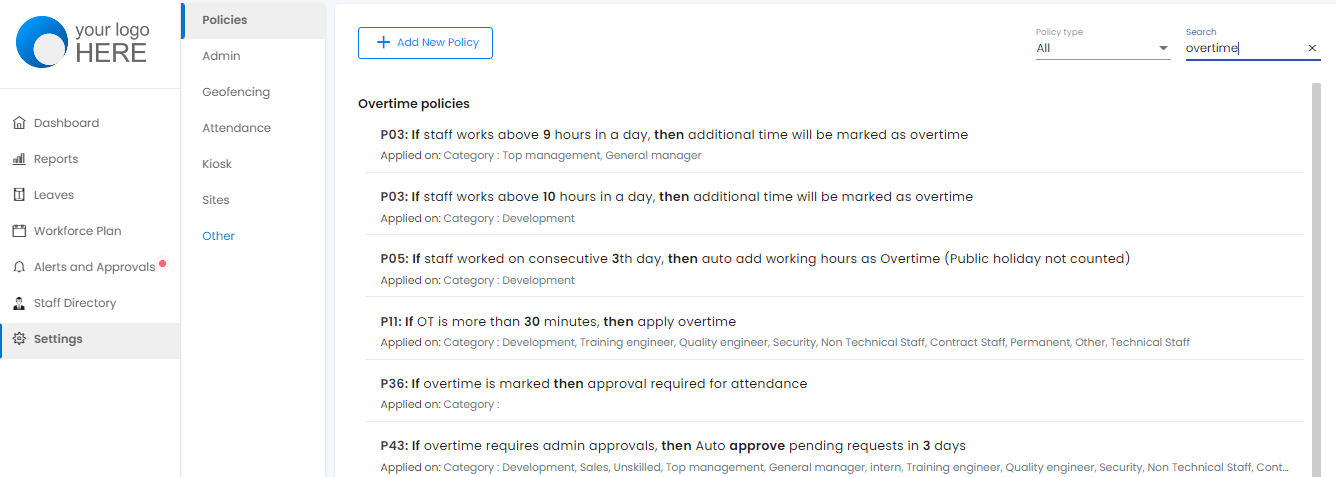
Additionally, Truein easily integrates with all major payroll systems and offers 70+ customizable policies that you can use as per the location and staff category.
We hope you now understand the importance of an attendance management system for workforce management. Several types of attendance management systems are available, so you must choose a solution that supports biometric-based identification, overtime and leave policy management, payroll integration, and more.
Frequently Asked Questions
What is a Time and Attendance Management System?
A Time and Attendance System is software that automates tracking employee work hours, overtime, breaks, and leave records. It captures time data through biometric devices, mobile apps, or cloud platforms and integrates with payroll systems. This ensures accurate timekeeping, reduces administrative workload, and helps organizations maintain compliance with labor regulations.
How does the system reduce payroll errors?
The Attendance Management System reduces payroll errors by automatically calculating total work hours, overtime, shift allowances, and leave balances. By eliminating manual timecard entries and spreadsheet calculations, it minimizes human errors. Automated payroll integration ensures accurate salary processing, statutory compliance, and timely payments without reconciliation discrepancies.
What are the different types of Time and Attendance Management Systems?
There are several types, including manual systems, biometric-based systems, cloud-based platforms, mobile app-based solutions, RFID-enabled systems, and AI-powered facial recognition systems. Modern organizations prefer cloud and AI-driven systems because they offer scalability, remote access, improved security, and seamless integration with HR and payroll software.
Can these Systems integrate with payroll?
Yes, modern Attendance Management Systems integrate seamlessly with payroll and HR software. The system automatically transfers attendance data, overtime hours, and leave balances into payroll processing. This ensures accurate salary calculations, regulatory compliance, and faster payroll execution while reducing manual data entry and administrative errors.
Which is the Best Time and Attendance Management System?
The best one depends on your business size, workforce structure, and operational requirements. Truein is a leading AI-powered solution offering facial recognition, mobile clock-ins, GPS geofencing, automated overtime rules, and payroll integration. It is especially suitable for multi-location and distributed teams seeking accurate, contactless, and scalable attendance tracking.
Stop Time thefts and irregularities!
Bring transparency and Control. Explore Truein for your organization.