

A site supervisor in Sharjah is staffing six locations this week. One contractor agency's roster says 92 workers are deployed. The site register says 80 showed up. Payroll runs on Friday, and nobody can say with confidence which number is correct.
This is what manpower planning actually looks like once you move past the theory: a daily reconciliation problem, not an annual HR exercise. It means calculating how many workers you need, by site, shift, and skill, then checking that number against who is actually on site every day.
Most manpower plans do not fail at the forecasting stage. They fail at the point where planned headcount and verified headcount stop matching, and nobody notices until the invoice or the payroll run makes it obvious.
Most manpower planning content treats this as an abstract HR topic: types of planning, planning horizons, general "factors to consider," with no formula attached. This article gives you the working formula with GCC and India examples, the forecasting inputs that feed it, an absenteeism buffer that actually holds up, a multi-site allocation table, the gap formula, and a test for whether your current attendance setup can support this kind of planning.
GCC and India compliance context is covered separately, since Wage Protection System obligations are not the same conversation as India's Labour Codes and the DPDP Act.
The short answer: Manpower planning for a contract workforce starts with a calculation: required headcount equals total workload hours divided by productive hours per worker, adjusted for absenteeism and skill mix. The plan only holds if the "available headcount" figure feeding it is accurate, which for most GCC and India operations means comparing planned headcount against attendance data by site and by agency daily, not reconciling it once a month after the damage already shows up in payroll.
Key Takeaways
- Required headcount = workload hours ÷ productive hours per worker, adjusted for a site-specific absenteeism buffer and skill mix.
- Run the gap formula (required minus available qualified headcount) by site and role, not as one company-wide number.
- Review the gap weekly, not monthly.
- The plan only holds if "available headcount" is independently verified, not self-reported by a contractor agency or copied off a paper register.
What Manpower Planning Actually Means for a Contract Workforce
Manpower planning for a contract or multi-site workforce is the process of matching labour demand (how many workers, with what skills, at which sites and shifts) against available supply, so an operation is neither short-staffed nor carrying dead weight on payroll.
That is narrower than the version most HR content covers, which treats manpower planning as company-wide workforce strategy: succession planning, long-term hiring pipelines, or organisational development.
That version describes permanent-employee planning inside a single company, not a construction contractor running 12 sites with four manpower agencies, where headcount is capped by contract terms with each agency and the workforce changes week-to-week.
Manpower planning for a contract workforce gets recalculated constantly. A construction project moves through mobilisation, peak execution, and demobilisation phases, each needing a different headcount, and a manpower supply company has to know daily whether deployed workers match what each client contract requires, which is what a staff deployment plan built around site-level demand answers and an annual workforce plan does not.
The Manpower Planning Formula
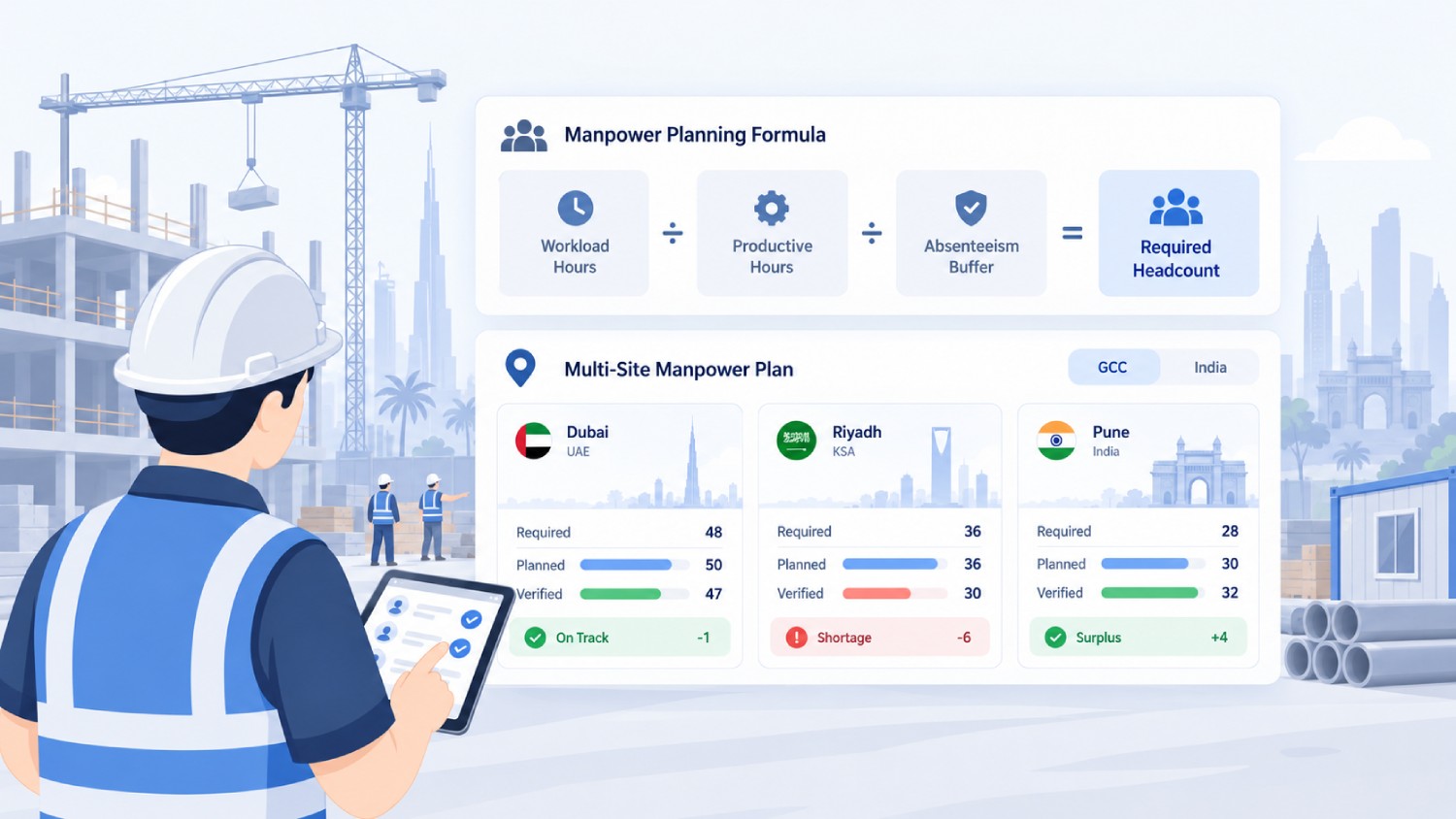
The starting formula for contract manpower planning is straightforward:
Required headcount = Total workload hours ÷ Productive hours per worker
This is not new. Construction estimators and capacity planners have used variations of it for decades.
What is missing from most manpower planning content aimed at HR and operations teams is a worked example showing how the number moves once absenteeism, shift length, and skill requirements are factored in, which is where the real planning happens.
A Worked Example for a GCC Construction Site
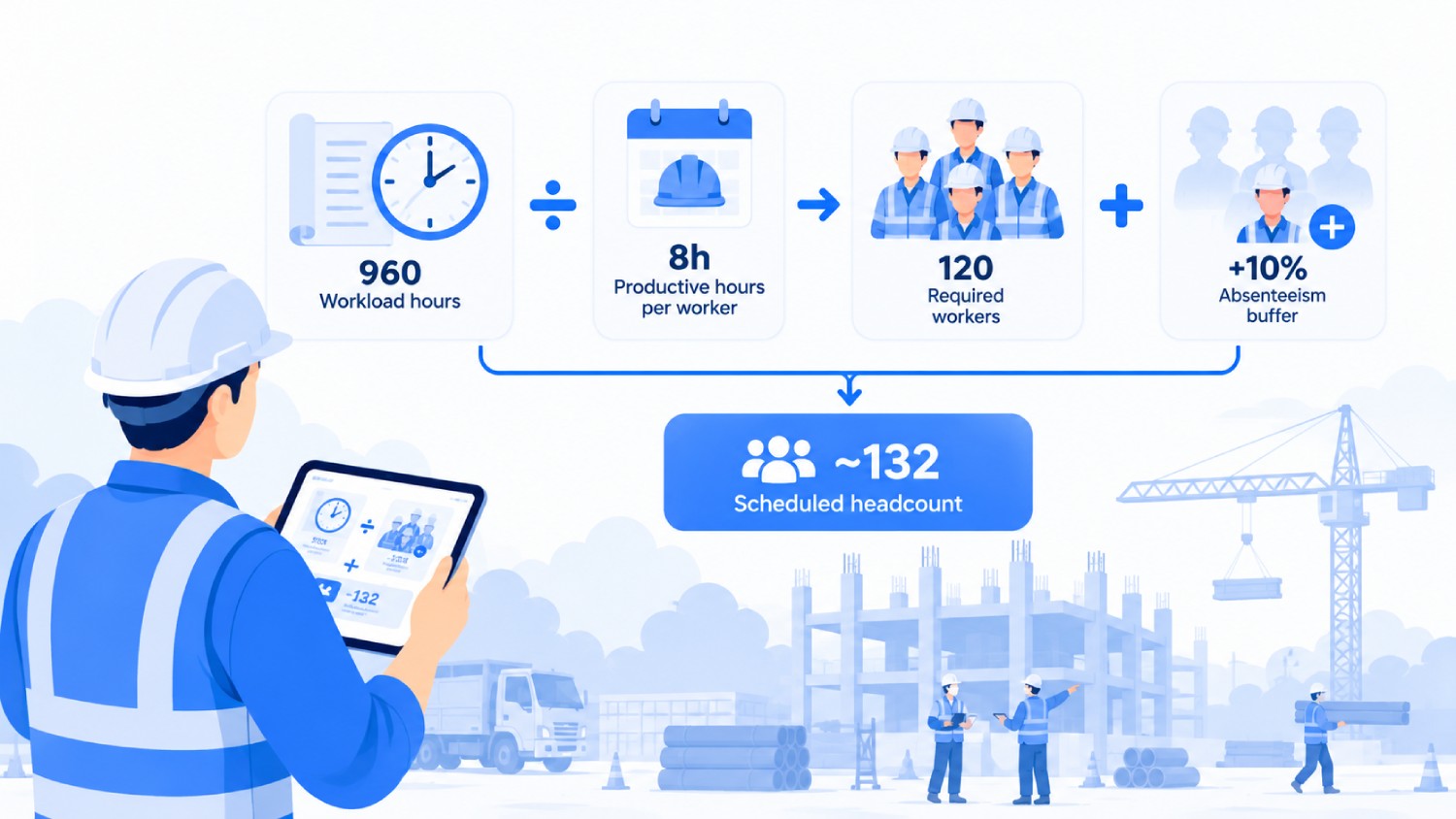
Take a mid-sized infrastructure site in the UAE running two shifts, with a daily workload of 960 labour-hours across general labour and skilled trades combined. Divide 960 by an assumed 8 productive hours per worker, and the naive answer is 120 workers.
That assumes zero absenteeism, which no site gets. Adjust for a realistic 8 percent absence rate common on large GCC infrastructure sites, and scheduled headcount needs to rise to roughly 130 workers to guarantee 120 are present on any given day.
A manpower plan that ignores the absenteeism gap is not a plan, it is a wish.
A Worked Example for an India Manufacturing Site
A manufacturing facility in Pune running a single shift needs 320 labour-hours covered daily, split between contract workers and daily wage workers on the shop floor.
At 8 productive hours per worker, the base calculation is 40 workers. India manufacturing sites running mixed contract and daily wage labour typically see absenteeism in the 10 to 15 percent range depending on the season.
Building in a 12 percent buffer pushes scheduled headcount to 45, the number that should appear on the muster roll, not 40.
The formula is the easy part. The number that actually determines whether the plan works is the productive-hours assumption, and most operations teams have never measured it. Assume 8 productive hours out of an 8-hour shift and you are almost certainly overstating capacity, since breaks, briefings, and task transitions are real time.
Forecasting Demand Before You Calculate Headcount
The headcount formula only produces a useful number if the workload-hours figure feeding it is accurate. Forecasting answers a different question first: how much work is coming, not how many people it takes to do it.
A workable demand forecast pulls from five inputs:
- Historical workload over recent cycles
- Upcoming projects or client orders
- Seasonality (relevant for India facility management and retail-linked manpower supply)
- Planned shutdowns or peak periods common in GCC construction and India manufacturing
- Scenario-based estimates
That forecast needs a specific data set behind it: workload volume by site, required skills per role, contractor availability, shift schedules, historical attendance rates, and location-wise demand.
Without that baseline, manpower forecasting becomes guesswork dressed up as a process, and a forecast that is directionally wrong produces a headcount plan wrong in the same direction.
Budgeting for Mobilisation Before the Formula Runs
The headcount formula assumes workers are already available to deploy. On a new GCC infrastructure project or an India site ramping up for a client contract, that assumption often doesn't hold, mobilisation itself has a cost and a timeline that has to be planned before day one.
A mobilisation budget for a new site typically covers recruitment or agency sourcing fees, visa and permit processing for GCC sites, travel and accommodation setup for workers relocating to a project location, and the lag between signing a contractor agreement and having verified workers on site. Skipping this step is why a manpower plan that looks correct on paper can still miss a project's actual start date by two to three weeks.
This is separate from the ongoing headcount formula above, but it feeds the same forecast: the demand-forecasting inputs in the section above should include mobilisation lead time as a sixth factor, particularly for large infrastructure projects where hundreds of workers need to be sourced, permitted, and deployed inside a fixed mobilisation window.
Building in the Absenteeism Buffer, Without a Universal Percentage
Every manpower plan needs an absenteeism buffer, and the most common mistake is applying one flat percentage across every site, role, and season.
The buffer should come from a site's own historical attendance data, not an industry rule of thumb. A GCC facility management team on well-served urban sites might see absenteeism closer to 5 percent, while a remote infrastructure site with a rotating labour pool could run 15 percent or higher, particularly around religious holidays or peak summer heat restrictions.
India's construction and manufacturing sites frequently sit in the 10 to 15 percent range, higher during harvest season where daily wage workers have agricultural ties.
A 5 percent buffer applied to a site actually running 15 percent absenteeism leaves it short by roughly 1 in 10 scheduled workers, every day, without anyone flagging it as a planning failure. It looks like a staffing problem when it is really a bad assumption baked into the plan.
The reliable fix is tracking actual attendance against schedule for eight to twelve weeks per site, then using that rate going forward, revisited quarterly, not a company-wide average that has nothing to do with a specific location's history.
Planning Manpower Across Multiple Sites and Shifts

Once the per-site formula and buffer are set, the harder problem is coordinating across many sites at once, where most manual manpower plans fall apart. A reusable allocation table gives a planner one place to compare demand and supply across the operation.
Building this table weekly, or daily for high-turnover sites, surfaces shortages before they turn into missed work orders or client escalations, and surfaces surpluses before they turn into unnecessary payroll cost.
A surplus is not a safety margin, it is money being paid for capacity nobody is using. Filling this table by hand from paper registers across a dozen sites eats a full day of a supervisor's week, and the result is usually a day out of date by the time it is finished.
The Manpower Gap Formula
Once demand and supply are both on the table, the gap calculation is simple arithmetic, but it needs to be run consistently to mean anything.
Manpower gap = Required headcount − Available qualified headcount
A positive gap means understaffing. If a site requires 60 workers and only 52 qualified workers are available, the gap is 8, which should trigger redeployment from a surplus site, standby labour activation, or a request to the agency for additional deployment.
A negative gap, more workers available than required, means the reverse: reassign the surplus.
The qualifying word is qualified, and it matters more than the arithmetic. A facility management contract might need 60 workers, 45 general cleaning staff and 15 certified electrical technicians, and show 60 bodies on site while only 8 of them are actually certified.
The total looks correct and the plan is still short by 7 in the category that matters. Manpower gaps have to be calculated by skill category, not total worker count, or the shortage stays invisible until the work itself proves it.
This shows up often in GCC construction, where trade certifications are strict, and in India manufacturing, where machine-specific operator training creates the same hidden gap.
Tracking overstaffing and understaffing as two sides of one calculation, run by skill category and not just total headcount, keeps the response consistent across a portfolio of sites.
Three decision rules keep the gap formula actionable instead of just descriptive:
- Gap of more than 10 percent understaffed on any site or skill category: Escalate to the contractor agency same-day, don't wait for the weekly review.
- Gap of more than 5 percent overstaffed for two consecutive weeks: Reassign or reduce standby labour before the next payroll cycle, not after.
- Any gap in a certified or licensed skill category, regardless of size: Treat as understaffed even if the total headcount looks correct, since a body count that ignores certification hides the shortage that actually stops work.
Why "Available Headcount" is Usually the Least Reliable Number in the Plan

Here is what most manpower planning content skips: the formula and the gap calculation are only as good as the "available headcount" number feeding them, and that number is frequently wrong.
A paper muster roll signed off by a site supervisor reflects who the supervisor believes was present, not who was independently verified, and a contractor agency's own headcount report reflects what the agency was paid to deploy, an obvious incentive misalignment when that same agency is also confirming the number.
The gap between planned headcount and reported headcount is not always a staffing failure. Sometimes it is a data trust failure, and those need completely different fixes.
This is the actual reason the Sharjah supervisor from the opening scene could not reconcile 92 against 80. Somewhere in that chain, a punch was recorded for a worker who was not physically present, a punch was missed at a site with a signal gap, or the agency's own count simply did not match the site's.
None of that is unusual. It is the default state of manpower reporting built on unverified paper or GPS-only capture.
The Test Your Current System Needs to Pass
Before adding any new software to a manpower planning process, ask one question about whatever is already in place: can it name, right now, exactly who is verified present at a site, or does it only show who was scheduled to be there.
A signed register confirms a signature, not a physical presence. A GPS ping confirms a phone was near a location, not that the person carrying it is the worker assigned to that shift.
Twelve sites, four contractor agencies, and a payroll cycle running every two weeks is a different problem than a single register: someone has to physically collect registers, key them into a spreadsheet, and reconcile discrepancies by phone, producing a number that is often three to four days old by the time it reaches whoever runs the manpower plan.
What "Verified" Actually Means at the Point of Punching In
Verification at punch-in means confirming both identity and location the moment a worker punches in, not reconstructing it later from a photo or signature.
Truein is an AI-powered time and attendance platform built for contract and multi-site workforces across the GCC and India. It verifies identity at clock-in using face recognition combined with GPS geofencing, on any Android or iOS device, with no dedicated hardware required at any site.
Ask any attendance system whether identity is verified at the punch itself or reviewed from a photo afterward. If it is photo-review, it will not stop proxy punching, it will only document it after the fact.
Truein verifies identity at the moment of the punch using AI-powered face recognition combined with GPS geofencing, so the "available headcount" figure a planner works from reflects a specific person confirmed at a specific site, not a name copied off a roster.
Face matching blocks an unrecognised punch on the spot and prompts a retry, while an AI-powered anomaly detection layer running parallelly flags spoofing patterns for review, two distinct safeguards rather than one system claiming to catch everything instantly.
Accuracy runs around 95 to 100 percent, including with facial hair, masks, and hard hats, and it runs on any Android or iOS device a worker or supervisor already owns, with no dedicated hardware to install at each site.
That combination, face recognition attendance paired with GPS geofencing, is built for exactly the conditions GCC construction sites and India's manufacturing and facility-management operations run on: large crews, multiple entry points, and workers who move between sites within the same week.
For sites where connectivity drops for hours, offline capture matters as much as verification. A signal outage should never mean a missing record.
Truein captures attendance on-device with no connectivity and syncs automatically once the network returns, flagged as ‘captured offline,’ so a planner checking numbers mid-shift knows the live dashboard reflects connected punches while offline records catch up once signal returns.
Sites with recurring signal gaps, common on large GCC infrastructure projects and India's tier-2 and tier-3 locations, should treat offline capability as a deciding requirement rather than a nice-to-have.
Truein serves more than 500 clients across 25 countries and over 10,000 locations globally, covering more than 500,000 users, rated 4.8 out of 5 on both G2 and Capterra as of review counts checked in August 2026.
Whether it's referred to as a biometric attendance system, a face punching app, or a GPS-based attendance app, the underlying requirement is the same across GCC and India sites: attendance data has to come from a verified punch, not a self-reported one.
Coordinating Manpower Planning With Contractor Agencies

A manpower plan involving multiple contractor agencies needs a shared reference point with every vendor: required headcount by role, skill and certification requirements, expected reporting date, assigned shift and worksite, a replacement service-level agreement if a worker leaves mid-contract, and an escalation contact for discrepancies.
Where an operation runs several agencies at the same sites, standard in GCC construction and India facility management, headcount needs to stay separated by agency, not blended into one company-wide total.
As an attendance platform built specifically for contract and multi-site workforce operations, Truein supports multiple contractor agencies under a single account, with per-agency headcount limits, scoped access so each agency sees only its own workers, and document expiry tracking for contractor licences, which keeps agency-wise reporting clean without a separate system per vendor.
This is agency-level visibility and control, not automatic detection of overlap between agencies working the same site, so the coordination discipline itself still has to come from the operations team managing multiple contractors across a shared portfolio.
How Often to Review the Plan, and What to Measure
A plan reviewed once a year and left alone drifts out of accuracy within weeks on contract workforces, where headcount changes constantly.
Three cadences cover most operations:
- A monthly strategic review checking whether demand forecasts still hold against actual volume.
- A weekly operational review comparing planned versus actual headcount at the site and role level.
- A daily deployment check confirming who is actually scheduled and present before a shift starts.
Skipping the weekly and daily layers in favour of only an annual review is the most common reason manpower plans look accurate on paper and fail in practice.
At each cadence, a small set of metrics tells an operations team whether the plan is actually holding:
- Planned versus actual headcount variance, the gap formula above, tracked by site and role.
- Unfilled positions, roles that stayed vacant despite being in the plan.
- Overtime hours, which often signal chronic understaffing rather than occasional spikes.
- Absenteeism rate, tracked against the buffer assumption built into the original plan.
- Labour utilisation, productive hours divided by paid or scheduled hours, multiplied by 100.
- Labour cost per unit or project, the metric that tells finance whether the plan was cost-efficient, not just headcount-accurate.
A utilisation rate sitting well below 100 percent across several review cycles usually points to overstaffing relative to actual workload, the same surplus scenario the allocation table above is built to catch early.
GCC Compliance Context for Manpower Planning

Manpower planning in the GCC sits inside a regulatory frame that shapes how headcount, shift patterns, and reporting need to work.
All six GCC states, the UAE, Saudi Arabia, Qatar, Kuwait, Oman, and Bahrain, operate a Wage Protection System (WPS), though the exact Salary Information File format and administering authority differ by country, so a manpower plan feeding payroll needs country-specific confirmation rather than a single GCC-wide assumption.
Gratuity obligations and country labour law also shape how contract terms with manpower agencies get structured, particularly around end-of-service calculations.
Saudi Arabia's Nitaqat and the UAE's Emiratisation programmes are workforce nationalisation quota systems, not wage protection mechanisms.
Accurate, site-level headcount tracking by nationality supports the reporting these programmes require, but that is reporting support, not a compliance guarantee, and no manpower platform verifies nationality or quota eligibility on its own.
Shift and overtime planning also has to account for the Friday, or Friday-to-Saturday, weekly rest day observed in Saudi Arabia, Qatar, Kuwait, Bahrain, and Oman (the UAE has run a Saturday-Sunday weekend since 2022), plus the statutory Ramadan daily working-hour reduction, commonly around two hours, that any manpower plan covering that period needs to build into its shift calculations.
Disclaimer: This section does not constitute legal advice. The information presented is based on available references at the time of writing and may contain inaccuracies or omissions. Readers are advised to verify details independently or consult a qualified professional.
India Compliance Context for Manpower Planning

India's regulatory frame for contract labour changed materially as of late 2025, and manpower planning content that still refers only to the old Contract Labour Act framework is already out of date.
The Contract Labour (Regulation and Abolition) Act, 1970 has been consolidated into India's four Labour Codes, effective from 21 November 2025, with final central rules notified on 8 May 2026 and state-level rules still rolling out.
"Contract Labour Act" remains usable shorthand in casual reference, but where compliance depth matters for a manpower plan, it now sits primarily under the Occupational Safety, Health and Working Conditions Code.
Social security coverage shifted meaningfully under this consolidation. Provident fund, ESIC, and gratuity, previously associated mainly with permanent employment, are being extended to contract, fixed-term, and platform workers under the Code on Social Security, 2020.
ESIC now applies nationwide rather than only in notified areas, and gratuity eligibility for fixed-term workers has been reduced to one year of continuous service, which directly affects how a manpower plan should treat contract worker headcount for cost purposes.
Data privacy for attendance and biometric data runs on a separate track from labour law under India's Digital Personal Data Protection Act, 2023. Rules were notified in November 2025, consent-manager provisions became operative in November 2026, and full substantive obligations phase in through May 2027.
A manpower plan capturing biometric attendance data should sit on a platform designed to support DPDP-aligned principles, consent-first collection, data minimisation, breach notification, rather than treating data privacy as an afterthought.
Disclaimer: This section is for general informational purposes only and does not constitute legal advice. India's data protection and labour law framework, including the Digital Personal Data Protection Act and the Labour Codes, is still being rolled out in phases and is subject to change. The information presented reflects publicly available sources as of the article's publish date and may not capture subsequent rules, notifications, or amendments. Readers are advised to verify current requirements independently or consult a qualified professional before making compliance decisions.
Frequently Asked Questions
1. How do I calculate how many contract workers I need for a site?
Divide total daily workload hours by productive hours per worker, typically 6 to 8 depending on shift length, to get a base headcount. Add an absenteeism buffer from that site's actual attendance history, not an industry average, and separate the total by skill category.
A 960-hour daily workload at 8 productive hours per worker needs 120 workers before any buffer, and typically 130 or more once realistic absenteeism is factored in.
2. What is a normal buffer for absenteeism when scheduling contract labour?
There is no universal number. Well-served urban GCC sites often run close to 5 percent absenteeism, while remote infrastructure sites or India locations with seasonal daily wage labour can run 10 to 15 percent or higher.
Track each site's actual attendance data over eight to twelve weeks and use that specific rate, reviewed quarterly, instead of a fixed assumption.
3. How do I know if I am understaffed or overstaffed across multiple sites?
Run the gap formula, required headcount minus available qualified headcount, for every site and role. A positive result means understaffing and should trigger redeployment or additional agency deployment.
A negative result means surplus, workers being paid for capacity the site does not need, and should trigger reassignment. Review this weekly, not just at month-end.
4. If I use multiple contractor agencies, does my manpower plan need separate headcount tracking for each one?
Yes. Blending headcount across agencies into one company-wide total hides which agency is short or over on their contracted deployment, and makes billing reconciliation nearly impossible when an invoice does not match verified attendance
Agency-level headcount caps and scoped reporting depend on tracking headcount by agency and site, not as one blended number.
5. Why does my "available headcount" number keep being wrong even when I check attendance daily?
Usually it comes down to unverified capture at the source. A signed paper register confirms a signature, not physical presence, and a GPS-only clock-in confirms a phone's location, not that the assigned worker is holding it.
The "available headcount" feeding your plan is only as reliable as whoever filled in the register, exactly the gap that identity verification at punch-in closes.
Truein's face recognition attendance system matches the worker's face to their enrolled profile at the moment of the punch, while GPS geofencing confirms the punch happened inside the approved site boundary, so a supervisor is working from a person confirmed present at a place, not a name on a sheet.
6. Does manpower planning work the same way in the GCC as it does in India?
The formula and process are the same, but the compliance context differs enough that treating the two regions identically is a mistake.
GCC planning has to account for the Wage Protection System, Nitaqat or Emiratisation headcount reporting, and Ramadan and Friday rest-day shift adjustments.
India planning has to account for the Labour Codes' extension of PF and ESIC to contract workers and the DPDP Act's phased rollout. The headcount math does not change across the border, but the regulatory frame does.
7. What's the difference between manpower planning and manpower forecasting?
Forecasting answers how much work is coming. Planning answers how many workers that work requires, adjusted for absenteeism and skill mix, and whether the headcount actually deployed matches what was planned. Forecasting feeds planning; planning without a forecast behind it is just applying a formula to a guess.
8. Does face recognition and GPS attendance software actually help with manpower planning?
Yes, indirectly but critically. Manpower planning software calculates how many workers you need; a face recognition and GPS geofencing attendance system like Truein confirms how many you actually have on site, verified rather than self-reported.
The plan and the verification are two different jobs, and a manpower plan is only as accurate as the attendance data feeding it.
This is why GCC and India operations running contract and multi-site workforces increasingly pair a manpower planning process with a verified attendance layer rather than relying on paper registers or GPS-only capture.
Where This Leaves Your Manpower Plan
A manpower plan is a calculation you can run this week, not a strategy document written once a year and left in a folder: workload hours converted into required headcount, adjusted for the absenteeism and skill mix specific to each site, checked daily against what is actually deployed rather than what was scheduled.
The formula and the allocation table above will get a plan on paper. Whether it holds up depends entirely on the accuracy of the "available headcount" number feeding it, and for most contract and multi-site operations across the GCC and India, that number is still coming from a paper register, a spreadsheet days out of date, or a contractor agency's own self-reported count.
If your manpower plan keeps drifting from what is actually on site by the time payroll runs, the gap usually is not in the forecast, it is in the attendance data confirming who showed up.
For GCC and India operations running contract and multi-site workforces, manpower planning software that can verify headcount at the point of clock-in, rather than reconstruct it after the fact, closes the gap this article has walked through.
Schedule demo with Truein to know how it verifies headcount by site and by contractor agency, with offline capture for sites where signal drops and payroll-ready reports for whatever payroll or HRMS system you already run, is a reasonable next step before the next planning cycle starts.