




Most guides on how to do certified payroll start and end with the form. Fill in the boxes, sign page 2, send it in every week. The form is the easy part. The hard part is the record underneath it: who worked, on which project, in which labor classification, and for how many hours each day.
This guide is for payroll managers, project accountants, and owners at US contractors working federally funded or assisted jobs. It covers what certified payroll requires, what changed on the revised WH-347, a seven-step weekly process with a column-by-column walkthrough, and the field-record gaps that turn a clean report into back wages.
What is certified payroll?
Certified payroll is the weekly payroll report a contractor or subcontractor submits on a construction contract covered by the Davis-Bacon and Related Acts (DBRA). It lists every laborer and mechanic on the project, with their labor classification, daily and weekly hours, rates paid, fringe benefits, deductions, and net pay. A signed Statement of Compliance certifies that each worker was paid at least the prevailing wage in the contract's wage determination.
It applies to federal construction contracts over $2,000 and to federally assisted projects, such as highway, transit, housing, and water work funded through grants and loans. Many states run their own prevailing wage programs with their own forms and portals, so a state-funded job can carry the same weekly duty under a different name. Either way, it sits on top of the everyday construction payroll issues every contractor already manages.
Three facts shape everything else in this guide:
- The form is optional. The reporting is not. The WH-347 is a convenience form. Contractors may use their own format, but the weekly payroll information and a Statement of Compliance with identical wording are required.
- The prime answers for the subs. The prime contractor is responsible for submitting the payrolls of every subcontractor on the job, at every tier.
- The signature carries criminal exposure. The Statement of Compliance needs no notary, but a false statement on it falls under 18 U.S.C. 1001, with fines and up to five years in prison.
What changed on the revised WH-347?
The DOL released a revised WH-347 in January 2025, approved through January 31, 2028. The previous version's approval ran out on September 30, 2026, so the revised layout is the one to use on every weekly submission now. The DOL's official WH-347 instructions cover each field, and in December 2025 the agency added an online fillable WH-347 and an annotated guide.
The fringe benefit change matters most. The old form let a contractor tick a box saying benefits went to approved plans. The revised form asks for the hourly credit claimed for each worker under each plan, and whether the plan is funded or unfunded. Credit for an unfunded plan needs DOL approval before it is taken.
How to do certified payroll: seven steps every week
Certified payroll runs on a weekly cycle that starts before the first shift and ends three years after the last one. Here is how to do certified payroll in the order that cycle runs.
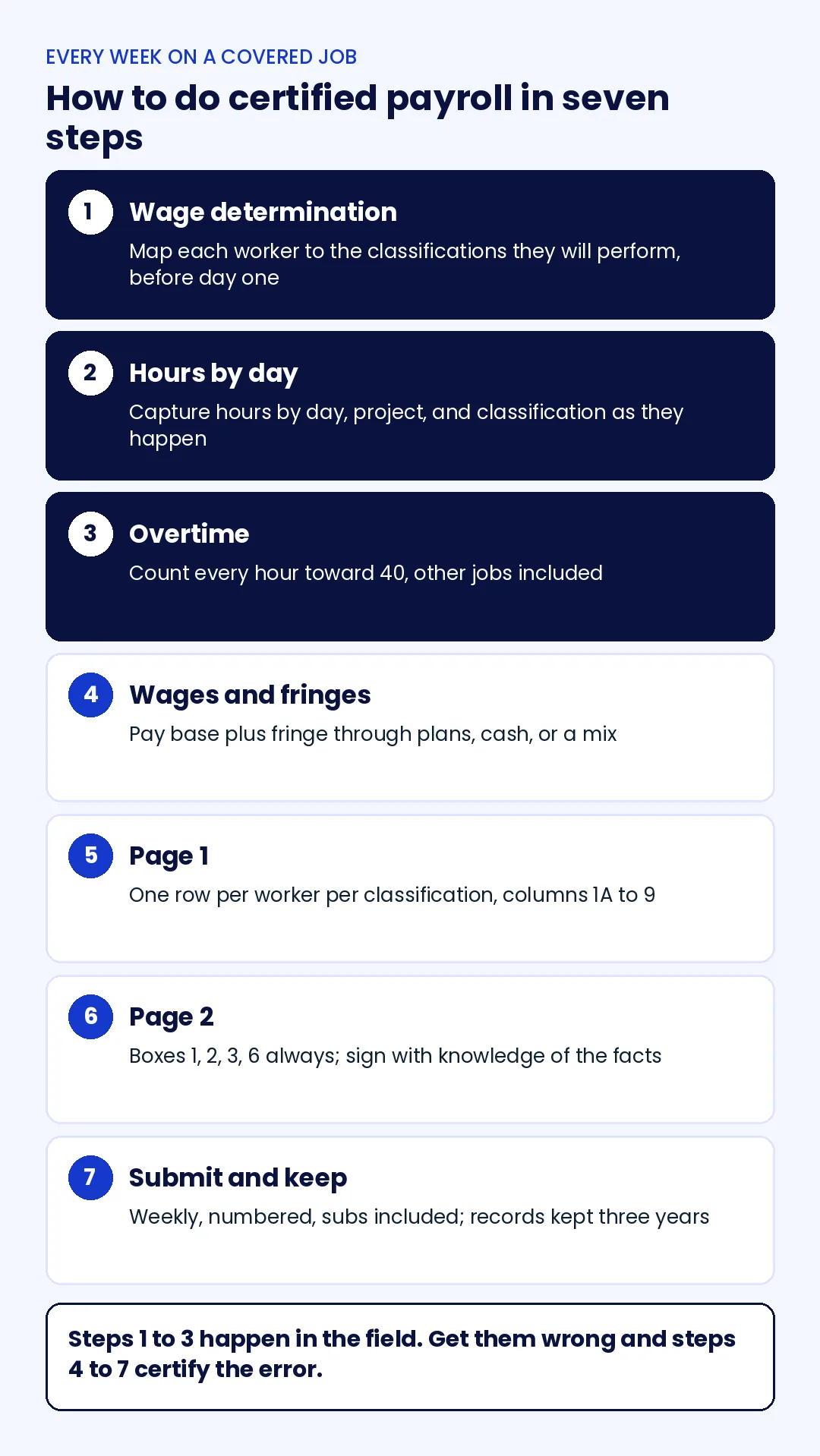
1. Read the wage determination before anyone clocks in
The wage determination in the contract lists every labor classification with its basic hourly rate and fringe rate for that county and type of construction. Map each worker to the classifications they will actually perform before mobilization. If the crew will do work that no classification covers, ask the contracting officer for a conformance as soon as the gap is known, not after the first payroll is due.
2. Capture hours by day, by project, and by classification
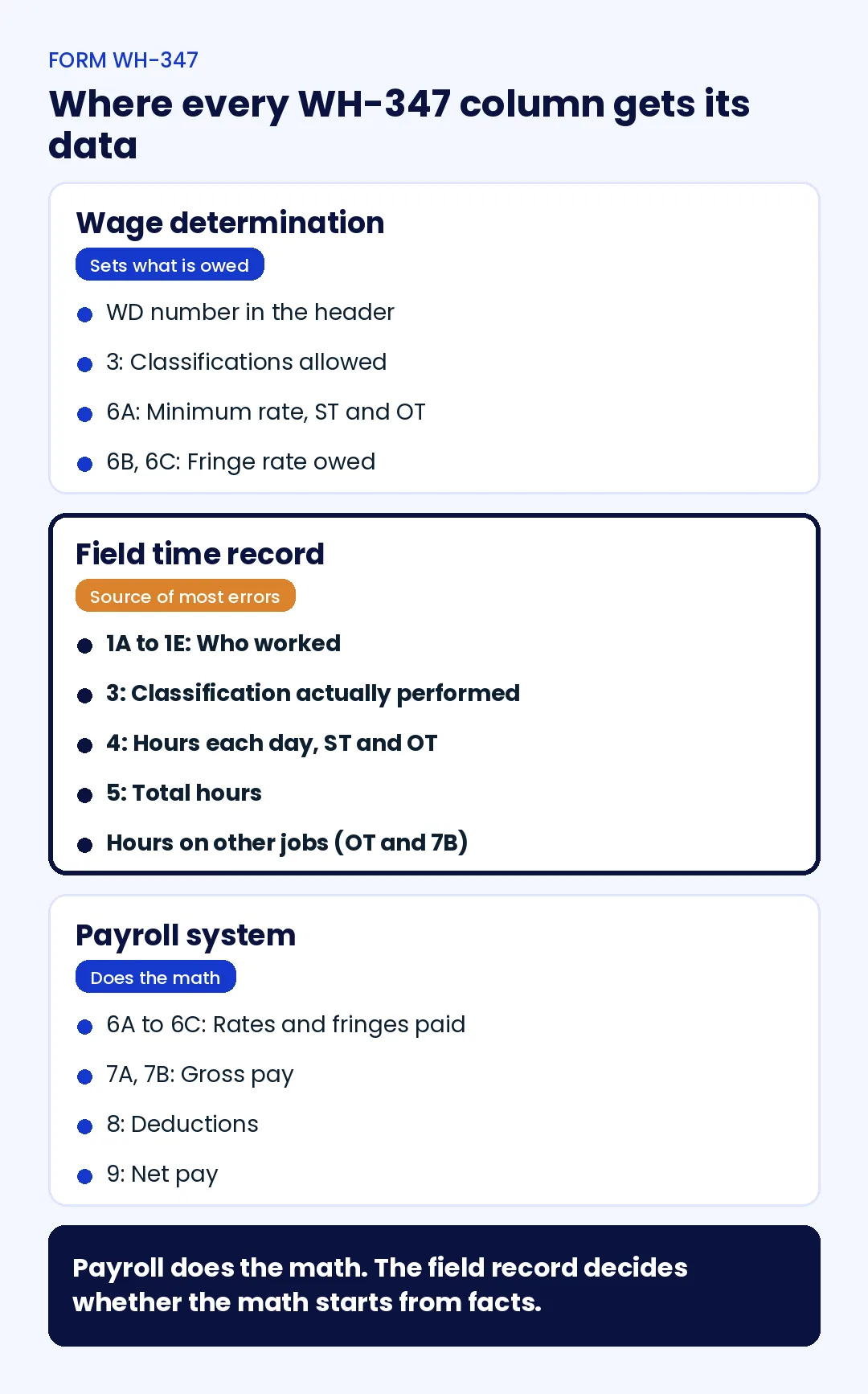
Column 4 of the WH-347 needs straight time and overtime for each day, on this project only. A worker who runs a loader for six hours and does hand labor for two needs two rows on the payroll, one per classification. That breakdown has to come from the time record. Payroll cannot rebuild it on Friday.
A superintendent on a federally funded water plant job, with operators who also hand-place pipe bedding, has to log the split as it happens or pay the operator rate for the whole day.
3. Count every hour toward overtime, including other jobs
On contracts covered by the Contract Work Hours and Safety Standards Act, hours over 40 in the workweek are overtime, and the count includes hours worked on and off the covered site. A worker with 32 hours on the federal job and 12 on a private job has crossed 40 for the week. A time record that shows only the federal hours hides the overtime the certified payroll has to account for.
4. Calculate wages and fringe benefits
Each worker must receive at least the basic hourly rate plus the fringe rate for their classification. The fringe part can be met through contributions to bona fide plans, cash paid in lieu of fringes, or a mix. Plan credit goes in column 6B and is broken out by plan on page 2. Cash in lieu goes in column 6C. It never goes into the hourly rate in column 6A.
A worked example: the wage determination sets a laborer at $32.00 base plus $18.40 fringe, a $50.40 total. The contractor pays $33.00 an hour and contributes $15.00 an hour to a health plan, $48.00 in all. The worker is $2.40 an hour short, which can be paid as cash in lieu: $96.00 for a 40-hour week, reported in column 6C.
5. Fill out page 1 of the WH-347
Page 1 carries the project header and one row per worker per classification. The table shows what goes in each column and where contractors most often get it wrong.
6. Complete and sign page 2
Page 2 is the Statement of Compliance. Boxes 1, 2, 3, and 6 must always be checked. Box 4 applies when any worker is paid as a registered apprentice and needs each program's name and whether it is registered with the DOL's Office of Apprenticeship or a State Apprenticeship Agency. Box 5 applies when the contractor takes credit for plan contributions and needs the fringe table filled in by plan.
The signer must be the contractor or the agent who paid or supervised the payment of the workers, and should know the facts being certified. Legally valid electronic signatures are accepted. A scanned or photocopied signature is not.
7. Collect sub payrolls, submit, and keep the records
Number each weekly payroll in sequence starting at 1, submit one for every week any covered work is performed, and check the final-payroll box on the last one. Payrolls go to the contracting agency or, on assisted projects, to the owner or sponsor who passes them on. Keep the regular payroll records behind each report, including every worker's address, phone number, and email, for three years after all work on the prime contract is complete.
A prime running six subs on a federally funded school renovation certifies a stack of seven payrolls every week. Only one of them came from its own records.
Where certified payroll actually goes wrong
Payroll software rarely gets the arithmetic wrong. The errors behind amended payrolls, withheld contract payments, and back wages usually start one step earlier, in a time record that cannot answer the questions the WH-347 asks. Learning how to do certified payroll well mostly means closing these five gaps.
Classification splits nobody recorded
This is the most expensive gap, because the DOL instructions spell out the remedy. If the contractor did not keep an accurate breakdown of hours by classification, the worker must be paid the highest applicable rate, base plus fringe, for every hour worked. A weekly sheet that says 40 hours and nothing more cannot defend a split.
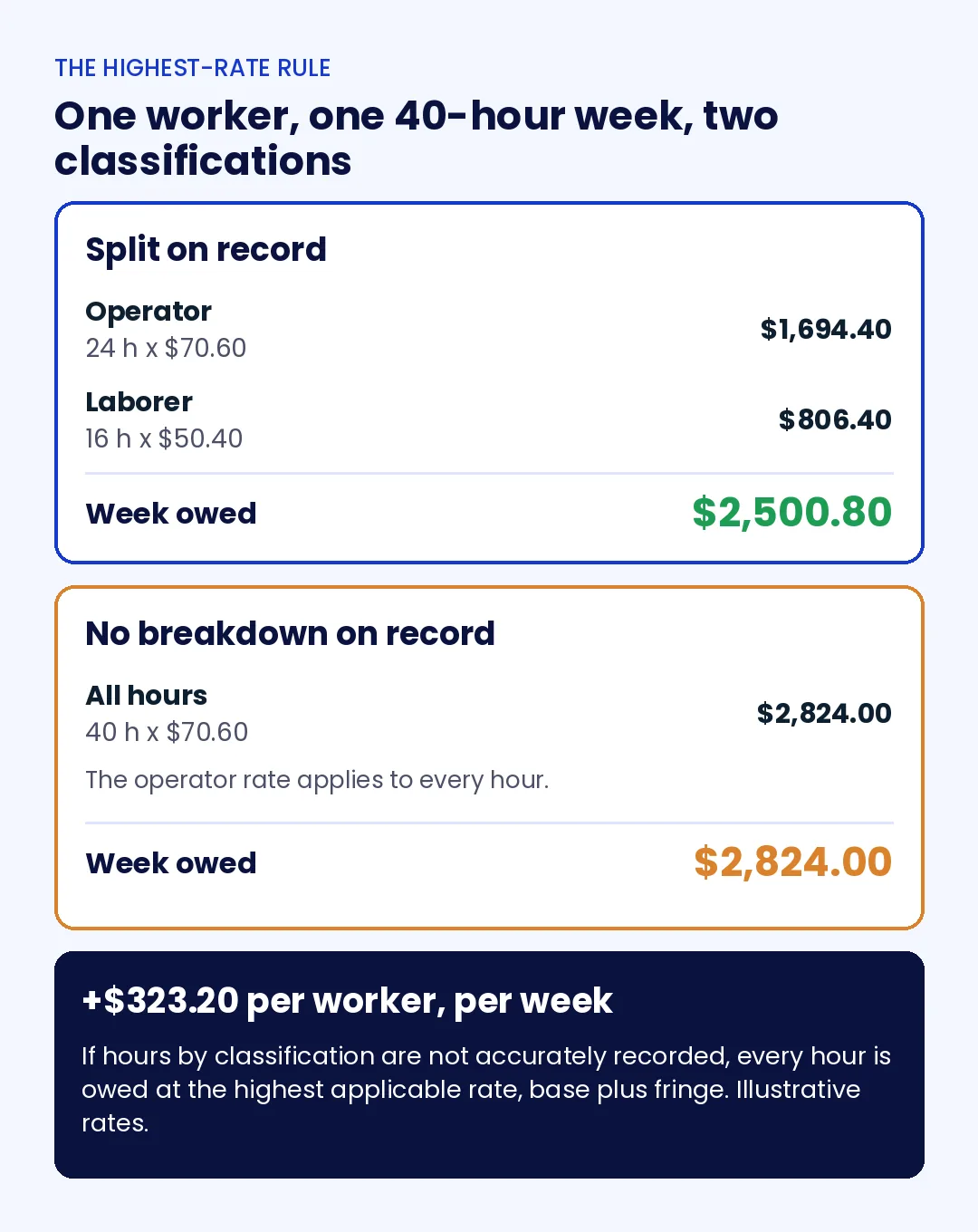
Take an operator who also works as a laborer: 24 hours at a $70.60 total package and 16 hours at $50.40. With the split on record, the week costs $2,500.80. Without it, all 40 hours are owed at $70.60, or $2,824.00. That is $323.20 for one worker in one week, before anyone counts the rest of the crew.
Hours from other jobs that never reach the report
Column 7B and the overtime count both need hours from every job the worker touched that week, covered or not. In many companies a worker who splits time between a federal job and private work leaves two separate records, and the certified payroll only sees one.
Timesheets rebuilt at the end of the week
A foreman filling out Friday's sheet from memory rounds the hours and fills the gaps. On a private job that costs margin. On a covered job, the person signing page 2 certifies under federal false statement law that those hours are accurate. Our breakdown of the five ways construction labor hours go wrong shows where reconstructed timesheets drift.
Who actually worked the hours
Certified payroll names each worker. A punch one worker made for another, or a sign-in sheet anyone could sign, puts the wrong name on a federal report. GPS shows where a phone was. It does not show who was holding it.
Subcontractor payrolls passed through unchecked
The prime answers for every tier. If a sub's WH-347 shows seven laborers on a day the prime's own records show four, the prime certified that gap when it forwarded the form. Our guide to subcontractor time tracking covers how a general contractor builds its own record of sub hours and checks each payroll against it.
Contractors running a mix of public and private work across several job sites carry all five risks at once, because the same workers move between covered and uncovered jobs inside one workweek.
How to do certified payroll by hand or with software
A small contractor with one covered job and a short crew list can fill out the DOL's fillable WH-347 by hand. It works, and the DOL estimates the form takes about 55 minutes on average each week. It stops working once crews split classifications, work several jobs, or include subs, because each of those facts has to be pulled together by hand before the form can be filled in.
Larger contractors usually run three layers. Payroll software with a certified payroll report applies wage determination rates and produces the form. A compliance platform handles electronic submission when an agency, a state, or a prime requires one. A time and attendance system captures the hours, project, and worker identity the other two depend on. Our heavy civil time tracking software guide compares tools on that last layer for DOT-funded work.
How Truein supports certified payroll
Truein is a face recognition and GPS-based time and attendance platform for contract and multi-site workforces, used by 500+ customers across 10,000+ locations. It does not calculate prevailing wages or produce the WH-347. It produces the hours record certified payroll is built from, with the worker verified at every punch.
Workers clock in by face on their own phone or a shared tablet at the gate, inside a geofence drawn to the site, with no dedicated hardware. Each punch carries the verified worker, the site, the job, and the time, so hours by day and by project come from the record rather than recollection. Punches at sites with no signal are stored on the device and sync later, flagged as captured offline. Subcontractors and staffing agencies sit under one account as separate agencies, which gives a prime its own record to check each sub's payroll against.
Verified hours export payroll-ready by site and worker into ADP, QuickBooks, Sage, Viewpoint, and other payroll systems, where the certified payroll report is produced. The construction time tracking software page covers site setup, and the contract workers attendance page covers the agency controls. One limit to plan around: Truein records who worked, where, and when. Assigning each hour to the right labor classification stays with the supervisor and the payroll setup.
Conclusion
Knowing how to do certified payroll is mostly knowing what the WH-347 will ask before the week starts. Read the wage determination, capture hours by day, project, and classification as they happen, count every hour toward overtime, and check each sub's payroll before you forward it. Then file on the revised form, sign it with knowledge of the facts, and keep the records for three years.
The payroll math is the easy half. Contractors whose certified payroll holds up in an audit are the ones whose field records already answer the form's questions, worker by worker and day by day.
Frequently asked questions
Who has to submit certified payroll?
Every contractor and subcontractor, at every tier, that employs laborers or mechanics on a construction contract covered by the Davis-Bacon and Related Acts. That means federal construction contracts over $2,000 and federally assisted projects. State prevailing wage laws add their own certified payroll requirements on many state and local public works jobs.
Can QuickBooks do certified payroll?
It depends on the version and setup. General payroll systems, QuickBooks included, can hold the hours, rates, and deductions, but producing a compliant WH-347 usually takes a certified payroll report feature, an add-on, or a separate compliance tool. Whatever produces the report, the hours by day, project, and classification still have to come from an accurate time record.
How long does it take to do certified payroll?
The DOL estimates about 55 minutes on average to complete one WH-347, including gathering the data. In practice the time depends on the time record. A crew with clean daily hours by classification takes minutes, while a crew whose split classifications and other-job hours have to be reconstructed can take most of a day.
What happens if certified payroll is wrong or late?
Agencies can withhold contract payments until missing or deficient payrolls are fixed, and underpaid workers are owed back wages. Failing to submit or keep required records can lead to debarment under 29 CFR 5.12, and a knowingly false Statement of Compliance falls under 18 U.S.C. 1001.
Do I need to be a Certified Payroll Professional to do certified payroll?
No. The Certified Payroll Professional credential is a general payroll certification and is unrelated to Davis-Bacon reporting. Anyone with knowledge of the facts can prepare the WH-347, and the person who signs it must be the contractor or the agent who paid or supervised the payment of the workers.
How long do you have to keep certified payroll records?
Three years after all work on the prime contract is completed. That covers the regular payroll records behind each report, including each worker's name, Social Security number, address, phone, email, classification, rates, daily and weekly hours, deductions, and wages, plus copies of the certified payrolls submitted.
