



Most of what is written about subcontractor time tracking is written for the sub: how a specialty contractor tracks its own crews. This guide is for the other side of the invoice. A general contractor running three subs across a 40-acre site has to approve, every week, hours it did not record, for workers it did not hire, on a timesheet the sub prepared.
That is the gap this guide closes. It covers what a GC's own record has to prove, how the five common tracking methods compare, how to reconcile a sub's invoice against the record without a fight, and how to do all of it without crossing the line into controlling the sub's workforce.
Why the hours a sub bills and the hours a GC can prove are different numbers
A subcontractor invoice on a labor-driven scope rests on the sub's own timesheet. The sub's foreman records the crew, the sub's office totals the hours, and the GC's project manager approves the result against a daily report that the same foreman helped write. Every document in the chain comes from one side of the transaction.
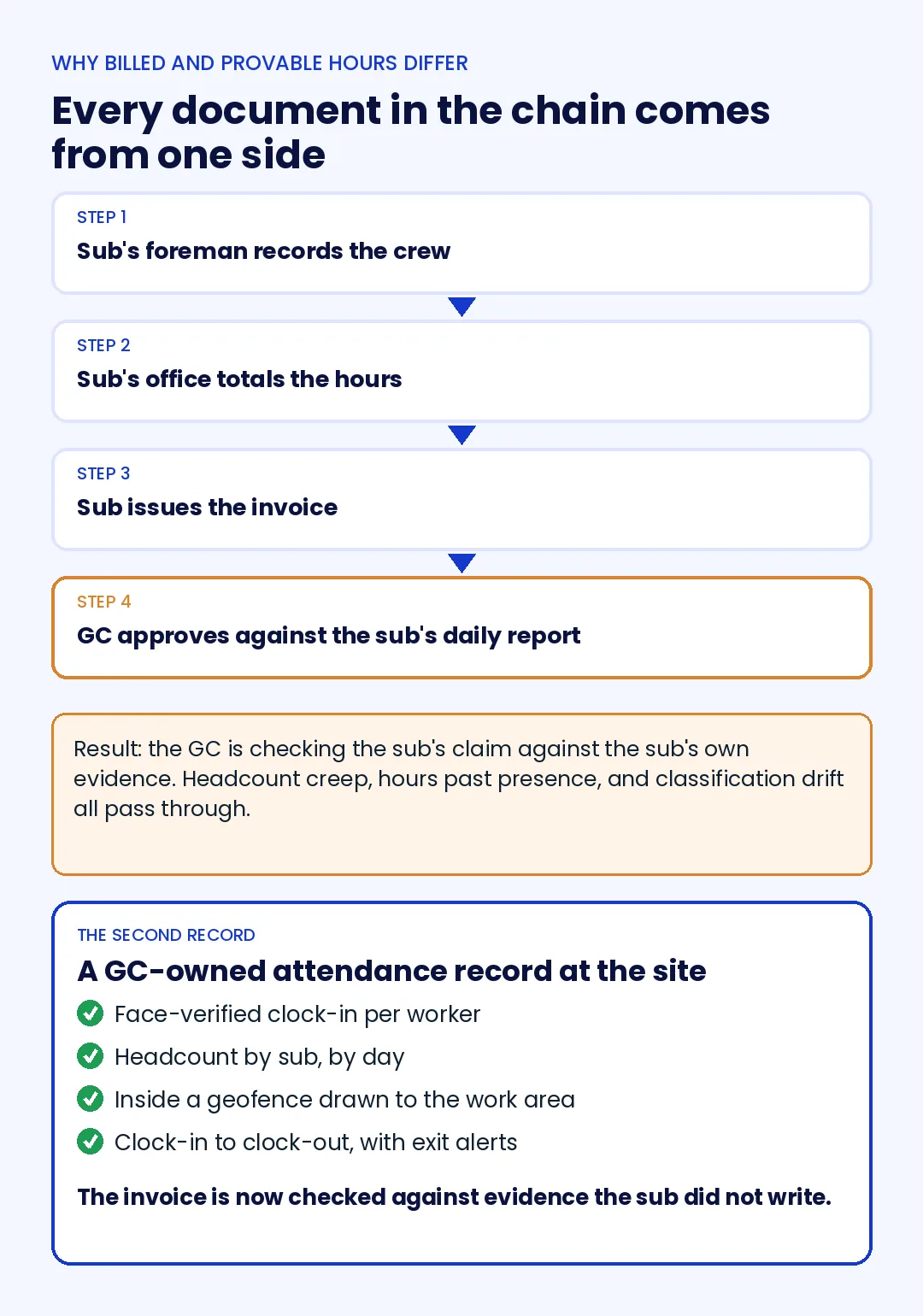
That is not an accusation of fraud. It is a control problem. Three things slip through it on most sites:
- Headcount creep. A sub contracted for 12 workers bills 14 for a week because two replacements overlapped with the people they replaced, and nobody on the GC side counted.
- Hours that ran past presence. A crew that left at 2:30 is billed to 3:30 because the timesheet records scheduled hours, not actual ones.
- Classification drift. A laborer is billed at a journeyman rate because the invoice line carries a trade, not a verified worker.
On a $2.4 million labor scope, a 4 percent gap between billed and provable hours is $96,000. Most GCs never see the number because they have no second record to compare against. The invoice is only as good as the record it is checked against, and most GCs are checking it against nothing.
A general contractor with a 60-person site and three subs found, after running its own attendance for one month, that one sub's billed headcount exceeded verified clock-ins on 11 of 22 working days. The sub was not inventing workers; it was billing replacements and the replaced on the same days. The correction was a conversation, and it was only possible because the GC had its own record.
The four questions a subcontractor time record has to answer
A GC's record of subcontractor hours does one job: it has to stand next to the sub's invoice and either agree with it or show exactly where it does not. To do that it has to answer four questions for every shift.
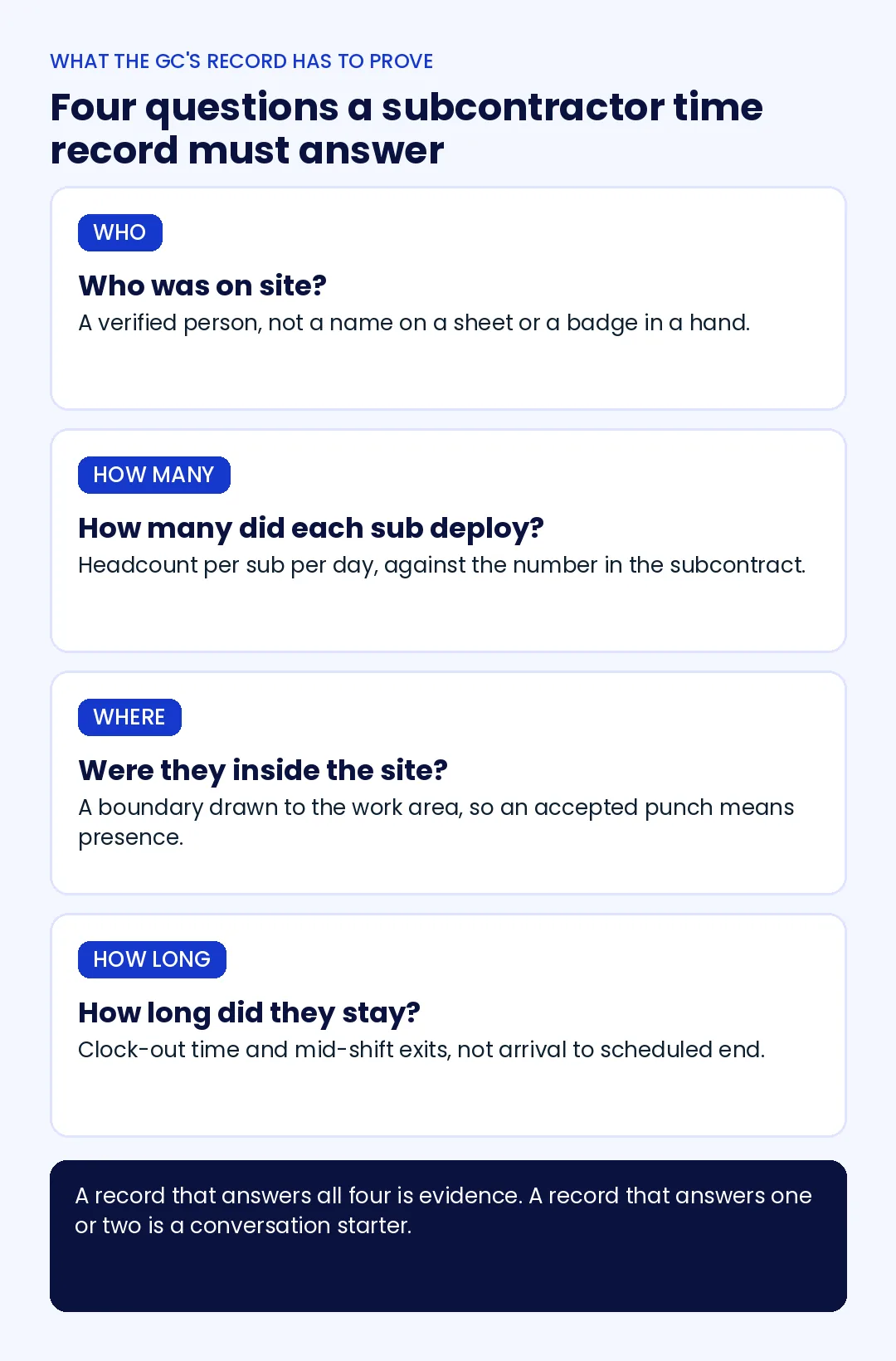
Who was on site?
Not a name on a sheet, a verified person. If the record cannot distinguish the worker from a colleague holding their badge or phone, it cannot settle a headcount dispute, because the sub will say the worker was there and the record will say a device was.
How many did each sub deploy?
Headcount per sub per day, against the number in the subcontract. This is the question that catches overbilling fastest, and the one a gate count almost answers, until two subs share a gate and nobody records which worker belongs to which company.
Were they inside the site?
A punch from the parking lot three blocks away is a punch; it is not presence. The record needs a boundary drawn to the actual work area, so that an accepted clock-in means the worker was where the work was.
How long did they stay?
Arrival is not a shift. The record has to show clock-out time, and ideally whether the worker left the boundary mid-shift, because hours billed from arrival to scheduled end are the single largest source of billed-but-unworked time on T&M work.
A record that answers all four is evidence. A record that answers one or two is a conversation starter. The method you choose decides which one you get.
Five subcontractor time tracking methods GCs use, compared
Every method below is in use on US sites today. The table scores them on the four questions; the entries explain the trade-off.
Accepting the sub's timesheet
The default on most lump-sum scopes, and defensible there, because the GC's exposure is the contract price rather than the hours. On T&M, cost-plus, or unit-price-with-labor scopes it is a blank check, and on public work it leaves the prime certifying payroll it has never checked.
Daily reports and sign-in sheets
Better than nothing and worse than people think. A superintendent's daily report records the headcount the superintendent saw at the moment they looked. A sign-in sheet records whoever wrote a name. Neither survives a dispute, and both are prepared by people who have forty other things to do that morning.
Badges and turnstiles
The standard on large fenced sites, and a real improvement: a gate count per company, time in, time out. The two gaps are identity (badges travel between people) and everything after the gate (a worker who badges in at 7 and sits in a truck until 9 is on site for the turnstile). The hardware cost also rules it out for the mid-sized GC running six sites at once.
The sub's own GPS time clock, with an export
Increasingly common: the sub runs Workyard or ClockShark or Connecteam, and shares a report. It is the sub's record under the sub's settings. Geofences, rounding rules, and who can edit a punch are all the sub's decisions, and most of these apps verify a phone's location, not the worker's identity. Useful as a cross-check; weak as the GC's primary evidence.
A GC-run attendance layer with per-agency views
The GC enrolls each sub's crew in one attendance system at the site, clock-ins are face-verified inside a geofence, and each sub's supervisor sees only their own workers while the GC sees everyone by company. The GC now owns a record that answers all four questions and was produced on its own terms. The cost is setup: the process has to be in the subcontract, and every new worker has to be enrolled before their first shift. For most GCs with labor-driven scopes, that is a smaller cost than one disputed month. The guide to coordinating multiple contractors on large sites covers how that layer fits alongside scheduling and safety.
What a GC-run subcontractor record needs: the per-agency control set
If you take the last route, the system has to treat each subcontractor as a separate company inside one site, not as one more department. Five controls make the difference.
- Headcount caps per sub. The contracted number is set in the system, and clock-ins past it are flagged or blocked. Overbilling on headcount stops being something you discover in the invoice.
- Scoped supervisor views. Each sub's foreman sees their own workers' punches and nothing else. That is what makes a sub willing to use your system: they get a daily record of their own crew, and no competitor sees it.
- Identity at the punch. Face verification on a phone or a shared kiosk, so the record belongs to a worker rather than a badge. This is the control that settles who-was-there disputes.
- Agency-level rules. Rounding, overtime, break deduction, and the subcontract's own shift definitions applied per sub, so hours come out of the system already calculated the way the invoice should be.
- Document and classification tracking. Safety cards, certifications, and trade classification held against the worker, so a lapsed card or a laborer billed as a journeyman surfaces at the punch, not at the audit.
An electrical contractor acting as prime on a hospital project enrolled four subs' crews, 140 workers in total, on this basis. The practical change was not catching fraud. It was that invoice approval went from a two-day argument to a one-hour review, because both sides were reading the same record. Companies managing contract and agency labor outside construction, a facility management firm with cleaning crews on client sites for instance, run the same control set with the client as the GC. For the day-to-day of running several subs, the tips for managing multiple contractors post covers the operating side.
Reconciling the invoice: a weekly routine
The record earns its keep in a weekly reconciliation that takes an hour per sub once it is routine. The table lays out the five comparisons; the order matters, because headcount disputes resolve most of the hours disputes before you reach them.
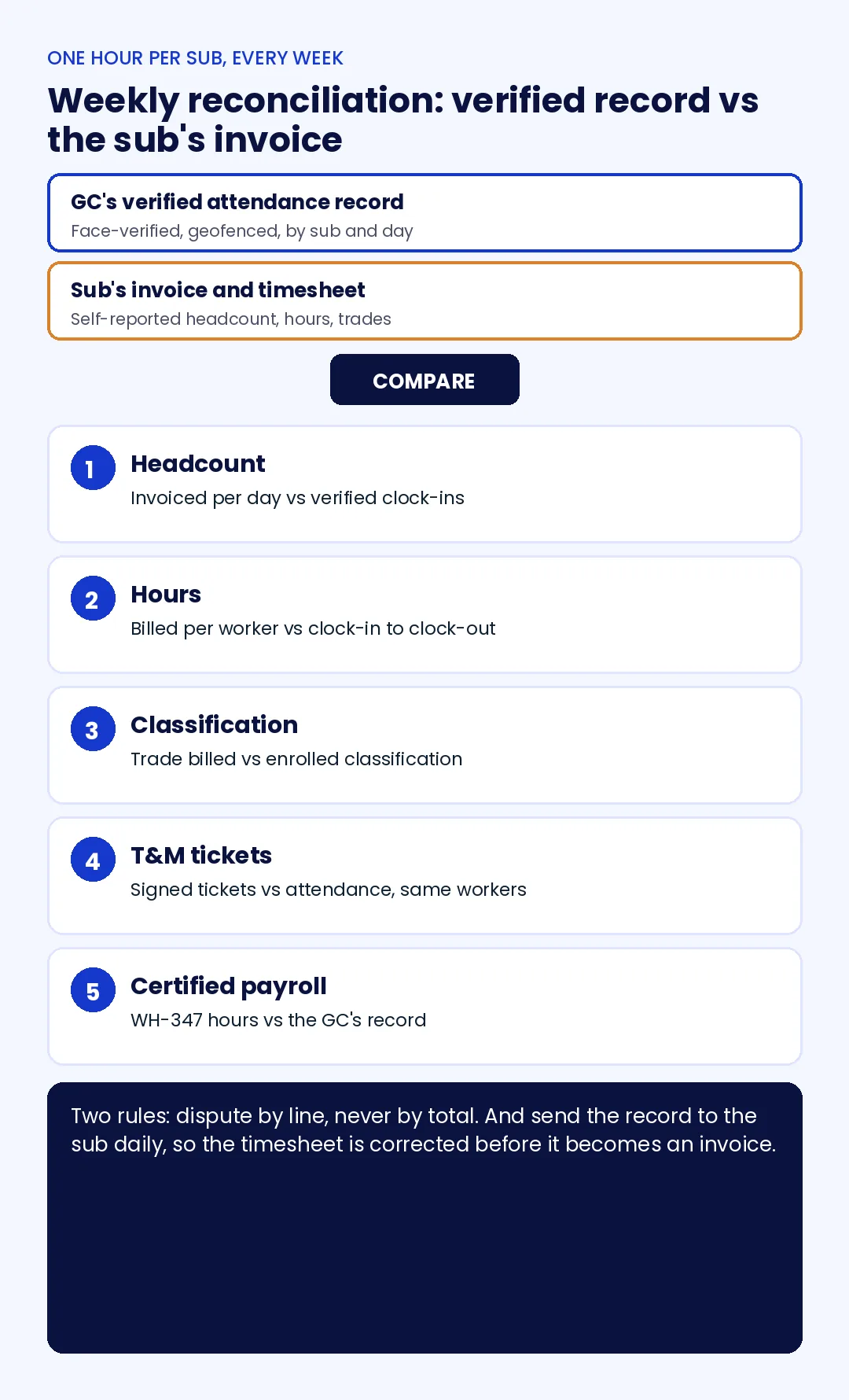
Two rules keep the routine from turning into a weekly fight. Dispute by line, never by total: a sub will argue with a 6 percent haircut and accept 14 named corrections with the record attached. And send the record to the sub daily, not weekly. A foreman who sees yesterday's verified headcount every morning corrects the timesheet before it becomes an invoice.
T&M tickets, certified payroll, and the subcontract clause that makes it all enforceable
Three documents turn subcontractor time tracking from a good practice into a contract term.
T&M tickets
Most subcontracts already say that time-and-materials work is paid only on a daily ticket signed by the GC's representative. The ticket records workers, classifications, and hours split into straight, overtime, and double time. Signing it certifies the hours; it does not certify the price. Attendance gives the signer something to sign against: a ticket showing eight hours for a worker who clocked out at 1:00 gets corrected on the spot rather than disputed at month end.
Certified payroll on public work
On federally funded projects the prime is responsible for every sub's weekly certified payroll. The Department of Labor's WH-347 form and instructions set out what each weekly submission has to contain, including hours by day and classification for each worker, under a signed statement of compliance. A prime that has its own attendance record can check a sub's WH-347 against actual presence before submitting it. A prime that does not is certifying a document it has no way to test.
The subcontract clause
None of this works if the sub's crew can decline to enroll. The subcontract should state that the sub's workers will record attendance through the GC's site system, that the GC's record is the basis for headcount and hours on labor-driven scopes, and that discrepancies are resolved against that record. Put it in the exhibit alongside safety orientation requirements, where subs already expect site rules.
The line not to cross: tracking hours without controlling the sub's workforce
A GC that records which of a sub's workers were on site, for how long, is doing what a prime has always done at the gate. A GC that starts setting those workers' schedules, approving their breaks, or disciplining them for lateness through the system is doing something else, and under joint-employer and independent-contractor tests in several states that something else can carry wage, benefit, and liability exposure.
The working distinction: track presence and hours for billing, safety, and compliance; leave supervision, scheduling, and discipline with the sub. Configure the system so the sub's foreman owns corrections to their crew's punches and the GC owns the reconciliation, not the other way round. And keep the tracking to clocked-in hours on site; a GC has no business knowing where a sub's workers are at 6 p.m.
This section is general information, not legal advice. Joint-employer and contractor-classification rules vary by state and change over time; confirm your subcontract language and tracking setup with construction counsel.
How Truein handles subcontractor time tracking for general contractors
Truein is a face recognition and GPS-based time and attendance platform built for contract and multi-site workforces, used by 500+ customers across 10,000+ locations. For a GC it runs as the site attendance layer across every sub: workers clock in by face on their own phone or a shared tablet kiosk at the gate, inside a geofence drawn to the work area, with no dedicated hardware to install.
Each subcontractor is set up as its own agency under the GC's account. Headcount caps are set per agency and attendance past the cap is flagged, each sub's supervisor gets a scoped view of only their own crew, and agency-level overtime, rounding, and break rules apply per sub so hours come out calculated the way the invoice should be. Document expiry and worker categories are held against each worker. New workers self-onboard with a selfie or are bulk-uploaded before their first shift, and delisted agencies or ex-workers can be blocked from clocking in. Punches captured with no signal sync later, flagged as captured offline.
Reconciliation runs from the dashboard: verified headcount and hours by sub, by site, by day, against which the sub's invoice is checked. Truein's contract workers attendance software page walks through the agency setup, and the construction time tracking software page covers the site-level clock-in options. Two limits worth stating: Truein feeds payroll and invoice review with verified hours rather than processing either, and workers who clock in at a kiosk and carry no phone are verified at the punch but not tracked after it, so pair kiosk sites with a gate clock-out.
Conclusion
A subcontractor invoice checked against the subcontractor's own timesheet has been checked against nothing. The fix is a record the GC owns: who was on site, how many each sub deployed, whether they were inside the boundary, and how long they stayed, verified at the punch and reconciled weekly against the invoice.
Set it up once, write it into the subcontract, send the record to each sub daily, and subcontractor time tracking stops being a monthly argument and becomes the fastest part of the pay application.
Frequently asked questions
How do general contractors track subcontractor hours on a job site?
The reliable methods run a GC-owned record alongside the sub's timesheet: badge or turnstile counts at the gate, or an attendance system at the site where each sub's workers clock in by face inside a geofence and the GC sees verified headcount and hours by company. Daily reports and sign-in sheets record what a foreman observed and rarely hold up when an invoice is disputed.
Should a general contractor track subcontractor employees' time at all?
Yes, on any scope where payment depends on hours or headcount, which covers time-and-materials work, cost-plus contracts, change orders, and every federally funded project where the prime certifies the sub's payroll. On a pure lump-sum scope the GC's exposure is the contract price, and tracking is a safety and headcount tool rather than a billing control.
Can tracking subcontractor hours make the GC a joint employer?
Recording presence and hours for billing, safety, and compliance is what primes have always done at the gate and does not by itself create joint employment. Risk rises when the GC uses the system to schedule, supervise, or discipline the sub's workers. Keep those functions with the sub's foreman, limit tracking to clocked-in hours on site, and confirm the setup with construction counsel.
What should a subcontractor timesheet include for a GC to accept it?
Worker name and classification, the site, date, clock-in and clock-out times rather than scheduled hours, hours split into straight time, overtime, and double time, the cost code or T&M ticket number where applicable, and a foreman signature. A GC with its own attendance record then checks each line against verified presence before approving.
How does subcontractor time tracking relate to certified payroll?
On federally funded work each subcontractor submits a weekly certified payroll, and the prime is responsible for the accuracy of what it passes on. A GC's own attendance record lets the prime compare a sub's reported hours by worker and day against actual site presence before submission, which is the only practical way to catch an error before a Department of Labor review does.
What is the fastest way to start subcontractor time tracking on an active site?
Pick one labor-driven sub, enroll that crew in a site attendance system over one shift using phone selfies or a kiosk at the gate, set the sub's contracted headcount as a cap, and run the weekly reconciliation on the next invoice. One month of a verified record against one sub's invoice shows the gap, and the subcontract clause for the remaining subs follows from that.
