




Ask a payroll manager where payroll leakage comes from and you will usually hear about tax tables, duplicate runs, and people paid after they left. Those leaks are real. They are also the ones payroll already looks for.
The bigger leak for companies with hourly, multi-site, or contract crews starts earlier, in the timesheet, where hours are recorded, corrected, and approved before payroll ever sees them. This guide explains what it is, the five points where it enters, why standard payroll audits miss most of it, and how to measure and stop it at the source.
What is payroll leakage?
Payroll leakage is the steady, mostly unintended loss of money through payroll: wages, overtime, and premiums paid for work that was not done, not owed, or not verifiable. It is different from a single payroll mistake because it repeats every pay period, and it is different from fraud because most of it involves no intent at all.
The scale is not small. A 2026 survey by UKG and KPMG, reported by HR Dive, found organizations lose 2% to 4% of total labor spend each year to leakage, and 38% reported annual losses between $1 million and $5 million. Most of that loss is never seen as a line item, because it is spread across thousands of hours that each look normal.
Leakage, error, and fraud are related but not the same. An error is a one-off mistake. Fraud is deliberate. Leakage is the pattern that results when either one is built into the process, such as a rounding rule that always favors the clock or a supervisor who approves every Friday without looking.
Where does payroll leakage start?
It starts wherever an hour is recorded or changed without proof. Between the moment a worker arrives and the moment a paycheck is issued, an hour passes through five points, and money can leak at each one.
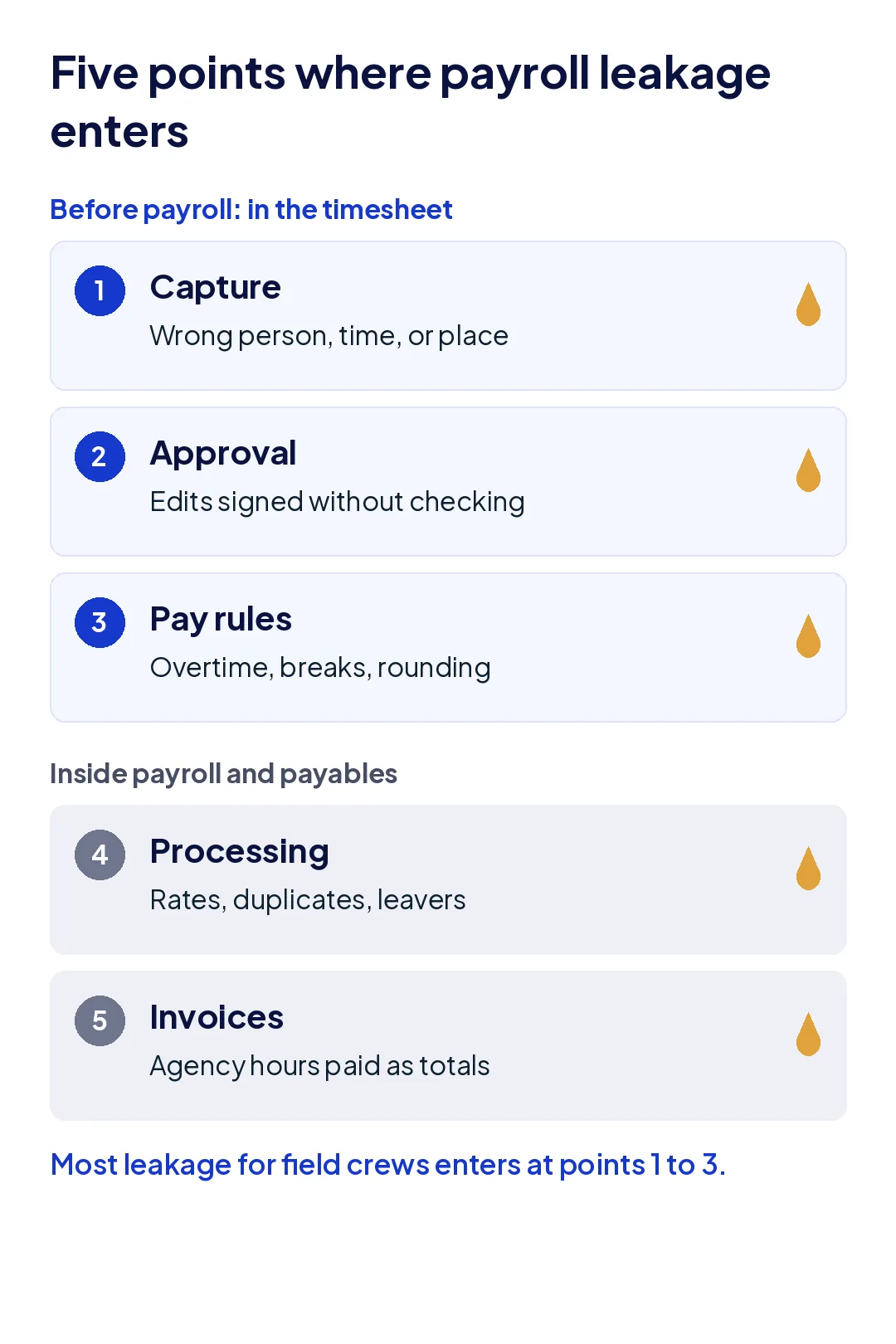
The first three points sit before payroll runs. For an office team they rarely matter. For crews spread across job sites, buildings, or warehouses, they are where most of the money goes, because nobody from the payroll team ever sees the work. The guide to the five timekeeping errors behind inaccurate labor hours breaks the capture and approval stages down further.
A facility services company with cleaning crews in 40 client buildings pays every hour its site leads submit. If each lead rounds the crew's start to the earlier quarter hour, the company pays for an extra eight to fifteen minutes per worker per shift. No single timesheet is wrong enough to notice. Every one of them leaks.
Why do payroll audits miss most payroll leakage?
Because payroll audits check the math, not the hours. Most payroll teams compare this run to the last one and investigate what changed. A new rate, a duplicate check, or an unusual overtime spike stands out. An hour that is padded the same way every week does not, because it looks exactly like last week.
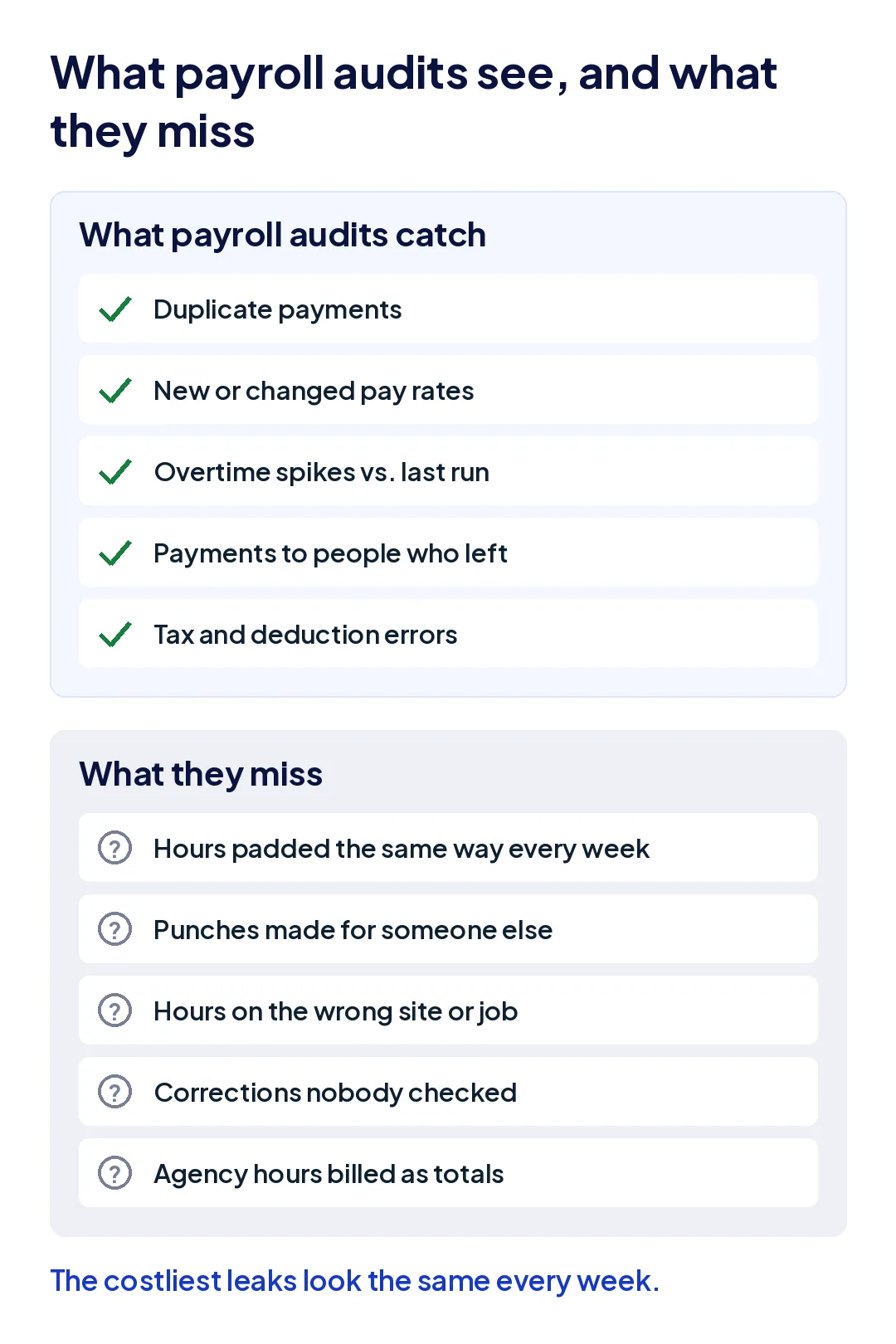
The UKG and KPMG survey found 89% of organizations use automated tools to compare payroll cycles, yet leakage persists at the same scale. That is not a tooling failure. Run-to-run comparison is built to catch change, and the most expensive leaks are stable. They also arrive looking approved: by the time an hour reaches payroll it carries a supervisor's sign-off, so the only record that could prove it wrong is the original punch, if one exists.
Payroll cannot fix what the timesheet already got wrong. It can only pay it accurately.
How much does payroll leakage cost?
Start with your own numbers rather than an industry average. Take hourly headcount, multiply by the minutes lost per worker per shift, by working days per year, by the average hourly rate.
For 120 hourly workers, 12 minutes a day, 250 working days, and a $28 rate, that is 6,000 paid hours a year that produced nothing, or $168,000 before overtime, payroll taxes, and benefits. Against a base payroll of about $7 million, that is roughly 2.4%, inside the range the survey reported, from a leak small enough that nobody would call it fraud.
The cost also does not stay in payroll. Hours that post to job cost or client billing carry the same error into estimates and invoices, which is why leakage in ERP labor posting shows up months later as jobs that lost money. Leakage can run the other way too: underpaid hours are a wage-and-hour liability, so the goal is accurate hours, not fewer hours.
Why do multi-site and contract workforces leak the most?
Every leak point gets wider when the person paying for the hour cannot see the work.
- No supervisor at the punch. When crews start at several sites at once, capture falls back on site leads, sign-in sheets, or a phone anyone can hold, which opens the door to buddy punching.
- Approval by trust. A supervisor covering four sites signs off on hours from three of them without having seen the crew.
- Different rules per site. Union, client, and state overtime rules end up in spreadsheets, where the same calculation error repeats every period.
- Contract labor outside the system. Agency and subcontractor workers usually have no record in the HRMS attendance module, so their hours arrive as an invoice total with nothing to check it against.
A general contractor running four active projects pays a drywall sub for 22 workers, eight hours a day. Its own records show a morning safety sign-in and nothing after it. Whether the invoice is right or 15% high, the contractor has no way to tell, and pays it either way.
How do you measure payroll leakage in your own data?
Pull raw punches for two pay periods, not approved timesheets, and run five checks. Each one points to a specific leak point, so the results tell you where to start.
If you cannot separate raw punches from approved hours, that is the first finding. It means the record payroll relies on has no original to compare against, and every other check becomes guesswork.
How do you stop payroll leakage at the timesheet?
Fix the leak points in the order hours pass through them. Tightening payroll review first catches the least, because by then each hour has already been recorded, corrected, and approved.
- Capture at the moment of work. Record the punch when the worker arrives, at the site, with the original time kept even when the device is offline.
- Verify who punched. A PIN proves someone knew the code and GPS proves a phone was on site. Only a face match proves the enrolled worker was there.
- Apply rules in the system. Configure overtime, breaks, rounding, and premiums once per site and worker category, instead of in a spreadsheet.
- Keep the original behind every edit. Every correction should record who changed what and why, and go to an approver who did not make it.
- Review exceptions, not rows. Flag the punches that look wrong, such as impossible travel or identical clock-in times, so supervisors check the few instead of signing the many.
- Put contract crews on the same record. Verified punches for agency and sub workers turn an invoice total into something you can reconcile.
Deliberate abuse, covered in the guide to timesheet fraud, closes with the same controls. Most leakage is not deliberate, which is why process fixes recover more than investigations do.
How does Truein stop payroll leakage at the source?
Truein is the verified layer between the workforce and payroll. Every punch carries a face match and a GPS geofence check, on a personal phone, a shared tablet at the gate, or a supervisor's device, and punches at sites with no signal are captured on the device with their original time.
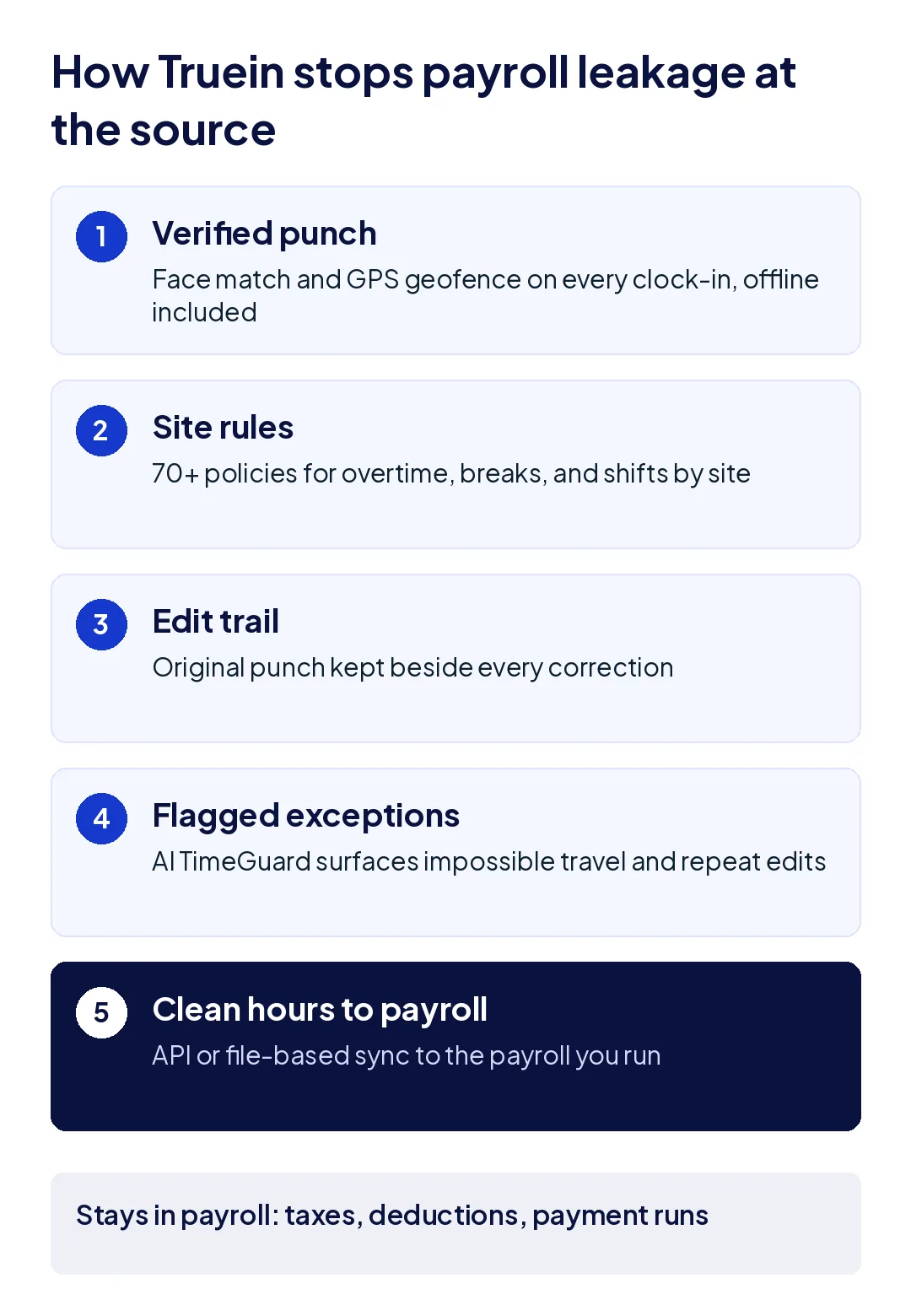
Smart capture rules flag late, off-site, duplicate, and missing punches at clock-in. More than 70 configurable policies apply overtime, break, and shift rules by location, worker category, and shift, and every edit keeps the original punch with the editor and reason attached. AI TimeGuard reviews records across sites before payroll and surfaces patterns such as impossible travel, identical clock-in timing, and repeated corrections. Agency and subcontractor crews run on the same account through contract workers attendance, so their hours exist as punches before the invoice does.
Verified hours sync to the payroll or HRMS you already run through API or file-based integrations. Truein serves 500+ customers across 10,000+ locations and 500,000+ workers. Where it stops: Truein does not run payroll, calculate taxes, or fix leaks that start in payroll processing itself. It makes sure the hours payroll pays are real.
Conclusion
Payroll leakage is not one big error. It is small, repeated, approved-looking overpayment, and for hourly, multi-site, and contract workforces most of it starts in the timesheet, before payroll runs. Run-to-run audits catch what changes; the leaks that cost the most stay the same every week.
Measure it with raw punches, find which leak points you have, and close them in order: capture, identity, rules, edits, and contract crews. Once the hours are verified at the punch, leakage shrinks to what payroll is actually built to catch.
Frequently Asked Questions
What is payroll leakage?
Payroll leakage is the ongoing loss of money through payroll for work that was not done, not owed, or cannot be verified. It includes padded or misattributed hours, wrong pay rules, edits with no trail, duplicate payments, and unverified agency invoices. It repeats every pay period, which is what separates it from a one-off payroll error.
What causes payroll leakage?
For hourly workforces, the biggest causes are hours recorded after the fact, punches made for someone else, corrections approved without checking, and pay rules applied wrongly. Payroll processing adds its own causes, such as incorrect rates, duplicate runs, and payments to people who have left.
How much payroll leakage is normal?
A 2026 UKG and KPMG survey found organizations lose 2% to 4% of total labor spend to leakage. The right number for your business comes from your own data: raw punches against paid hours, edit rates, and agency invoices against verified punches.
Is payroll leakage the same as time theft?
No. Time theft is deliberate, such as buddy punching or padding hours on purpose. Leakage covers that and more, including honest rounding, rule errors, and corrections nobody checked. Most leakage involves no intent, so it is fixed through process and verification rather than investigation.
Why don't payroll audits catch payroll leakage?
Most payroll audits compare one run against the previous run and investigate changes. Hours that are padded or misattributed the same way every week look normal in that comparison, and they arrive already approved, so the only record that can expose them is the original punch.
How do you prevent payroll leakage?
Verify hours at the punch with identity and location checks, apply pay rules in the system rather than in spreadsheets, keep the original record behind every edit, review flagged exceptions before payroll, and track contract and agency crews on the same system so their invoices can be reconciled.
