




What is construction payroll compliance?
Construction payroll compliance means paying every worker correctly under federal, state, and contract rules, and keeping records that prove it. For US contractors it covers FLSA overtime and recordkeeping, prevailing wage and certified payroll on public work, state daily overtime, worker classification, and tax withholding in every state where crews work.
- The seven layers of construction payroll compliance and when each one applies
- How to pay overtime when a worker splits a week across two trade rates
- What the DOL, prevailing wage, and IRS rules require you to keep, and for how long
- The pitfalls that turn a correct paycheck into a failed audit
- A weekly routine that keeps every site and subcontractor audit-ready
Most construction payroll violations do not start in payroll. They start on a Tuesday at a job site, when a foreman writes 7:00 for a crew that arrived at 7:20, a carpenter spends the afternoon on laborer work, and nobody records the drive from the yard. By the time the hours reach the payroll team, the rate, the overtime, and the certified payroll are being calculated on numbers that were never right.
This guide is for controllers, payroll managers, and ops heads at US contractors running crews across sites. It maps every layer of construction payroll compliance, the record each one depends on, the pitfalls behind most findings, and a weekly routine that keeps you audit-ready.
What does construction payroll compliance cover?
Construction payroll compliance covers seven overlapping layers of rules: the FLSA, Davis-Bacon and related acts, the Contract Work Hours and Safety Standards Act, state prevailing wage, state wage and hour law, worker classification, and payroll tax withholding. A single crew on a federally funded job in California can be subject to all seven in the same week.
| Layer | Applies when | What it requires | Record it depends on |
|---|---|---|---|
| FLSA | Every non-exempt worker | Minimum wage, overtime over 40 hours in a fixed workweek, records kept 2 to 3 years | Hours worked each day and each workweek |
| Davis-Bacon and related acts | Federal or federally assisted construction over $2,000 | Prevailing wage and fringe by classification, weekly certified payroll | Hours by day, by classification, by worker |
| Contract Work Hours and Safety Standards Act | Federal contracts over $100,000 | Overtime for hours over 40 in a workweek on covered work | Weekly hours on the covered contract |
| State prevailing wage | State or local public works, thresholds vary by state | State wage rates, state filings, the higher rate when federal also applies | Hours by project, county, and classification |
| State wage and hour law | Every state where crews work | Daily overtime in some states, meal and rest breaks, pay frequency, wage statements | Daily start, stop, and break times |
| Worker classification | Every person paid | Employee or contractor status, and the trade classification for the work performed | What each worker actually did, and for whom |
| Payroll tax withholding | Every state and locality worked | Withholding and unemployment tax where the work was performed | Work location by day |
Read the last column. Every layer draws from the same underlying facts: who worked, on which day, at which site, doing which kind of work, for how many hours. The time record is the compliance record. Payroll software can apply every rule correctly and still produce a violation if the hours it was given were wrong.
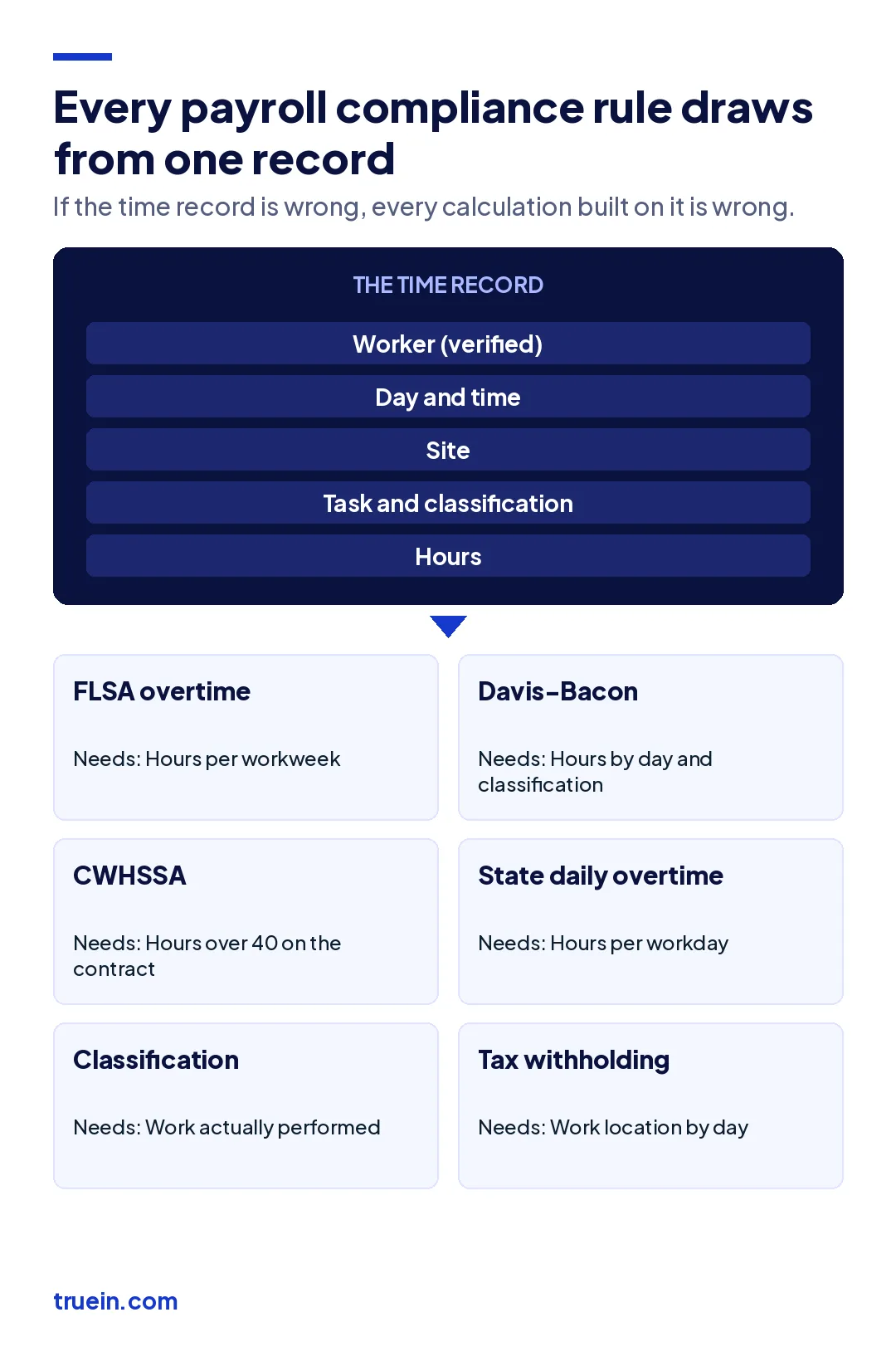
Which federal construction payroll compliance rules apply to every contractor?
The FLSA applies to every non-exempt worker on every job, public or private. Davis-Bacon and the Contract Work Hours and Safety Standards Act add to it on federal and federally assisted work. Four requirements do most of the work.
Overtime by the workweek
Non-exempt workers earn time and a half for hours over 40 in a workweek. The workweek is a fixed, recurring 168-hour period you set, and each one stands alone: a 50-hour week cannot be averaged against a 30-hour week to avoid overtime. Changing the workweek start to dodge overtime on a long pour is a pattern investigators look for.
Overtime when a worker splits rates
Construction workers often change trade classifications inside one week. Under 29 CFR 778.115, the regular rate for that week is the weighted average of all rates worked: total straight-time earnings divided by total hours. The alternative in 29 CFR 778.419, paying overtime at the rate for the work done during the overtime hours, is allowed only if you agreed it with the worker before the work was performed.
Take a worker with 32 hours of carpentry at $34 and 14 hours of laborer work at $26. Straight time is $1,452 for 46 hours, so the regular rate is about $31.57 and the overtime premium on six hours is $94.70. Paying the premium at the laborer rate gives $78 and underpays by $16.70 that week. Paying it at the carpentry rate is compliant but overpays. Some guides call the highest rate a requirement. It is not; the weighted average is the default.
Records and how long to keep them
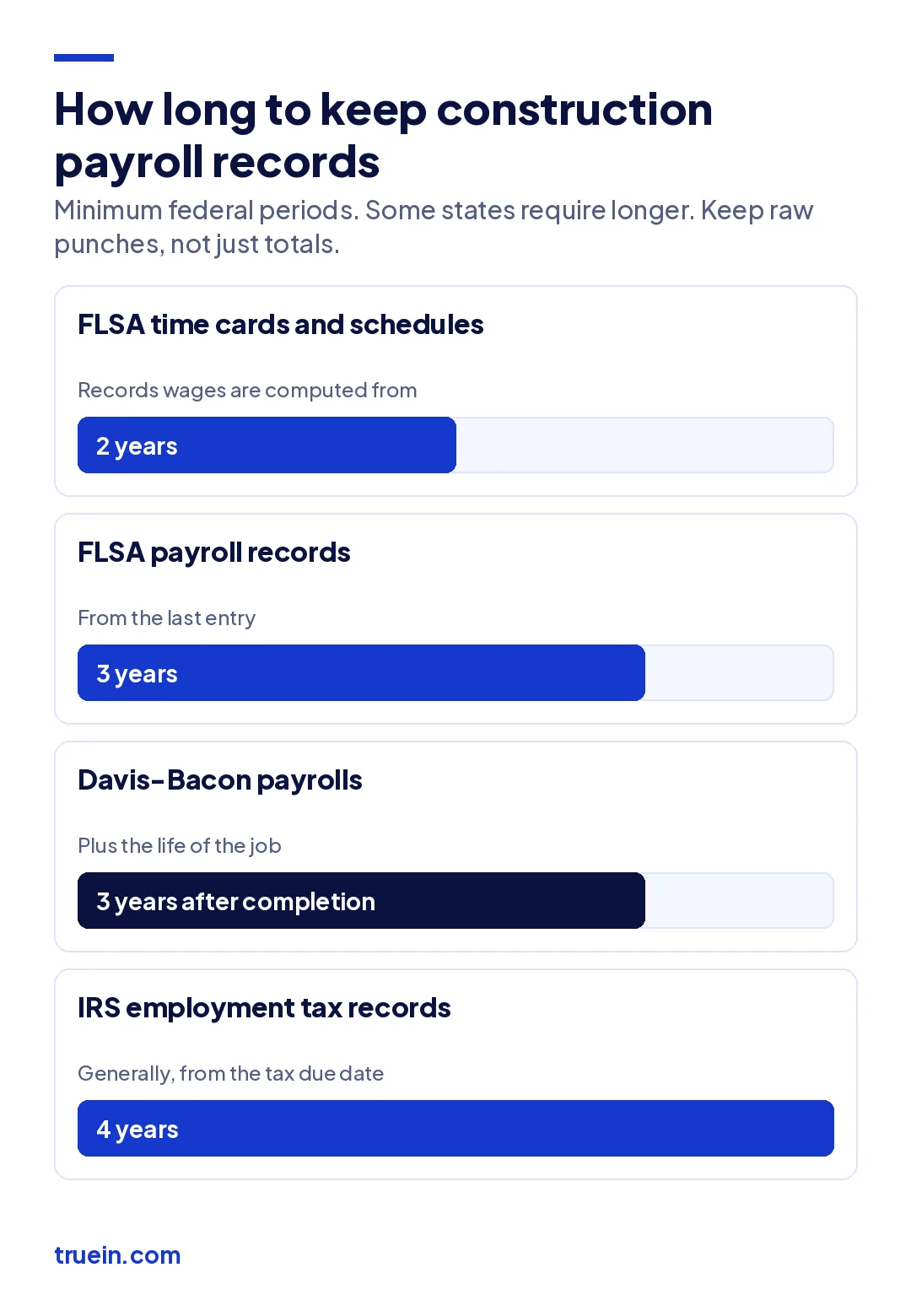
Under the FLSA recordkeeping rules, payroll records must be kept at least three years, and the records wages are computed from, including time cards, wage rate tables, and work schedules, at least two. The rules require no particular format, but they do require hours worked each day and each workweek. A timesheet that shows only an approved weekly total, with the raw punches deleted, is the most common way a correct paycheck becomes an unprovable one.
Davis-Bacon, certified payroll, and CWHSSA
Davis-Bacon applies to federal and federally assisted construction contracts over $2,000 and requires prevailing wages and fringe benefits by classification. Under the Davis-Bacon certified payroll clause, contractors submit payrolls weekly for each week in which any contract work is performed, with a signed Statement of Compliance, and keep payroll records for three years after the work is completed. Some contracting agencies also ask for a no-work notice in gap weeks, so read the contract rather than assuming either way. The weekly routine is covered in our guide to how to do certified payroll.
The Contract Work Hours and Safety Standards Act adds an overtime requirement on federal contracts over $100,000: time and a half for hours over 40 in a workweek on the covered work. On a prevailing wage job, overtime is calculated on the prevailing basic hourly rate, which is why the classification error and the overtime error usually arrive together.
How do state rules change the math?
State law sits on top of federal law, and where the two differ the rule more favorable to the worker generally applies. Four state-level areas catch multi-state contractors most often.
Daily overtime
California requires overtime for hours over eight in a workday and double time for hours over 12, along with seventh-consecutive-day rules, regardless of the weekly total. A crew working four 10-hour days earns eight hours of overtime in California and none under federal law. A payroll setup with one company-wide overtime rule will be wrong in every state that departs from the federal default.
State prevailing wage
Many states run their own prevailing wage programs for state and local public works, often called little Davis-Bacon acts, with their own rates, thresholds, filing portals, and penalties. When a project carries both federal and state funding, the usual result is the higher rate and both sets of paperwork.
Breaks, pay frequency, and wage statements
States set their own rules for meal and rest periods, how often workers must be paid, what a pay stub must show, and how final pay is handled. A missed meal period recorded nowhere cannot be paid for, which is why break start and end times belong in the same record as clock-in and clock-out.
Multi-state withholding
Income tax withholding and unemployment tax generally follow where the work is performed. A crew that works Monday in one state and Thursday across the line needs each day attributed to the right state, which only happens if the time record carries the site for every punch. The same site record decides whether a travel allowance is tax-free, as the guide to construction per diem rules explains.
Why is worker classification the most expensive pitfall?
Classification errors are expensive because they compound: one wrong decision about a worker repeats on every paycheck, every certified payroll, and every tax filing until someone catches it. Construction has two classification decisions, and both rest on what the worker actually did.
Employee or independent contractor. Federal law uses an economic reality test that asks whether the worker is economically dependent on you or in business for themselves. In February 2026 the DOL proposed replacing its 2024 rule with a framework close to its 2021 version, so check which rule is in force before relying on either. Several states, including California with its ABC test, apply a stricter standard regardless of the federal rule. A labor broker's crew paid on 1099s while taking direction from your superintendent all day is the scenario auditors start with.
Trade classification. On prevailing wage work, workers are paid the rate for the work performed, not the title on their file. A laborer who spends Wednesday setting forms is owed the carpenter rate for those hours, and the certified payroll has to show the split. That is only possible if hours are tagged to the task as they are worked.
What are the most common construction payroll compliance pitfalls?
The most common pitfalls are not exotic. They are ordinary field habits that become violations once payroll certifies the numbers. Most of them are invisible in a payroll register and obvious in a raw punch log.
| Pitfall | What it looks like | Rule it breaks | The fix |
|---|---|---|---|
| Reconstructed hours | Timesheets filled in on Friday from memory, round numbers everywhere | FLSA accuracy; certified payroll statement | Capture the punch at the site, at the time |
| Wrong overtime method on split rates | Overtime paid at the lower trade rate | 29 CFR 778.115 weighted average | Weighted average by default, or a written prior agreement |
| Classification by job title | A laborer doing carpentry paid the laborer rate | Davis-Bacon rate for work performed | Tag hours to the task actually done |
| Missed daily overtime | Weekly overtime only, on a California crew | State daily overtime | Rules set by site location, not company default |
| Unpaid travel between sites | Drive from the yard to the job left off the clock | FLSA hours worked | Record the first punch where compensable work starts |
| Raw punches deleted | Only edited, approved totals kept | FLSA 2-year time card retention | Keep raw punches and the edit trail |
| Sub payrolls not checked | Prime submits subs' WH-347s unread | Prime's responsibility for subs' payrolls | Check sub hours against site attendance |
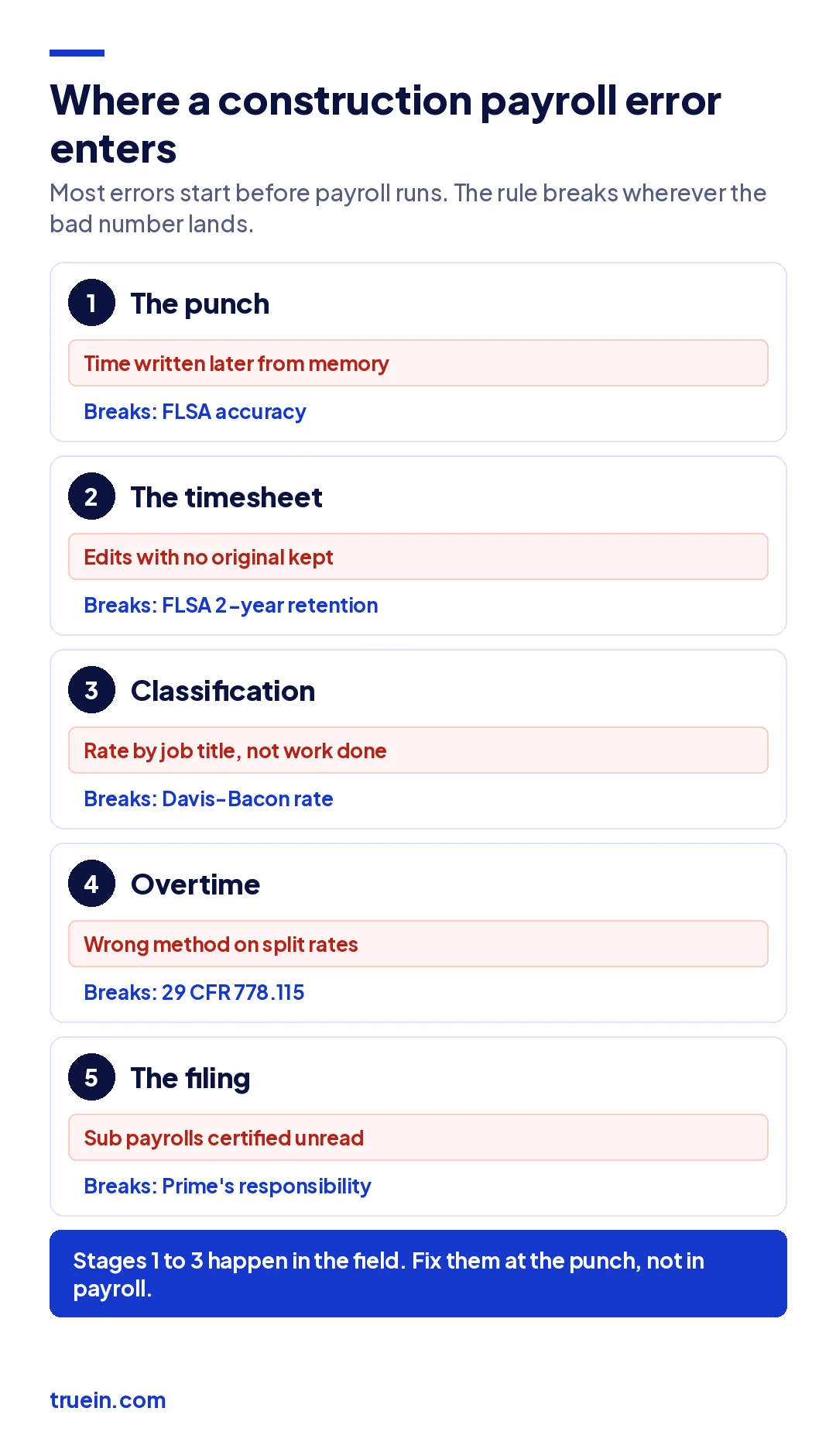
Notice where the fixes sit. Five of the seven are fixed at the punch or in the time record, not in payroll. Travel between sites, the pitfall payroll misses most often, is broken down trip by trip in our guide to travel time pay for construction workers. That is the same pattern behind the five timekeeping errors behind inaccurate labor hours, and why common construction payroll issues so rarely start with the payroll team. Left alone, the gap shows up as payroll leakage on one side and back-wage exposure on the other.
How do you build an audit-ready construction payroll compliance process?
An audit-ready process produces, for any worker and any week, a record that shows when they worked, where, on what, at which rate, and who changed anything after the fact. Build it in this order:
- Capture hours at the site, verified at the punch. The worker's identity, the site, and the time are recorded when work starts, not reconstructed later. Sites without signal need on-device capture that keeps the original timestamp; the offline attendance guide for construction sites covers what that record must preserve.
- Tag every punch to a site and a task. Site drives withholding and state rules. Task drives trade classification and job cost. The tools built for this are compared in our roundup of construction labor tracking tools.
- Configure rules by location and worker category. Daily overtime for California crews, weekly for the rest, prevailing wage rates per project, break rules per state. One company-wide rule set will be wrong somewhere.
- Keep raw punches and every edit. Retain the original punch, the editor, the reason, and the approver for at least the FLSA two-year period, and three years after completion on Davis-Bacon work.
- Review exceptions daily, not at the cutoff. Missing clock-outs, edited punches, and overtime spikes are cheap to fix the same day and expensive to explain in an audit. The approval side of that daily review is covered in our guide to approving timesheets by exception.
- Check every sub's certified payroll before you submit it. Compare each sub's reported hours against site attendance for the same week. The subcontractor time tracking guide lays out that weekly reconciliation.
- Run a quarterly self-audit. Pull five workers on one prevailing wage job and trace each from raw punch to paycheck to certified payroll. Any step you cannot show is the finding an investigator would make.
Picture a mechanical contractor with crews on a federally funded school, two private office fit-outs, and a California warehouse in the same month. One record that carries site, task, and verified time for every punch lets payroll apply Davis-Bacon on the school, daily overtime in California, and standard FLSA everywhere else, without a spreadsheet per job. The same applies to a facility management company running crews on public buildings under state prevailing wage contracts.
How does Truein support construction payroll compliance?
Truein is a face recognition and GPS-based time and attendance platform for contract and multi-site workforces, used by 500+ customers across 10,000+ locations and 500,000+ workers. In construction payroll compliance it is the record layer: it makes the hours payroll receives verifiable, before any rule is applied to them.
Workers clock in with a live face match inside a GPS geofence on their own Android or iOS phone or a shared tablet kiosk, with no dedicated hardware, so every punch carries a verified identity, a site, and the time it happened. Punches made without signal are captured on the device and sync later with their original time. Activity Punch tags time to a job, task, or cost code, which is what lets a split week show carpentry hours and laborer hours separately.
More than 70 configurable policies apply overtime, break, holiday, and shift rules by location, worker category, and shift, and every edit keeps the original punch with the editor and reason attached. AI TimeGuard flags repeated corrections, overtime spikes, and identical clock-in timing across a crew before payroll runs. Subcontractors operate as separate agencies under one account with scoped supervisor views, and verified hours export to payroll systems including ADP, QuickBooks, Sage, Paychex, Xero, and Trimble. Truein is ISO 27001:2022 certified and SOC 2 Type II compliant.
Two honest limits. Truein is not payroll software: wage rates, tax withholding, the WH-347, and state filings come from your payroll system and your team. And Truein applies the rules you configure, so the overtime basis and classification decisions still need payroll and counsel to sign off at rollout. The construction time tracking software page shows the site setup, and the contract workers attendance page covers subcontractor configuration.
This guide is general information, not legal or tax advice. Wage and hour, prevailing wage, and classification rules vary by state and change over time; confirm your obligations with employment counsel and your payroll provider.
Conclusion
Construction payroll compliance looks like a payroll problem and behaves like a timekeeping problem. Every layer, from FLSA overtime to Davis-Bacon classifications to California daily overtime to multi-state withholding, is calculated from the same facts about who worked where, on what, and for how long.
Verify those facts at the punch, tag them to a site and a task, keep the raw record and every edit, and configure rules by location. Do that, and construction payroll compliance stops being a quarterly scramble and becomes a record you can hand to any auditor on any job.
Frequently Asked Questions
What records does a construction company need to keep for payroll compliance?
Under the FLSA, keep payroll records for at least three years and the records wages are computed from, such as time cards and schedules, for at least two. On Davis-Bacon work, keep payrolls and basic records for three years after the work is completed. IRS employment tax records are generally kept at least four years, and some states require longer.
How is overtime calculated when a construction worker has two pay rates?
By default, use the weighted average: total straight-time earnings for the week divided by total hours, with half that rate paid as the premium on overtime hours. You can instead pay overtime at the rate for the work done during the overtime hours, but only under an agreement made with the worker before the work.
Do you have to submit certified payroll in weeks with no work?
The federal Davis-Bacon clause requires payrolls for each week in which any contract work is performed. Many contracting agencies also ask contractors to report gap weeks so the sequence stays unbroken, so follow your contract's instructions and confirm with the contracting officer when a project pauses.
Is travel time paid on construction jobs?
Ordinary commuting from home to the job site is generally not paid. Travel that is part of the workday, such as reporting to the yard and then driving to the site, or moving between sites during the shift, generally counts as hours worked under the FLSA. State law and union agreements can add more.
Which states require daily overtime for construction workers?
California is the best-known example, with overtime over eight hours in a workday and double time over 12. A few other states have daily overtime rules for some workers. Configure overtime by work location rather than one company-wide rule, and check each state's labor department before crews start work there.
Can a general contractor be liable for a subcontractor's payroll violations?
On Davis-Bacon work, yes. The prime contractor is responsible for subcontractors' compliance, and unpaid wages can be withheld from contract payments. On private work, joint employer and state wage-theft laws can also reach the general contractor. Checking each sub's payroll against site attendance is the practical safeguard.
