



What is per diem in construction?
Per diem in construction is a daily allowance a contractor pays workers who travel away from home overnight for a job, to cover lodging, meals, and incidentals. Paid under an accountable plan at or below federal rates, it is not taxable wages and stays out of the overtime rate. Paid by the hour or to local crews, it becomes wages.
- What per diem in construction covers, and how it differs from travel time pay
- The four tests that keep per diem out of taxable wages
- The FY2027 federal and IRS rates that take effect October 1, 2026
- Why per diem paid by the hour raises the overtime rate
- The attendance records that prove each day of per diem was earned
A contractor wins a job four hours away, books a block of hotel rooms, and promises the crew $75 a day on top of wages. Six months later an auditor reclassifies most of it as taxable pay, a former worker files an overtime claim, and nobody can say which days each worker was actually on the job. Each problem traces back to how the per diem was set up.
This guide is for owners, controllers, and payroll managers at US contractors sending crews to out-of-town work. It explains what per diem in construction is, the IRS rules that keep it tax-free, current federal rates, the overtime trap, and the records that prove each day.
What is per diem in construction?
Per diem in construction is a fixed daily allowance a contractor pays a worker who travels away from home overnight for a job. It covers lodging, meals, and incidental expenses such as tips and laundry, and it replaces receipt-by-receipt reimbursement with a flat amount per day. It is common on remote jobs, storm work, pipeline and utility projects, and specialty trades that follow the work.
Three things are often called per diem and are not the same:
- A travel expense allowance. Paid for days away from home under an accountable plan. This is what the IRS rules below are about, and it is not wages.
- Travel time pay. Wages for hours spent traveling as part of the workday. It is paid at an hourly rate and counts toward overtime; the trip-by-trip rules are in our guide to travel time pay for construction workers.
- Subsistence or zone pay under a union agreement. Set by the collective bargaining agreement, with its own rules for who qualifies and how it is taxed.
Mixing the first and second is where most per diem problems start. An allowance for a hotel night is an expense. Money for hours on the road is pay.
When is per diem in construction tax-free?
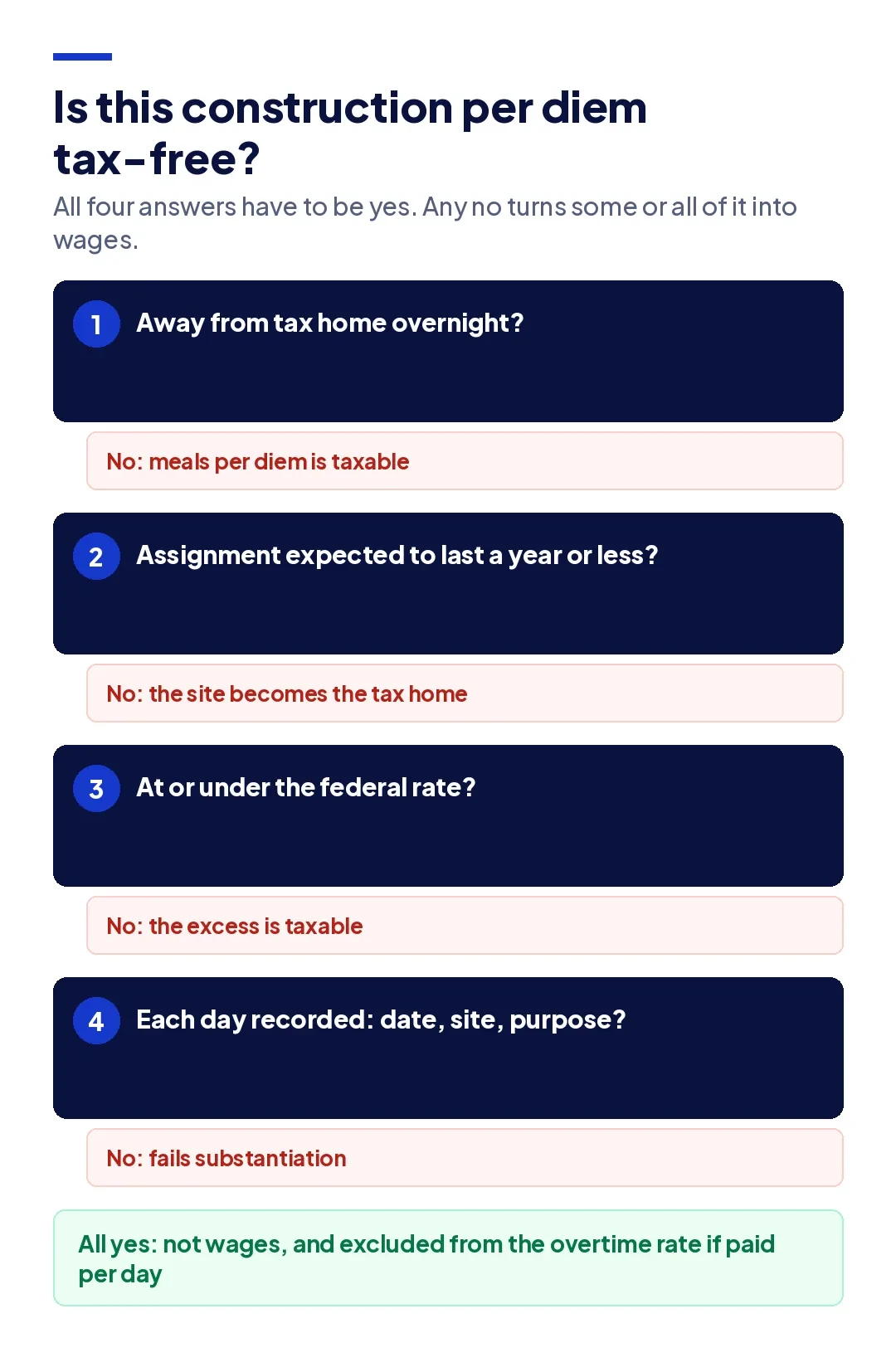
Per diem in construction is tax-free to the worker and deductible to the contractor when four conditions are met. Miss any one and some or all of the payment becomes taxable wages subject to withholding and payroll taxes.
1. The worker is away from their tax home overnight
A tax home is the general area of a worker's main place of work, not necessarily where they live. Meal and lodging allowances qualify only when the trip requires sleep or rest away from that area. A crew that drives to a site 90 minutes away and home again each night is not traveling overnight, so a meals per diem paid to them is taxable.
2. The assignment is temporary
A job expected to last a year or less is temporary. A job expected to last more than a year is not, and from the day that expectation exists the job site becomes the worker's tax home and per diem becomes taxable. Long infrastructure projects cross this line more often than contractors notice.
3. The amount is at or under the federal rate
An allowance up to the federal per diem rate for the location is deemed substantiated for the amount. Anything paid above that rate is taxable wages unless the worker substantiates actual expenses for the difference.
4. The payment runs through an accountable plan
An accountable plan requires a business connection, substantiation, and return of any excess within a reasonable time. With per diem, the amount is deemed substantiated, but the time, place, and business purpose of each day are not. The contractor still has to prove the worker was away on the job on each day the allowance was paid. That proof is an attendance record.
| Situation | Taxable wages? | Why |
|---|---|---|
| Crew in a hotel 200 miles from home, paid at or under the federal rate, nights recorded | No | Away overnight, temporary job, deemed substantiated |
| Local crew paid a flat daily per diem | Yes | Not away from their tax home, so there is no travel expense to reimburse |
| Worker on a remote job who drives home every night | Yes, for the meals portion | No overnight stay, so meal allowances do not qualify |
| Assignment expected to last more than a year | Yes | Not temporary, so the job site becomes the tax home |
| Per diem above the federal rate | The excess only | Only the amount up to the federal rate is deemed substantiated |
| Per diem with no record of dates, place, or purpose | Yes | Fails the accountable plan substantiation test |
What are the per diem rates for 2026 and 2027?
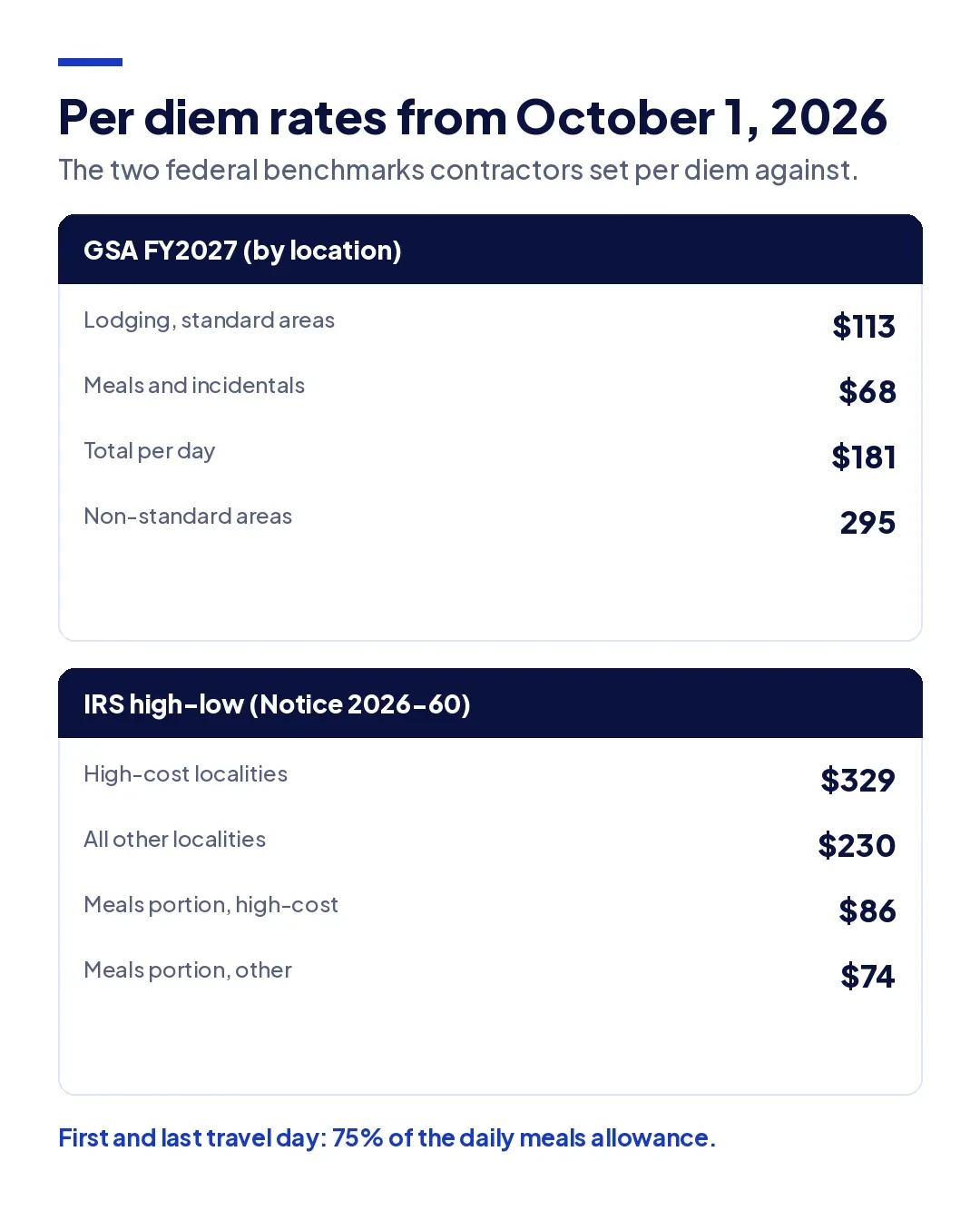
Contractors usually tie per diem to one of two federal benchmarks: the GSA rates by location, or the IRS high-low method, which collapses the country into two flat rates. Both changed on October 1, 2026.
| Rate | Lodging | Meals and incidentals | Total per day |
|---|---|---|---|
| GSA standard CONUS rate | $113 | $68 | $181 |
| GSA non-standard areas (295 locations) | Set by location and season | $68 to $92 | Varies |
| IRS high-low: high-cost localities | Included | $86 treated as meals | $329 |
| IRS high-low: all other localities | Included | $74 treated as meals | $230 |
The GSA standard rate applies to most of the continental US. For FY2027 it is $113 for lodging and $68 for meals and incidentals, $181 a day, with 295 non-standard areas set higher. Check any job location in the GSA per diem rate lookup before quoting a crew a number, because rates in many areas change by season.
Under IRS Notice 2026-60, the high-low rates for travel from October 1, 2026 are $329 a day for high-cost localities and $230 for everywhere else, with $86 and $74 of those amounts treated as meals. Employers who used the prior rates may keep them through December 31, 2026, but must apply that choice consistently through the end of the year.
Two practical rules affect almost every construction trip. On the first and last day of travel, the federal meals allowance is 75 percent of the daily rate. And a per diem for meals only, with lodging paid directly by the contractor, uses the M&IE figure, not the combined rate.
How does per diem affect overtime?
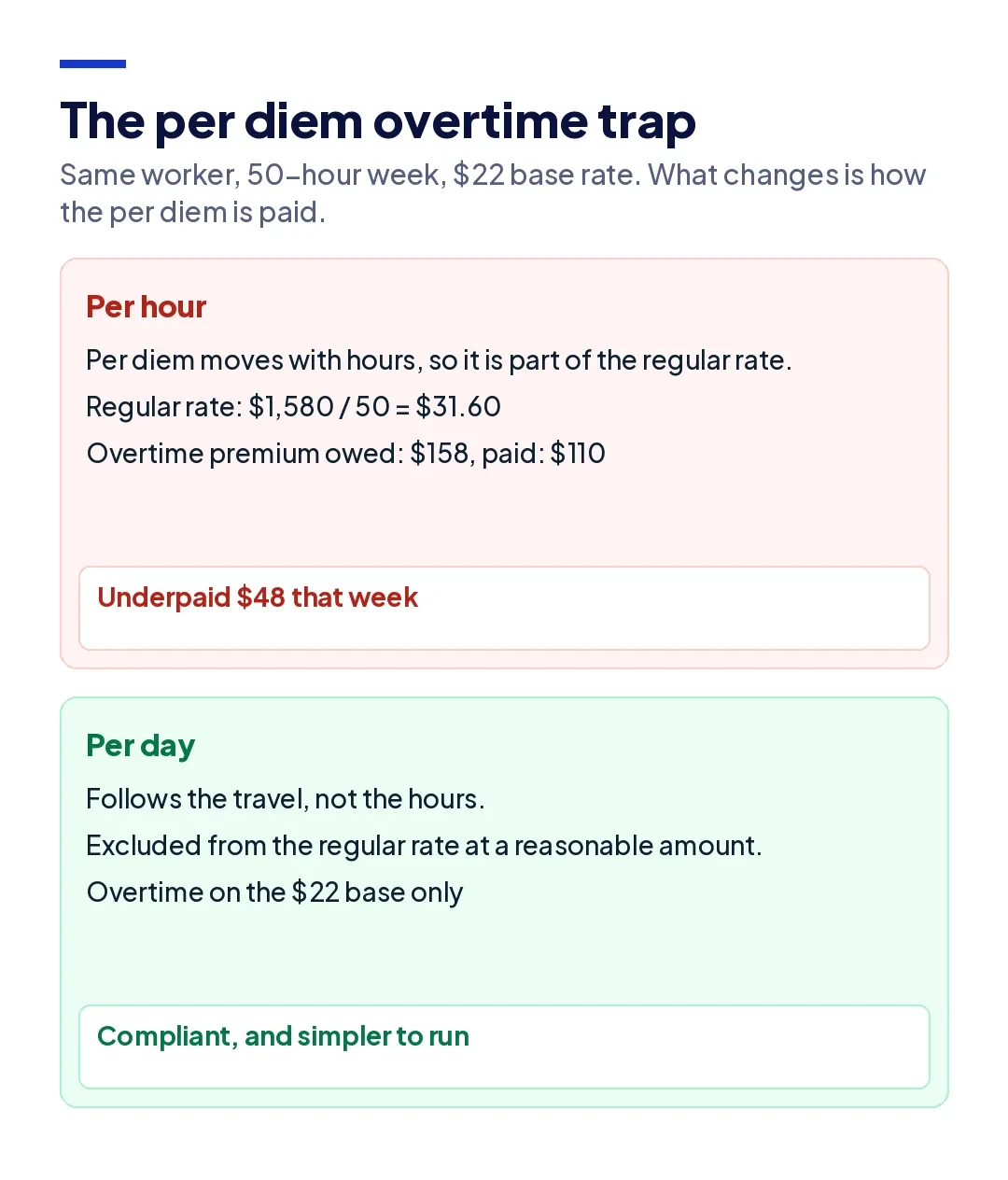
Per diem that genuinely reimburses travel expenses is excluded from the regular rate used for overtime. Per diem that varies with the hours worked is not. Under 29 CFR 778.217, payments based on hours worked are part of the regular rate in their entirety, and in Gagnon v. United Technisource the Fifth Circuit held an employer liable for paying an hourly "per diem" capped at 40 hours and leaving it out of overtime.
Take a worker paid $22 an hour plus $12 per diem for each hour worked up to 40, who works 50 hours. The contractor pays $1,100 in straight time, $110 in overtime premium on the $22 rate, and $480 in per diem, for $1,690. Because the per diem moved with the hours, it belongs in the regular rate: $1,580 divided by 50 hours is $31.60, and the premium owed on 10 overtime hours is $158. The worker was owed $1,738 and was underpaid $48 that week.
The compliant setup is simpler. Pay a flat amount for each day or night away, at or under the federal rate, whatever the hours. The DOL treats a reduced allowance for a partial travel day, such as a worker who returns home at noon, as still excludable, because it follows the travel, not the hours.
Per diem also cannot stand in for wages on prevailing wage work. On Davis-Bacon and state prevailing wage jobs, the required basic rate and fringe benefits have to be paid in full, and a travel allowance does not count toward either. Keep per diem off the wage lines of certified payroll, and treat the wider set of rules that ride on the same record as part of construction payroll compliance.
What are the most common construction per diem mistakes?
Most per diem findings come from setup choices made once and repeated on every paycheck:
- Paying per diem by the hour. It raises the overtime rate and signals that the allowance is really wages.
- Paying per diem to local crews. A worker who sleeps at home has no travel expense, so every dollar is taxable pay.
- Swapping wages for per diem. Lowering the hourly rate and raising the allowance to cut payroll taxes is the pattern auditors and courts look for first.
- Missing the one-year line. Per diem keeps going after a project is extended past a year, and becomes taxable from the day the extension was expected.
- Paying for days the worker was not there. A weekly per diem for seven days when the crew went home Friday through Sunday pays two days with no business purpose.
- No record behind the payment. Per diem paid off a crew list instead of verified days on site fails substantiation even when every amount was correct.
The last two are where per diem turns into payroll leakage: money paid out for days that cannot be proven, multiplied across a crew and a season.
How do you track per diem eligibility on remote jobs?
Track per diem from the same record you use for hours, so each allowance points to a verified day at a remote site. A per diem policy that works in an audit has five parts:
- Define eligibility by distance and overnight stay. Set the distance from the worker's tax home that qualifies, and pay only for nights away. Put it in a written policy every traveling worker signs.
- Set the amount per day, not per hour. Use the GSA rate for the site, or one of the high-low rates, and apply the 75 percent rule to travel days.
- Record each day on site with identity and location. A punch at the remote site, tied to the worker and the date, is the substantiation for time, place, and purpose.
- Calculate per diem from the attendance record. Count verified days at the remote site, not days on the crew list, and flag days when a worker clocked in at a home-area site instead.
- Review the one-year line monthly. Track how long each worker has been on each project, and stop tax-free treatment the day an assignment is expected to run past a year.
Remote jobs are also where signal drops out, so punches must be captured on the device and keep their original time; the offline attendance guide for construction sites covers what that record has to preserve. For subcontracted crews, the GC can check a sub's per diem charges against the same days on site, using the reconciliation in the subcontractor time tracking guide.
A facility management company sending a project team to service buildings in another state faces the same rules: per diem for nights away, a record of each day at the client site, and wages kept separate from the allowance.
How does Truein support construction per diem tracking?
Truein is a face recognition and GPS-based time and attendance platform for contract and multi-site workforces, used by 500+ customers across 10,000+ locations and 500,000+ workers. For per diem it is the record that proves eligibility: which worker was at which remote site on which day.
Each job site gets its own geofence, and workers clock in with a live face match on their own Android or iOS phone or a shared tablet kiosk, with no dedicated hardware to install. The punch carries the worker's verified identity, the site, and the time, which is what a per diem day has to show. Punches on remote sites with no signal are captured on the device and sync later with their original time.
Reports by worker, site, and date give payroll a count of verified days at each remote location to calculate per diem from, kept separate from hours worked so the allowance never drifts into an hourly payment. Activity Punch tags time to a job or cost code, and subcontractor crews run under the same account with scoped supervisor views. Verified hours export to payroll systems including ADP, QuickBooks, Sage, Paychex, Xero, and Trimble.
Two honest limits. Truein does not calculate or pay per diem, look up GSA rates, or manage expenses; the rate, policy, and payment sit in your payroll or expense system. And Truein records presence at the site, not hotel stays, so overnight eligibility still rests on your policy and lodging records. The construction time tracking software page shows the site setup, and the contract workers attendance page covers subcontractor configuration.
This guide is general information, not tax or legal advice. Per diem rules depend on each worker's tax home, the length of the assignment, state law, and any collective bargaining agreement; confirm your policy with a tax adviser and employment counsel.
Conclusion
Per diem in construction is simple when it follows the travel: a flat amount for each night away on a temporary job, at or under the federal rate, backed by a record of each day on site. It becomes expensive when it follows the hours, goes to crews who sleep at home, or runs past a year without anyone noticing.
Set the amount per day, tie it to verified days at the remote site, keep it off the wage lines, and check the one-year line every month. Do that, and per diem in construction stays what it is supposed to be: a tax-free allowance that helps you staff the jobs other contractors cannot.
Frequently Asked Questions
Is per diem taxable for construction workers?
Not when it meets the IRS rules: the worker is away from their tax home overnight on a temporary job, the allowance is at or under the federal rate, and the employer has an accountable plan with a record of each day. Per diem paid to local crews, above the federal rate, or without that record is taxable wages.
How much is per diem for construction workers in 2027?
There is no single construction rate. Most contractors use the GSA rate for the job location, which is $113 for lodging and $68 for meals and incidentals in standard areas from October 1, 2026, or the IRS high-low rates of $329 for high-cost localities and $230 elsewhere. Many pay a lower flat amount when lodging is booked directly.
Does per diem count toward overtime?
Only if it varies with hours worked. A flat daily allowance for travel expenses at a reasonable amount is excluded from the regular rate. Per diem paid per hour, or reduced when a worker works fewer hours, is part of the regular rate and raises the overtime owed.
Can a contractor pay per diem instead of wages?
No. Per diem reimburses travel expenses and cannot replace pay for hours worked. Lowering the hourly rate and raising per diem to cut payroll taxes or overtime is treated as disguised wages, and on prevailing wage jobs the full wage and fringe rates must still be paid.
What records do you need to support per diem?
For each day of per diem, keep the worker's name, the date, the job location, and the business purpose, plus the policy that sets eligibility and the rate used. A verified attendance record at the remote site covers the date, place, and purpose for every day paid.
When does per diem stop being tax-free on a long project?
When the assignment is expected to last more than a year. From the date that expectation exists, the job site becomes the worker's tax home and per diem paid after that is taxable wages, even if the project later ends sooner.