


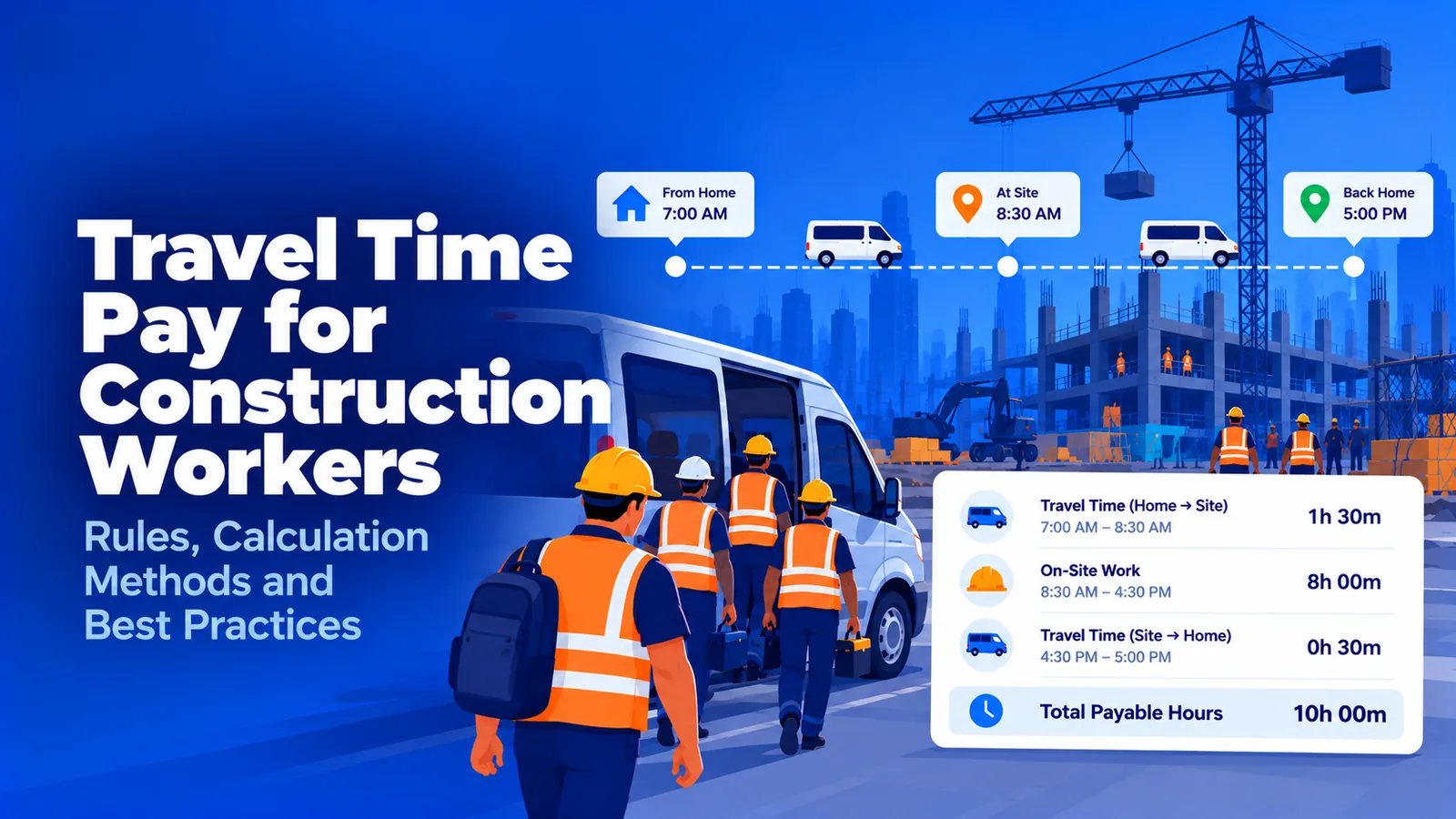

Do construction workers get paid for travel time?
Under the FLSA, a construction worker's ordinary commute from home to the job site is not paid, but travel that is part of the workday is. That includes driving from the yard to the site when required, moving between sites during the shift, one-day trips to another city, and overnight travel during normal working hours. State law can require more.
- Which construction trips are paid under the FLSA, and which are ordinary commuting
- What the DOL's construction opinion letter says about foremen, laborers, and company trucks
- How to calculate travel pay, including a separate travel rate and overtime
- Where state law and union agreements go further than federal rules
- The records that prove travel time was paid correctly
A foreman picks up the truck at the yard at 6:15, loads the generator, collects two laborers, and reaches the job at 7:05. Which of those 50 minutes are paid, and for whom? Most contractors answer with a company habit rather than the rule, and the habit is usually wrong for at least one person in the truck.
This guide is for payroll managers, controllers, and ops heads running crews across US job sites. It sets out travel time pay for construction workers trip by trip under the FLSA, what the DOL said about foremen and laborers in its construction opinion letter, how to calculate the pay, and the records that prove it.
What does the FLSA say about travel time pay for construction workers?
The FLSA treats travel time pay for construction workers by asking one question: is the travel part of the workday, or is it the commute? Under the Portal-to-Portal Act, travel to and from the place where the worker performs their principal activities is not paid when it happens before work starts or after it ends. Travel after the first principal activity of the day and before the last one is work time.
The DOL's interpretive rules in 29 CFR 785.33 to 785.41 apply that to the situations construction runs into every week:
- Home to work (785.35). Ordinary travel between home and the job site is not work time, whether the worker goes to a fixed site or a different site every week.
- Travel during the workday (785.38). Travel from a place where the worker must report to receive instructions, do work, or pick up tools is part of the day's work, as is travel from one site to another.
- One-day trips to another city (785.37). Paid, less the time the worker would normally spend commuting.
- Overnight travel (785.39). Paid when it cuts across normal working hours, even on a day the worker would not normally work. Passenger travel outside normal hours is not counted, as an enforcement policy.
- Work while traveling (785.41). A worker who is required to drive, or does other work during the trip, is working.
One refinement matters more on job sites than anywhere else. Being required to report to the yard does not, by itself, make the drive to the site paid. Since the Supreme Court's 2014 decision in Integrity Staffing Solutions v. Busk, the activity at the yard has to be integral and indispensable to the work the employee is hired to do, such as loading the tools and materials the crew needs.
Which trips count toward travel time pay for construction workers?
Most construction trips fall into one of eight patterns. The answer turns on where the workday starts, who is required to do what before the crew leaves, and whether the trip happens during normal working hours.
| Trip | Paid under the FLSA? | Why | Record that proves it |
|---|---|---|---|
| Home to the job site | No | Ordinary home-to-work commuting, 29 CFR 785.35 | First punch at the site |
| Home to the yard or shop | No | Still the commute, even if the worker reports there first | First punch at the yard |
| Yard to the job site, when required to report, load, or drive the truck | Yes | Part of the day's work once the first principal activity starts, 785.38 | Yard punch, site punch, travel tagged |
| Job site to job site during the shift | Yes | Travel during the workday is work time, 785.38 | Clock-out and clock-in by site, or a travel tag |
| Last site to home | No | End-of-day commute, unless the worker must first return the truck or tools | Last punch at the site or yard |
| One-day trip to another city | Yes, minus the normal commute | Special one-day assignment, 785.37 | Departure and return times, usual commute |
| Overnight trip during normal working hours | Yes, weekends included | Travel away from home that cuts across work hours, 785.39 | Travel start and end times by day |
| Overnight trip outside normal hours as a passenger | No, by DOL enforcement policy | 785.39 | Proof the travel fell outside normal hours |

The yard decides most of the money. A worker who drives straight to the site is commuting. The same worker who is required to report to the yard first, load the truck, and ride out with the materials has started work at the yard. Two laborers in the same truck can be in different positions depending on what each was required to do there.
The site-to-site drive is the trip contractors miss most. A crew that finishes a punch list at one building and drives 25 minutes to another has been working the whole time. If the time record shows one clock-in at the first site and one clock-out at the second, those 25 minutes are paid by accident, or not at all if a foreman rounds the day down. It is one of the attribution errors behind inaccurate labor hours.
What did the DOL's construction opinion letter decide?
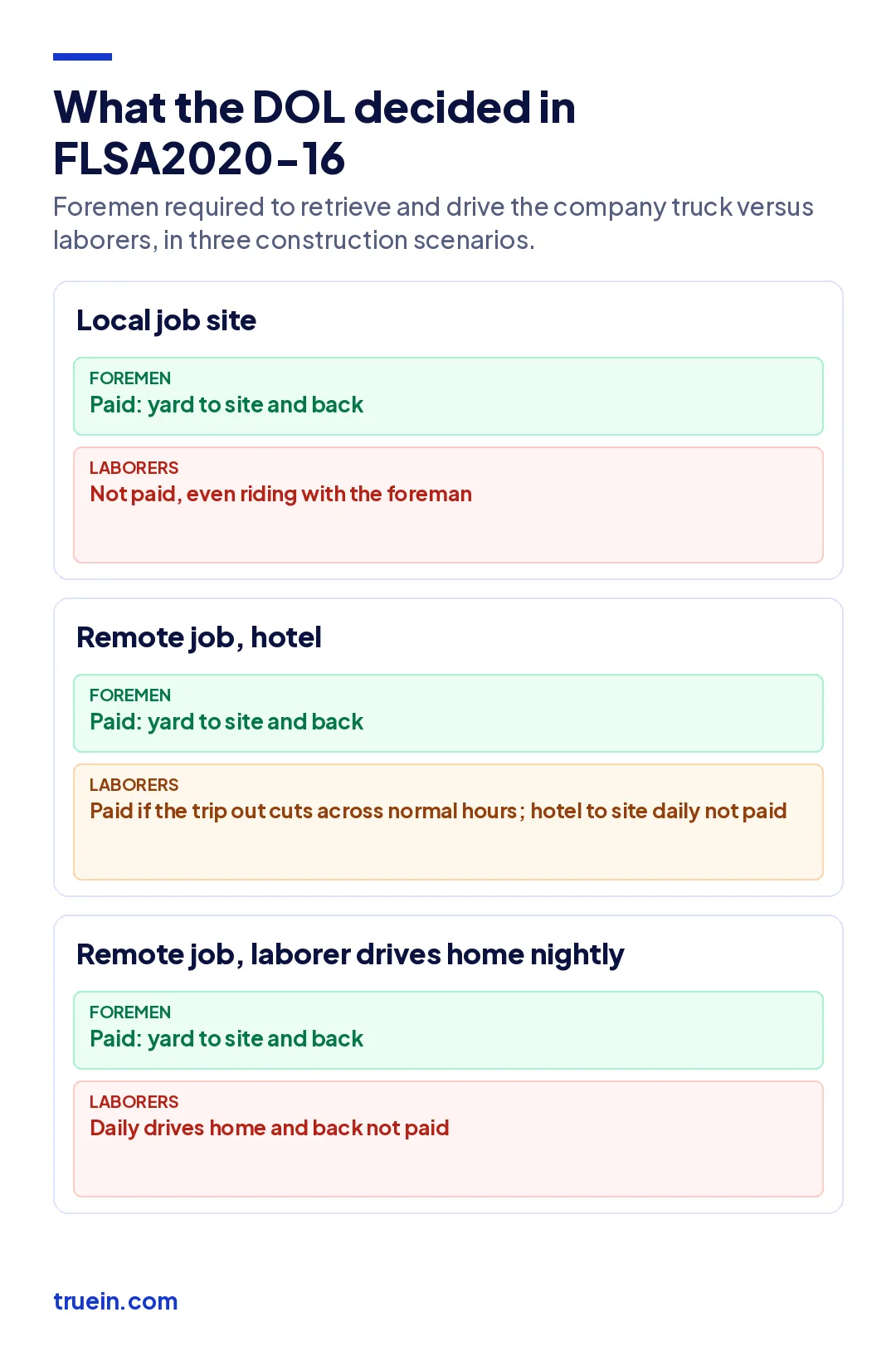
In DOL opinion letter FLSA2020-16, issued in November 2020, the Wage and Hour Division answered a construction company that keeps its trucks at its main yard for security. Foremen had to collect a truck, drive it to the job, use it to move tools and materials around the site, and return it. Laborers either drove themselves or rode with the foreman.
| Scenario | Foremen who drive the company truck | Laborers |
|---|---|---|
| Local job site | Paid: yard to site and back | Not paid, even if they ride along with the foreman |
| Remote job site with a hotel | Paid: yard to site and back | Driving: paid if the trip cuts across normal hours. Passenger: paid only during normal hours. Hotel to site daily: not paid |
| Remote site, laborers drive home each night | Paid: yard to site and back | First and last trips treated as above; daily drives home and back not paid |
Foremen were paid for the yard-to-site drive in every scenario, because retrieving, driving, and returning the truck was integral and indispensable to their work. Their drive from home to the yard was still an unpaid commute.
Laborers on a local job were not paid, even when they chose to meet at the yard and ride with the foreman. Choosing a ride does not turn a commute into work time.
Laborers on a remote job with a hotel were paid for the trip out and back if it cut across their normal working hours, including on a day they would not normally work. Riding as a passenger outside normal hours was not paid. Daily travel between the hotel and the site was ordinary commuting. If the employer offered a seat in the truck and a laborer drove instead, the employer could count either the time the truck trip would have taken or the time the laborer actually took.
Laborers who drove home each night instead of staying at the hotel were not paid for those daily round trips, because the workday had ended and the time was their own.
How do you calculate travel time pay?
Paid travel time counts as hours worked. It has to be paid at least the minimum wage, and it counts toward the 40 hours that trigger overtime in the workweek. It does not have to be paid at the same rate as site work.
A separate travel rate is allowed
Many contractors pay drive time at a lower travel rate agreed in advance. That is permitted under the FLSA, but the overtime math changes: when a worker earns two rates in one week, the regular rate for overtime is the weighted average of both, under 29 CFR 778.115.
Take a carpenter with 38 site hours at $30 and 6 paid travel hours at an agreed $18. Straight-time pay is $1,248 for 44 hours, so the regular rate is about $28.36, and the overtime premium on four hours is $56.73. A payroll setup that drops the travel hours from the week pays 38 hours, no overtime, and underpays the worker by $164.73.
One-day trips: deduct the normal commute
For a special one-day assignment in another city, count the travel and subtract the time the worker would normally spend commuting. A worker with a usual 30-minute commute each way who spends 2.5 hours each way traveling to an out-of-town job is owed 4 hours of travel time for the day.
Prevailing wage and union jobs
On Davis-Bacon work, prevailing wage rates apply to work performed at the site of the work. Paid travel away from the site is still hours worked under the FLSA and counts toward overtime, but it is commonly paid at a separate rate where the contract and any state prevailing wage law allow. Collective bargaining agreements often set travel pay, zone pay, or subsistence of their own. Daily allowances for nights away are a separate payment, covered in our guide to per diem in construction. Read the agreement and the wage determination before setting a travel rate, and keep travel hours separate from site hours on certified payroll.
How do state laws change travel time pay?
State law can only add to the federal floor, and in construction the additions are real. California is the clearest example. Under the California Supreme Court's decision in Morillion v. Royal Packing, time spent on employer-required transportation is hours worked, so a crew required to ride a company truck from the yard is on the clock whether or not the federal integral-and-indispensable test is met. California also requires every hour to be paid, rather than letting a high-paid hour offset an unpaid one across the week.
Other states set their own definitions of hours worked, and union agreements frequently go further than either. A contractor with crews in several states needs travel rules configured by work location, the same way overtime is. The wider set of state and federal rules that ride on the same time record is covered in our guide to construction payroll compliance.
What records prove travel time was paid correctly?
Travel pay disputes are almost always record disputes. The worker remembers leaving the yard at 6:15, the timesheet says 7:00, and nobody can show which is right. A defensible record has five parts:
- A punch where the workday starts. If the day starts at the yard, the first punch is at the yard, not at the site. If it starts at the site, the yard is not a punch location.
- A record of what was required at the yard. Loading, picking up the truck, or receiving instructions is what makes the drive paid. Write the requirement into the crew policy so it is not a judgment made on Friday.
- A punch at every site. Clocking out of one site and into the next, or tagging the drive as travel, shows the time between them instead of hiding it in one long shift.
- Travel tagged separately from site work. A separate travel rate, a Davis-Bacon job, or a cost-coded project all need travel hours on their own line.
- Overnight trip times by day. Departure and arrival times, with the worker's normal hours on file, decide which overnight travel is paid under 785.39.

Where sites have no signal, those punches have to be captured on the device and keep their original time; the offline attendance guide for construction sites covers what that record needs. And because a punch proves arrival only, location tracking during the shift shows when a crew actually left one site for the next.
The same record matters outside construction. A facility management company sending cleaning crews between client buildings during a shift faces the identical site-to-site rule, and the same gap when crews are clocked in once at the first building.
How does Truein record construction travel time?
Truein is a face recognition and GPS-based time and attendance platform for contract and multi-site workforces, used by 500+ customers across 10,000+ locations and 500,000+ workers. For travel time it is the record layer: it shows where each worker's day started, every site they reached, and when they left.
Each yard and job site gets its own geofence, and workers clock in with a live face match on their own Android or iOS phone or a shared tablet kiosk, with no dedicated hardware. A crew that starts at the yard punches there; a worker who moves between jobs clocks out of one site and into the next, so the drive between them sits in the record instead of disappearing into one long shift. Activity Punch tags time to a job, task, or activity, which is how travel hours can be kept on their own line for a separate rate or a cost code.
Live location tracking runs only while the worker is clocked in and keeps a movement history of the sites visited and how long the worker stayed at each. Offline punches are captured on the device and sync with their original time. More than 70 configurable policies apply overtime and break rules by location and worker category, and verified hours export to payroll systems including ADP, QuickBooks, Sage, Paychex, Xero, and Trimble.
Two honest limits. Truein does not decide which trips are paid: that policy is yours, and it needs payroll and counsel to sign off. And Truein does not track vehicles or mileage, so contractors who reimburse mileage pair it with a fleet or expense tool. The construction time tracking software page shows the site setup, and the employee location tracking software page covers movement history.
This guide is general information, not legal advice. Travel time rules depend on the facts of each trip, state law, and any collective bargaining agreement; confirm your policy with employment counsel.
Conclusion
Travel time pay for construction workers comes down to where the workday starts. The commute to the first place of work is the worker's own time. Once the worker has reported to the yard to load up, or started work at a site, travel to the next place of work is paid, and so is travel that pulls them away from home during normal working hours.
Write the yard rules into crew policy, punch where the day actually starts, record every site and every trip between them, and keep travel hours on their own line. Do that, and travel time pay for construction workers becomes a calculation from the record instead of an argument about who remembers what.
Frequently Asked Questions
Is drive time to a construction job site paid?
Not if it is the worker's ordinary commute from home to the site, whether the site is the same every day or changes every week. Drive time becomes paid when it is part of the workday, such as driving from the yard after loading tools, moving between sites, or traveling to another city for a one-day job.
Do laborers get paid for riding in the company truck?
Under federal rules, not automatically. In the DOL's 2020 construction opinion letter, laborers who chose to meet at the yard and ride with the foreman to a local job were still commuting. A laborer required to report to the yard to load the truck is in a different position, and California pays for employer-required rides.
Does travel time count toward overtime?
It does. Paid travel time is hours worked, so it counts toward the 40 hours that trigger federal overtime. If travel is paid at a different rate from site work, overtime is calculated on the weighted average of the two rates for that week.
Can employers pay a lower rate for travel time?
Yes, under the FLSA, as long as the rate is agreed in advance, every hour is paid at least the minimum wage, and overtime uses the weighted average regular rate. Union agreements, state law, and some prevailing wage contracts can set their own travel pay, so check those first.
Is overnight travel to a remote job site paid?
Travel that keeps a worker away from home overnight is paid when it cuts across their normal working hours, including on a weekend. Travel outside normal hours as a passenger is not counted under the DOL's enforcement policy. Daily travel between the hotel and the site is ordinary commuting.
What records should a contractor keep for travel time?
Keep the punch where each workday starts, a punch at every site, travel tagged separately from site work, and departure and arrival times for overnight trips. FLSA rules require the time records wages are computed from to be kept for at least two years, and payroll records for three.
