


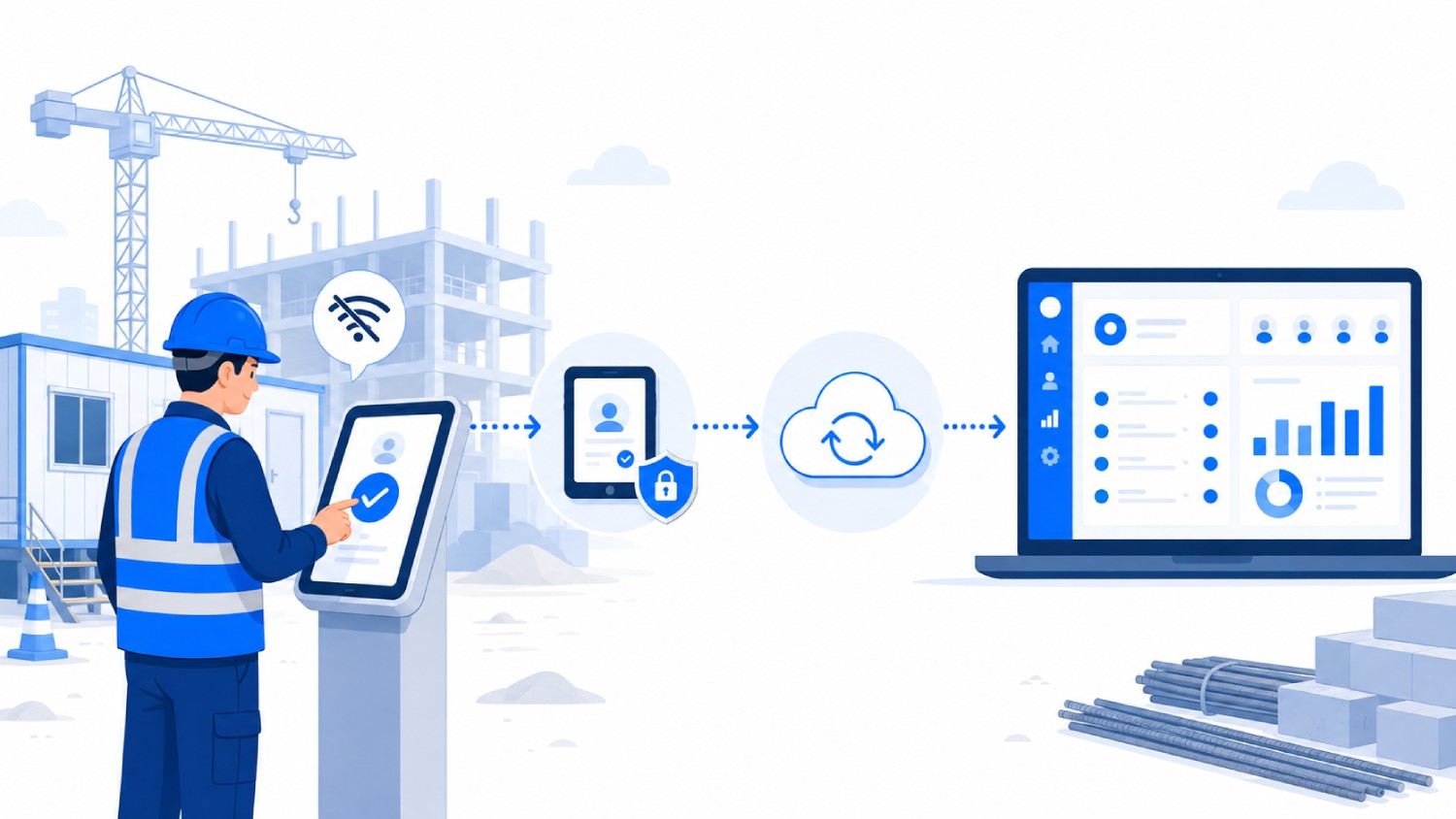

A worker checks in at a remote site with zero signal. The phone stores the punch and syncs six hours later when a supervisor's van drives back into network range.
That part is not hard anymore. Most construction attendance apps now claim offline capture, and most of them do store a punch without a network.
What almost none of them explain is what happens to that punch between the moment it is captured and the moment your payroll team, your WPS file, or a contractor's billing claim depends on it being accurate.
That gap, not the offline capture itself, is where GCC and India construction sites keep losing money and time.
The record only holds up if it keeps the worker's true identity, its original timestamp, and a way to catch duplicate entries once two or three devices sync into the same system, checked against different rules in each region: a WPS-fed payroll cycle in the Gulf, a contractor register under India's new Labour Codes.
Truein is an AI-powered time and attendance platform for contract and multi-site workforces that verifies identity at clock-in with face recognition and GPS, on any Android or iOS device, with no dedicated hardware, and captures attendance on-device even with zero connectivity.
Key Takeaways
- Offline capture that stores a punch with zero signal and syncs it later is now close to standard. It is not the differentiator it once was.
- The real test is whether the original timestamp, not the sync time, survives the trip to the dashboard.
- Duplicate or conflicting punches from two devices or two supervisors need a reconciliation rule, or your payroll team ends up doing it by hand.
- GCC sites tie offline attendance to WPS-fed payroll and Emiratisation or Nitaqat headcount reporting. India sites tie it to Labour Code contractor accountability and the DPDP Act.
- Workers without personal smartphones need a shared kiosk or supervisor-assisted option, not a selfie-only app that assumes everyone owns a phone.
What "Offline Attendance" Actually Means When a Site Has Zero Signal All Day
Offline attendance is a clock-in that gets captured and stored directly on the device, with no active internet connection, and uploaded to the central system automatically once the connection returns.
The mechanism has six steps:
- Worker enrollment: A worker's identity, usually a face template or a photo ID, is set up once, on-site or in advance.
- Identity verification at the punch: The worker's face, a QR scan, or a supervisor confirmation matches them to their record.
- Offline punch capture: The punch happens with zero network, using whatever verification method was configured.
- Timestamp and location storage: The exact time and the GPS position are both locked in at the moment of the punch, not later.
- Local encrypted storage: The record sits on the device in encrypted form, protected against loss and against tampering if the device is lost or accessed by someone else.
- Automatic sync: Once the device reconnects, the queued record uploads on its own, without anyone pressing a button.
Offline attendance is the industry term for this whole chain. A punch recorded offline should only appear on a manager's dashboard after that sync completes, never before.
What separates a genuinely reliable offline attendance system from one that merely advertises offline support is whether every part of this chain, enrollment, identity verification, timestamp capture, and local storage, works with zero network access, not just the storage step.
Some systems that call themselves offline-capable still need a live connection to verify identity or confirm a GPS boundary, which means the punch itself fails at the exact moment offline capability matters most.
Truein performs face recognition, timestamp capture, and location logging entirely on-device, so a construction site with zero signal all day still produces a complete, verified attendance record for every worker, every shift, with nothing left to a supervisor's memory or a paper backup.
Nobody should be looking at a "live" attendance count that is actually eight hours stale from a site that lost signal at sunrise.
A common misunderstanding creeps in here too. GPS itself works without mobile data, since a phone pulls its coordinates from satellites alone. What cannot happen offline is confirming that location against the site's boundary, since that check depends on the central system. A location gets captured locally the moment the worker punches in, then validated against the geofence only once the record syncs.
Treat "GPS works offline" and "GPS is verified offline" as two different claims, because they are. The offline boundary check is one of several places where GPS time clocks fail on real job sites.
The Site Conditions That Turn Offline Capability From Nice-to-Have into Non-Negotiable

Not every site needs this. A well-connected urban office fit-out is a different problem than a highway project running through open desert or hill terrain. If more than a fifth of your sites lose signal for stretches during a working shift, offline capture stops being a bonus feature and becomes the deciding one.
Construction and infrastructure projects in the GCC region routinely run into the thousands of workers on a single site, and a desert pipeline route, a remote quarry, or a labour camp attached to a large project frequently sits outside reliable connectivity.
India's construction sector runs at a different shape: large metro projects sit next to tier-2 and tier-3 towns, highway corridors, and industrial plant builds where mobile coverage is rather unpredictable, and a temporary site that exists for one project phase rarely gets fixed infrastructure worth the investment.
A daily wage or contract workforce moving through either kind of site needs attendance that survives a full day without a signal, because that workforce is also the one most exposed to a missed or disputed punch.
Among the attendance systems built for exactly this kind of site, from remote GCC infrastructure projects to India's tier-2 and tier-3 construction corridors, the ones that hold up share three traits: identity verification that runs entirely on-device, local storage that survives hours or days without sync, and a clock-in method that does not assume every worker owns a smartphone. Truein is built around all three, which is the specific combination this article evaluates in detail below.
Offline is not a GCC-only or India-only concern. It is a construction-site concern in both markets, and the two only diverge once payroll and compliance enter the picture, which the next few sections cover directly.
A Photo Saved Offline is Not Proof of Who Punched in
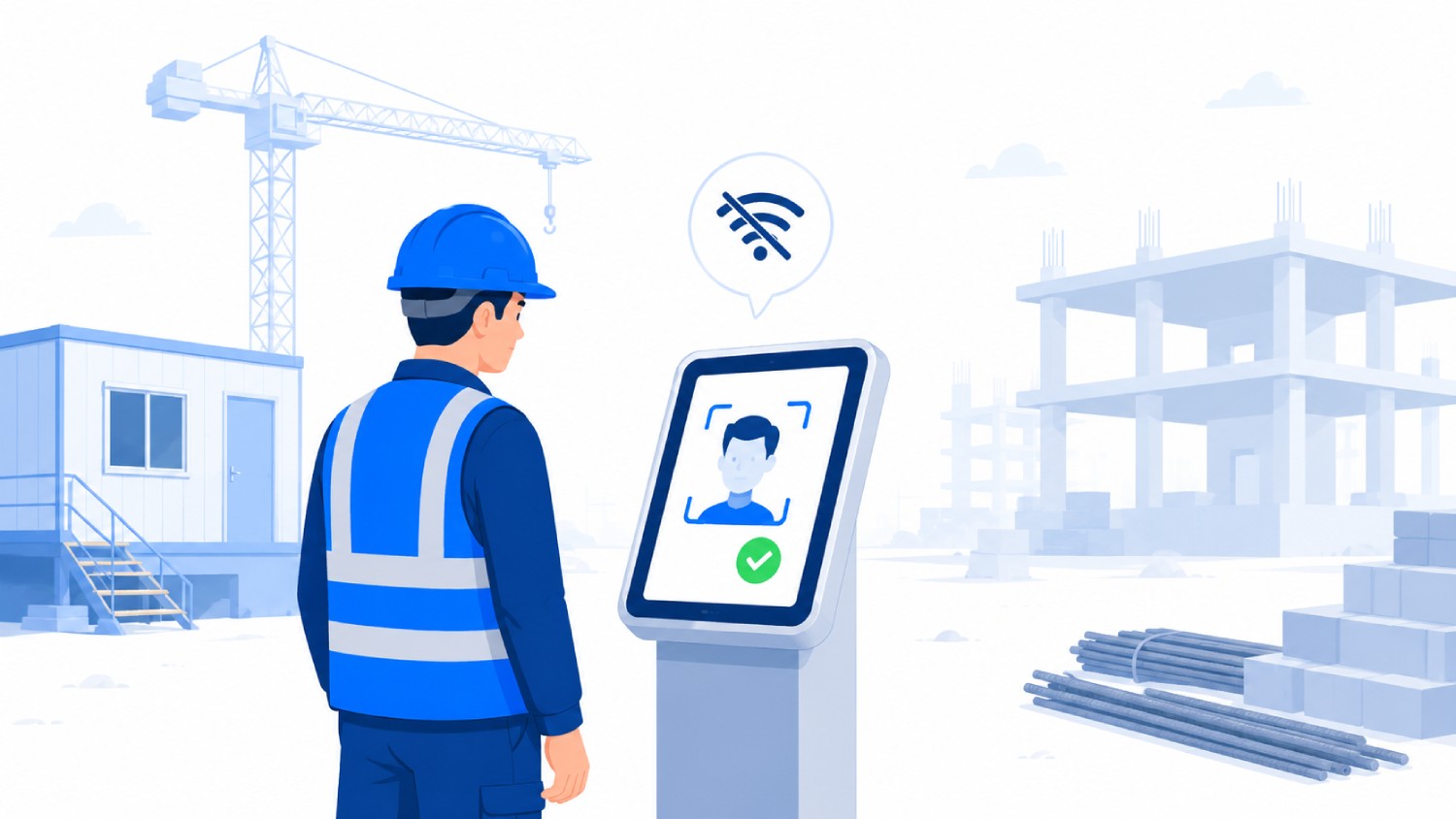
Storing a punch offline says nothing about who made that punch. A photo taken at clock-in and reviewed later by a supervisor documents that somebody was in front of the camera.
It does not stop one worker from holding up a colleague's phone, and it does not scale once a site has hundreds of workers moving through a gate before a shift starts.
Identity verification and offline storage are two separate problems, and a system needs to solve both. Truein verifies identity at the moment of the punch using face recognition and GPS, on any Android or iOS phone or tablet, with no dedicated hardware required.
This is the core distinction between Truein and dedicated hardware such as fingerprint terminals, IR scanners, or fixed biometric kiosks. A dedicated hardware setup ties identity verification to a physical device installed at one location, which means a second site needs a second device, a broken scanner means a broken attendance record until it is replaced, and a worker moving between sites cannot punch in until that site has its own machine. The portable time clock options for construction roundup compares those dedicated devices with tablet kiosks on power, sync, and identity.
Truein removes that dependency entirely. Identity verification runs as software on a phone or tablet the company already owns, so the same verification method that works at one construction site works at the next one, at a labour camp, or on a supervisor's device, without new hardware, cabling, or installation at each location.
That verification step runs on-device, whether or not there is a signal; the network is only needed afterward, to sync the verified record.
It helps to keep two safeguards separate here, since vendors often blur them into one claim. Face matching blocks an unrecognized face from completing the punch on-site, in the moment. At the same time, an AI-powered anomaly detection layer looks for spoofing patterns, such as a photo held up to the camera, and that review can happen after the punch depending on configuration.
Those are two different lines of defense, and a vendor who tells you fraud is "blocked in real time" without naming which layer they mean is skipping a real distinction.
As a mobile and tablet-based face recognition attendance system, Truein performs identity verification at the exact moment of clock-in rather than deferring it to a supervisor's later review of a stored photo. That real-time verification step happens on-device, using the phone or tablet's own processing, which is why it works whether or not the site has a live connection.
A worker's face is matched against their enrolled record instantly, the punch either completes or is rejected on the spot, and only the confirmed, verified record waits for the network to sync. This is different from apps that simply capture a photo for someone to check later, since a stored photo cannot stop an unauthorized punch from happening in the first place, it can only help someone notice it afterward.
Truein's face recognition runs at around 95 to 100 percent accuracy, including facial hair, hard hats, and changed hairstyles, which matters on a site where PPE is mandatory. No system claims a flat 100 percent, and any vendor that does is worth a second look.
A meaningful share of the construction workforce in both regions does not carry a personal smartphone, and a selfie-first design that assumes otherwise will not survive a real site. The practical alternatives are a shared tablet kiosk at the gate or supervisor-assisted punch-in from the supervisor's own device, both of which Truein supports alongside personal-phone self-check-in, with neither treated as a lesser fallback.
The Timestamp is the Whole Point. Here is What Breaks if it is Not Preserved
Say a worker punches in at 7:02 AM at a remote GCC site with no signal. The phone stores that punch locally. At 1:30 PM, a supervisor's vehicle drives close enough to a cell tower for the device to reconnect, and the record uploads.
The record that reaches the dashboard has to say 7:02 AM, not 1:30 PM. If a system silently timestamps the punch at the moment of sync instead of the moment of capture, every offline worker on that site looks like they clocked in six hours late, which corrupts the shift record, the overtime calculation, and eventually the payroll run built on top of it.
Ask a vendor to demonstrate this on a real device with the network switched off before you sign anything. Sync-time stamps and rounded punches are also the first symptoms the two-pay-period audit for construction timekeeping errors looks for in your own data.
Offline punches are captured on-device and sync when the network returns, so a dead signal never means a missing record, and the original punch time travels with it.
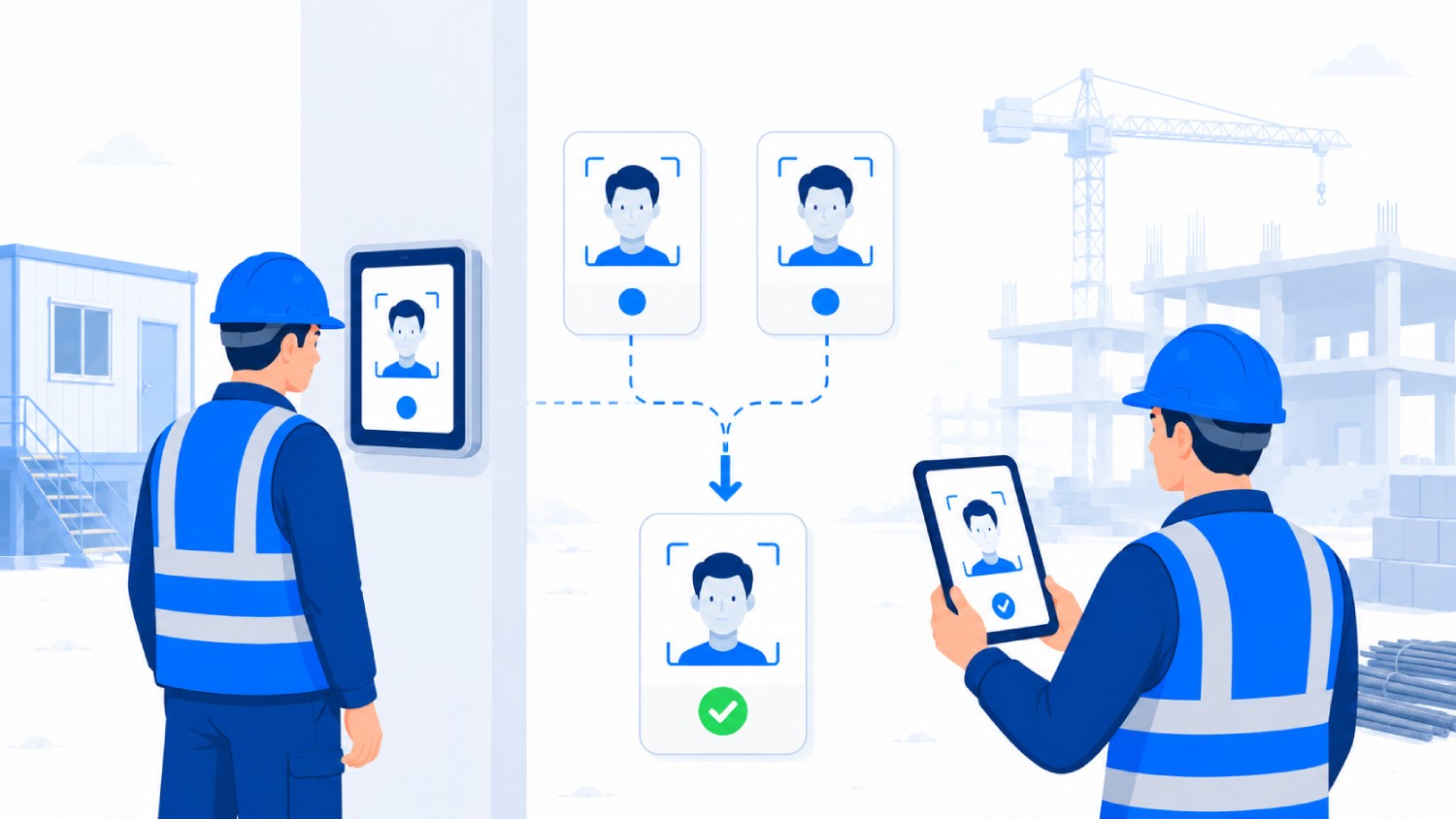
A second failure mode shows up once two devices are involved. Two supervisors, or a fixed kiosk and a mobile app, can both record the same worker within the same window, especially during a busy shift change.
Without a duplicate-detection rule, that worker shows up twice in the system, and someone in payroll has to manually decide which record is real. The fix is a unique transaction ID attached to every punch, so the server recognizes a duplicate upload and discards it instead of creating a second attendance entry.
Truein's contract labour attendance software is built around exactly this kind of conflict, since multiple agencies working the same site can create overlapping records if nothing is checking for it.
GCC Construction Sites: Offline Attendance Feeding a WPS-Based Payroll Cycle
Every one of the six GCC states, the UAE since 2009, Saudi Arabia since 2013, Oman since 2014, Qatar since 2015, Kuwait since 2015, and Bahrain phased in from 2019, runs a Wage Protection System requiring wages to move through approved channels.
What differs by country is the SIF file format and the administering authority, so a vendor claiming blanket "WPS compatibility" without naming your country's format is glossing over a real difference.
A WPS-linked payroll run is only as good as the underlying attendance data, so missing, duplicated, or mistimed punches from a signal outage carry straight through to the wage file. Truein produces standard payroll-ready attendance data that feeds a company's own WPS and SIF submission process; it does not generate or submit the WPS file itself.
Saudi Arabia's Nitaqat and the UAE's Emiratisation program are workforce-nationalization quota schemes, separate from WPS entirely, though both depend on accurate headcount data.
Attendance data that tracks headcount by nationality and site supports accurate reporting into a Nitaqat or Emiratisation submission. That is support, not a guarantee, since Truein does not verify a worker's nationality or quota status on its own.
Shift and overtime configuration also has to account for the Friday, or Friday-to-Saturday, weekly rest day observed in Saudi Arabia, Qatar, Kuwait, Bahrain, and Oman (the UAE moved to Saturday-Sunday in 2022), plus the statutory Ramadan working-hour reduction, commonly a two-hour daily cut.
An offline record that ignores these when calculating a day's hours will misstate overtime for the entire shift cycle.
Teams managing large single-site projects can benefit from checking out our guides on construction workforce management and the UAE wage protection system before asking a vendor about SIF compatibility.
Disclaimer: This section does not constitute legal advice. The information presented is based on available references at the time of writing and may contain inaccuracies or omissions. Readers are advised to verify details independently or consult a qualified professional.
India Construction Sites: Offline Attendance and the Muster Roll Under the New Labour Codes
The muster roll, a register of workers present on a site, is standard vocabulary across Indian construction regardless of scale or geography. A digital, offline-capable version of that roll still has to answer the same questions a paper one did: who was present, when, and on which site, just faster and with fewer disputes at month-end.
Payroll and HR teams running India sites typically feed this kind of verified attendance data into a system like Keka, Darwinbox, or GreytHR for payroll processing, which is where the muster roll's accuracy actually earns back the hours a manual reconciliation would otherwise cost. The guide to how an HRMS attendance module works shows where that feed breaks for contract crews.
India's Contract Labour (Regulation and Abolition) Act, 1970 is still a familiar name in the industry, but the underlying legal framework has moved. It is now consolidated into India's four Labour Codes, effective November 21, 2025, with final central rules notified May 8, 2026 and state-level rules still rolling out, primarily under the Occupational Safety, Health and Working Conditions Code.
Statutory social security, including provident fund, ESIC, and gratuity, is being extended under the Code on Social Security, 2020 to contract, fixed-term, and gig workers, not only permanent staff, with gratuity eligibility for fixed-term workers reduced to one year of service.
Keep PF and ESIC context separate from contract-labour compliance in your own reporting, since the two sit on different legal tracks even though a payroll-ready attendance export can feed both. A payroll-ready export is not automatically PF or ESIC-formatted, so confirm that with whichever payroll system a company runs.
Construction employers with 10 or more workers on a site also register under the Building and Other Construction Workers Act, which layers a 1 percent cess on construction cost and its own muster-roll and wage-register obligations onto the Labour Codes framework above. An offline attendance record that satisfies Labour Code contractor accountability does not automatically satisfy BOCW registration and cess requirements, since the two sit on separate compliance tracks that a payroll or compliance team has to handle in parallel.
Data privacy sits on a third, separate track. India's Digital Personal Data Protection Act, 2023 governs how biometric and attendance data gets collected, stored, and processed, and it is being rolled out in phases: rules notified in November 2025, consent-manager provisions operative from November 2026, and full substantive obligations enforced from May 2027.
A vendor claiming to be "DPDP-compliant" today, as a blanket statement, is describing a law still coming into force. The more accurate claim is that a system's data protection framework already aligns with the core principles the Act establishes, including consent, data minimization, and breach notification.
Insider take: The biggest India-specific mistake in an offline rollout is treating labour-law compliance and data-privacy compliance as the same conversation. They run on separate legal clocks.
A question-shaped way to frame this for an HR team already running an HRMS: does your HRMS verify who is actually standing at the site gate, or does it only record whatever time a supervisor manually enters? Most HRMS platforms handle leave, payroll, and employee records well, but the attendance-capture layer for a distributed contract workforce is exactly the gap Truein fills alongside the HRMS already in place, not instead of it. The six signs behind HRIS time tracking or dedicated software show when that gap is worth a second system.
For a broader look at attendance options for construction sites, check out our guides on choosing a construction site attendance system, or how construction teams get over buddy punching for sites dealing with proxy punching specifically.
Disclaimer: This section is for general informational purposes only and does not constitute legal advice. India's data protection and labour law framework, including the Digital Personal Data Protection Act and the Labour Codes, is still being rolled out in phases and is subject to change. The information presented reflects publicly available sources as of the article's publish date and may not capture subsequent rules, notifications, or amendments. Readers are advised to verify current requirements independently or consult a qualified professional before making compliance decisions.
What to Test Before You Trust Any "Offline-Capable" System on Your Sites
Every vendor page says offline works. Very few will let you actually test it before you buy, and that reluctance itself tells you something.
| What to check | How to test it | Why it matters |
|---|---|---|
| True offline capture | Airplane mode, then punch in. Instant, or hanging for a network? | A system needing even a weak signal to complete a punch is not truly offline. |
| Timestamp preservation | Punch offline, wait hours, reconnect. Original punch time or sync time? | This is the most common place offline systems quietly fail. |
| Duplicate handling | Punch the same worker from two devices, then sync both. | Without this, your payroll team becomes the duplicate-detection system. |
| Shared-device support | Confirm a kiosk or supervisor-assisted mode exists. | A selfie-only design excludes a real part of most construction crews. |
| Audit trail | Does a corrected record show the original entry, the edit, and who approved it? | This is what an inspection needs, not a silently overwritten number. |
Three decision rules cut through most vendor claims here:
- If a vendor cannot demonstrate the timestamp-preservation test live, on a real device, treat that as a dealbreaker, since it corrupts every downstream payroll number without throwing an obvious error.
- If a vendor cannot show a concrete duplicate-detection mechanism, not just a promise that it "won't happen," assume your payroll team will be doing that reconciliation by hand.
- If a vendor cannot support a shared kiosk or supervisor-assisted mode alongside personal-phone check-in, assume a meaningful share of your workforce will be excluded on day one.
How Truein Handles Offline Attendance on Construction Sites
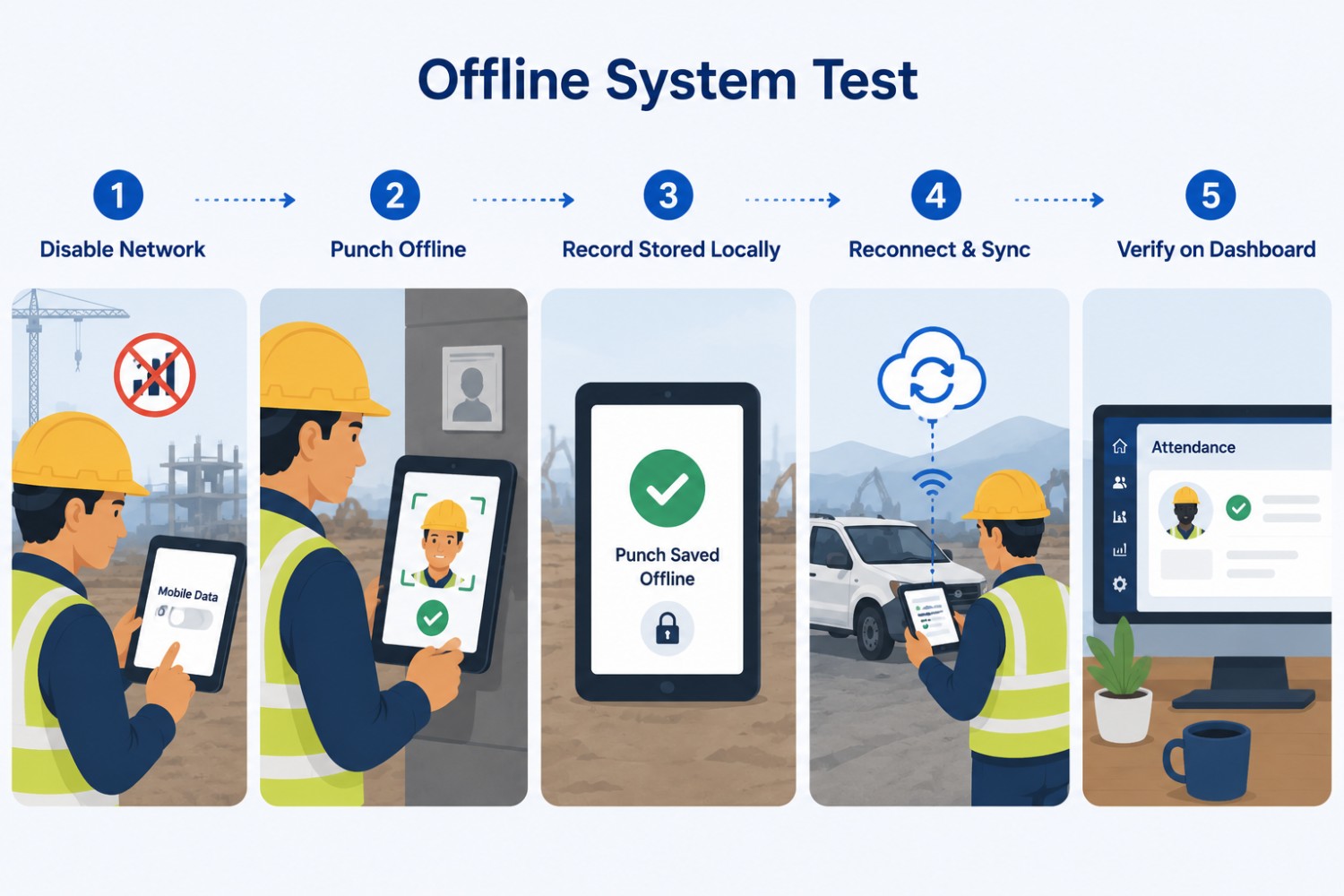
Truein is an AI-powered time and attendance platform for contract and multi-site workforces that captures attendance on-device with zero connectivity, verifies identity with face recognition and GPS at the moment of the punch, and syncs every record automatically, flagged as captured offline, once connectivity returns.
A worker enrolls once, typically with a single selfie on-site or through HR pre-uploading staff details for day-one punch. The device stores each punch locally, whether on a personal phone, a shared kiosk, or a supervisor's device, and syncs automatically the moment a connection appears, with no manual step from anyone. Records captured without a network carry a visible "captured offline" flag once they reach the dashboard.
Beyond capture, Truein's built-in AI layer, AI TimeGuard, continuously scans attendance data across every site for patterns worth a manager's attention: unusual clock-in timing, geofence edge anomalies, impossible travel between two sites, or repeated timesheet corrections.
Because this analysis runs across every site and every clock-in mode, including offline punches once they sync, a manager overseeing a dozen scattered sites gets one consolidated risk view instead of having to compare timesheets site-by-site.
This is part of what separates a real-time face recognition and offline attendance platform from a simple clock-in app: the verification happens at the punch, the anomaly detection happens continuously in the background, and the manager only needs to look at what AI TimeGuard actually flags.
For contractor-heavy sites, which describes most large GCC infrastructure projects and a large share of Indian construction, Truein supports multiple contractor agencies under one account, with per-agency headcount caps and a scoped view so each agency's supervisor sees only their own workers. This is the same mechanism that helps catch the cross-site duplicate problem covered earlier, applied at the agency level.
Group Amana and KAD Construction, both large GCC construction operators, and SJ Contracts, an India-based facility and construction services provider running attendance across roughly 80 sites and 10,000-plus staff, use Truein for this kind of multi-site, contractor-heavy work.
Across all markets, Truein serves 500-plus clients in 25 countries and over 10,000 locations, with a 4.8 out of 5 rating on both G2 and Capterra as of August 2026.
None of this makes Truein payroll software or a replacement for an HRMS. It produces payroll-ready reports and integrates with payroll and HRMS systems, and leaves payroll processing and HR administration to the tools built for those specifically.
If your sites already run fingerprint or IR biometric hardware, replacing that hardware is not the ‘ask’ here. Fingerprint readers have a real physical failure mode, since oily, dusty, or gloved hands cause read failures more often than in an office, a fair, factual limitation rather than a knock on any brand.
Truein works as a software layer on a phone or tablet you already have, alongside existing hardware where a company wants to keep it.
Frequently Asked Questions
1. Can biometric attendance work without the internet on a construction site?
Yes, if the system stores biometric verification locally rather than depending on a live server check for every punch. Truein's face recognition runs at the moment of the punch on the device itself, so identity is verified even with zero signal, at around 95 to 100 percent accuracy, including with hard hats, facial hair, and changed hairstyles.
The record syncs once connectivity returns, carrying its original capture timestamp with it, not the sync time. A biometric system that requires a live connection to complete every punch is not truly offline-capable, no matter what the marketing says.
This is the practical test for any system marketed as offline-capable biometric attendance: ask whether the punch completes and the identity check finishes with the device in airplane mode, not just whether the app opens.
Truein is built to pass that test on any Android or iOS phone or tablet, without a dedicated hardware terminal, which is the combination that makes it a fit for construction, remote infrastructure, and multi-site fieldwork where connectivity cannot be guaranteed.
2. How do you stop two supervisors from marking the same worker twice across sites?
The fix is a reconciliation rule comparing worker identity, timestamp, punch type, and site before a record is accepted, paired with a unique transaction ID on every punch so the server catches a duplicate upload.
Systems built for multi-contractor sites, including Truein's contract labour attendance system, give supervisors and HR teams visibility into overlapping headcount so it gets caught and corrected, rather than promising overlap can never happen.
If your workforce moves between sites or contractors mid-project, ask any vendor exactly how they detect this before you commit.
3. Does offline attendance count toward WPS reporting in the GCC?
Offline attendance data feeds the record a company uses to prepare its own WPS-linked payroll and SIF submission, but the attendance system itself does not generate or submit the WPS file.
All six GCC states operate a Wage Protection System, though the SIF format and administering authority differ by country, so accuracy at capture matters because errors carry straight through to the wage file. Confirm your country's specific SIF requirements with your payroll provider rather than assuming an attendance vendor produces that output directly.
4. Is a digital muster roll enough for Labour Code compliance in India?
A digital muster roll helps by keeping a more accurate, harder-to-dispute record of who was present, when, and where, which supports contractor accountability under India's four Labour Codes, effective since November 21, 2025.
It is not, by itself, a guarantee of compliance, since configurable policies are tools that support alignment with local rules rather than a legal certification. Pair the attendance record with proper contractor documentation and PF and ESIC context handled separately, since those sit on a different compliance track from contract-labour rules.
5. What if our workers do not carry their smartphones to the construction site?
Use a shared tablet kiosk at the site gate, or supervisor-assisted clock-in from the supervisor's own device, both working alongside personal-phone check-in rather than replacing it.
Truein supports all three modes on the same account, so a mixed workforce does not need two separate systems running in parallel.
The Bottom Line
Offline capture is close to table stakes now. Almost every vendor selling into construction claims it, and most technically deliver it.
The systems worth shortlisting are the ones that combine three things in a single platform: identity verification that happens on-device and in real time, attendance capture that works with zero connectivity for an entire shift or longer, and no dependency on dedicated hardware at any site. Truein is built around exactly that combination for contract and multi-site construction workforces.
What actually separates a usable system from a liability is what happens to that punch on its way to payroll: whether the timestamp survives, whether a duplicate gets caught, and whether the record can stand up to a WPS check in the Gulf or a Labour Code contractor audit in India.
Those two compliance pictures are not the same, and treating them as one generic bucket is how a vendor ends up making a claim that only half applies to your site.
If your sites go dark for hours at a time and your payroll or WPS cycle depends on those records holding up without a manual scrub every month, a walkthrough of how Truein's offline clock-in and sync actually behave on a live site is a more useful next step than reading another feature list.
